


Chapter 08: AGILITY TRAINING
AGILITY TRAINING

Tim Dornemann, Ed. D., CES, PES, CSCS, OS Pro
Exercise Science Program & Kinesiology Director, Barton College
Associate Professor of Exercise Science, Barton College
&
Scott O’Dell
Director of Strength & Conditioning, East Central University
“AGILITY GENERALLY REFERS to two sorts of motor functions. On the one hand, it is integral to the ability to explosively start, decelerate, change direction, and accelerate again quickly while maintaining body control and minimizing loss of speed (Costello and Kreis 1993). Agility, in this respect, is important in sport because movements are often initiated from various body positions. So athletes need to be able to react with strength, explosiveness, and quickness from these different positions in short bursts of 10 yards (9 meters) or less before a change of direction is required. On the other hand, agility refers to the ability to coordinate several sport-specific tasks simultaneously, such as when a player dribbles a basketball around a full-court press while looking for an open teammate to whom he or she can pass the ball (Barnes & Cissick 2004). Studies show that agility in these tasks is the primary determining factor to predict success in a sport (Halberg 2001).” Definition of agility taken from Training for Speed, Agility, and Quickness (2005).
In High-Performance Sports Conditioning (2001), the importance of balance in agility training is emphasized with the following definition: “Balance The ability to maintain the center of body mass over a base of support has long been classified as an important aspect of motor development. It is the underlying component of all movement skills, especially agility.”
By the previous points of emphasis and definitions with agility, agility is much more than creative drills performed in short distances around a bunch of cones. As you see in the definition above, there are words such as “explosively start,” “strength,” “quickness,” “balance” and “body control,” among many others used to describe exactly what it is. Agility consists of everything we have done in this book and will consist of factors covered in the rest of this book as well. As was covered in linear speed training and to be covered in plyometrics, there is a systematic, progressional approach to take with developing agility properly for injury prevention and sports performance.
Every area of sports performance can be agility, just as agility can be in every area of sports performance. All areas of sports performance are relative to each other. In this chapter, we will cover the “norm” in thinking when we use the word agility. During the training plan, when looking at a change of direction, or agility, day of emphasis in the field/court work, there is a process to take in progressing the drills and using them for maximum performance and injury prevention. As suggested in the acceleration start, the center of gravity should always be out in front of the direction the body is moving, creating movement and good acceleration angles.
Lateral Movement
Initiating the lateral movement from a previous movement is taught in two different ways by various coaches. There is the crossover step, which seems to be more popular–this consists of the athlete immediately turning their hips and committing their body as soon as they make the decision to move in the given direction. The crossover step will typically have a faster time compared to the open/shuffle step during the initial phase of training.
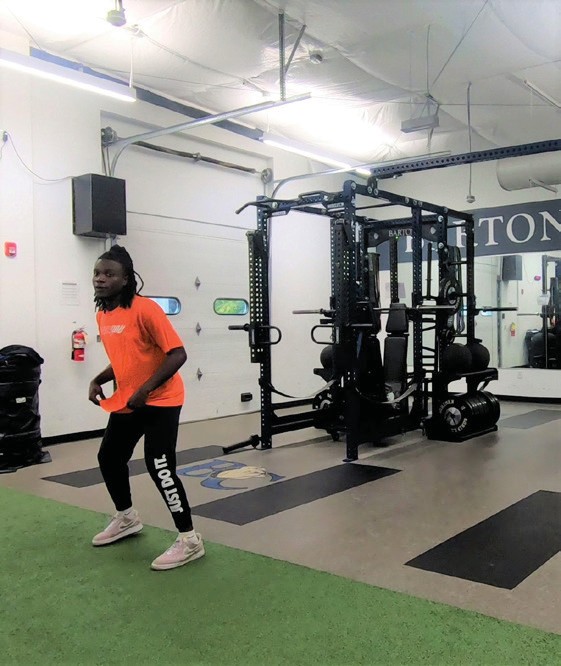
Figure 8.1:
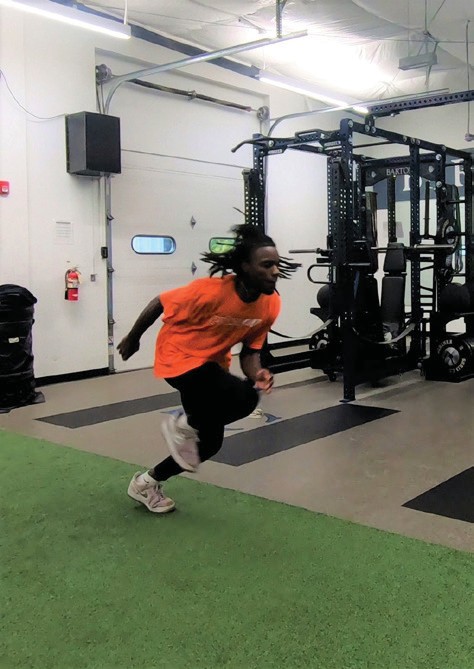
Figure 8.2:
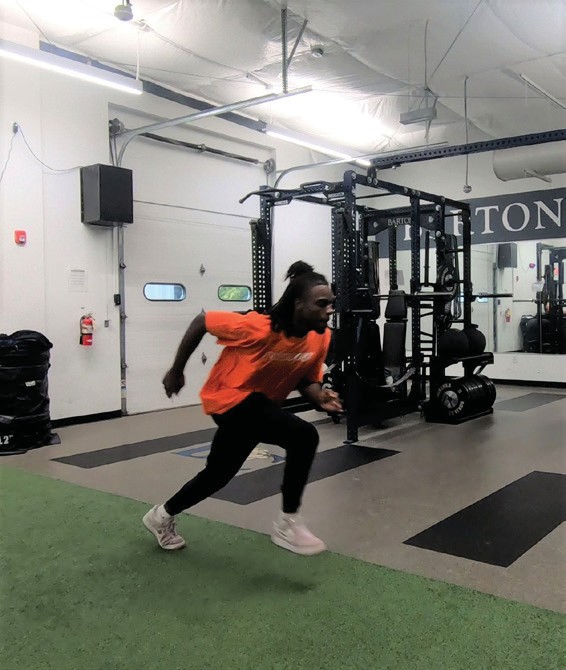
Figure 8.3:
Then there is the open step. This is where the athlete pushes off of both feet and opens up the knee and toe of the nearest leg in the direction they are planning to move. The open step allows the body to commit in the direction of movement with more time to still be in a better position to unexpectedly cut back the other direction.
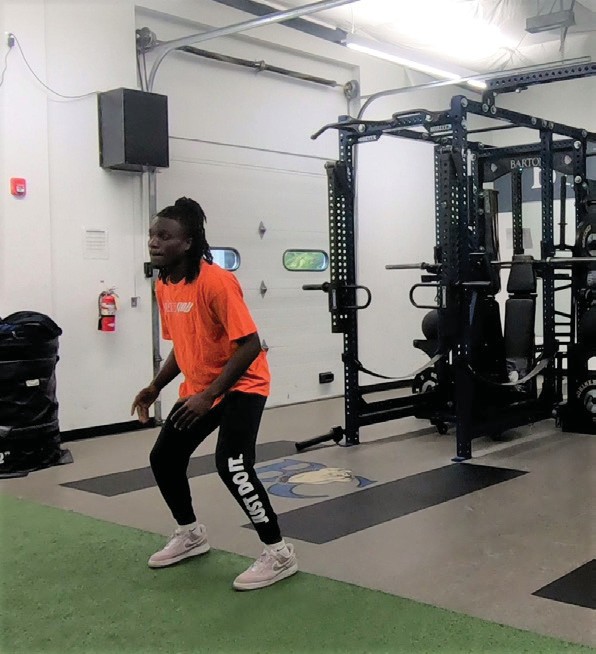
Figure 8.4:
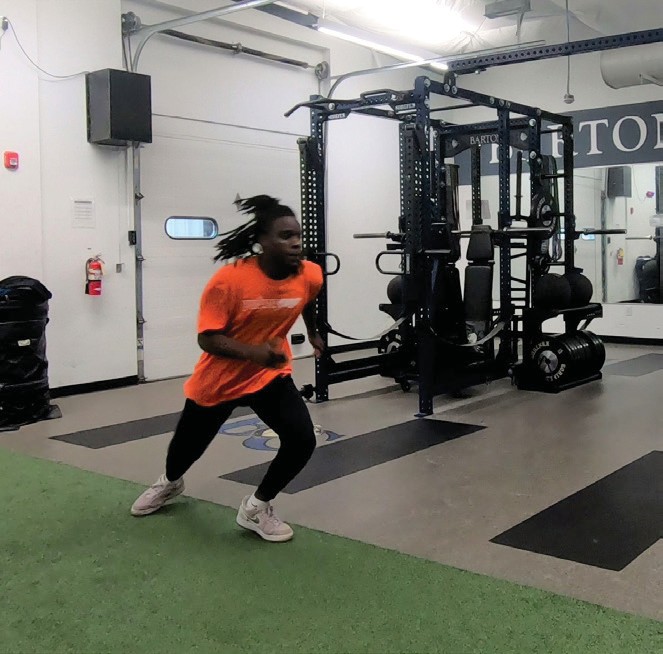
Figure 8.5:
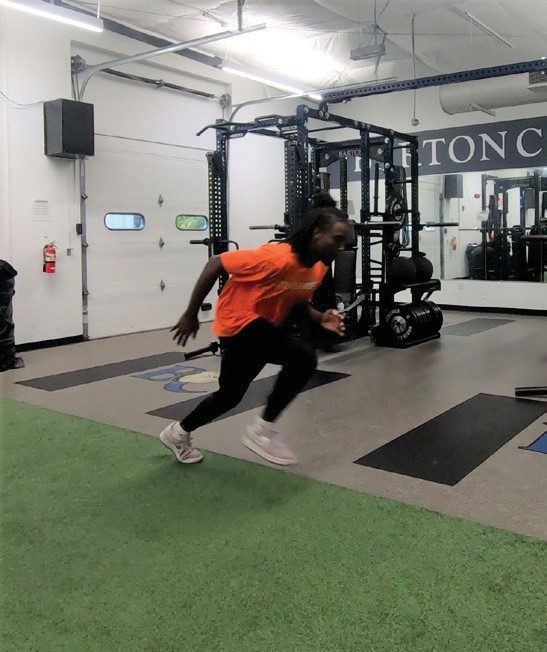
Figure 8.6:
University of Oregon Head Strength and Conditioning Coach James Radcliffe reveals some good research and analyses to this debate over which lateral step is better to train in his book Functional Training For Athletes At All Levels (2007):
In much of the University of Oregon Strength & Conditioning Program and Exercise and Movement Science’s experience and data collection, we have found simple answers to the debate on whether a crossover is better than an open step, or vice versa. In novice performers, the cross-over step has shown faster initial get-off. Video analysis reveals that without practice they push off with both feet and project the hips better than unpracticed open steps. The hips are often held higher as with higher-velocity running and speed cuts. In many sports, however, the crossover step can lead to improper positions on the field or court. Crossover technique may also lead to step sequences that are not as efficient as open technique due to other change-of-direction needs. Once trained in the art of projecting the hips from the open technique, the get-off times become more comparable, and may be more useful in certain positions and patterns on the field or court.
The purpose of the agility program is to teach body control, acceleration, deceleration and change direction skills. The agility program progressively utilizes cutting, change of direction and quick feet drills, using multiple movement patterns to teach participants how to better control their bodies, accelerate, decelerate and change direction. Initially two cone and three cone drills, like the pro-agility (5-10-5) drill using three cones, are incorporated to teach acceleration, deceleration and change of direction using the outside foot. Next, inside and outside foot cuts are taught using five-cone drills. As the training progresses, shuffling and combined forward and backward movement patterns are added into the drills. Speed cuts introduce inside foot cuts with a series of straight cones.
Use of drills like the figure-eight drill, can be introduced as an advanced power cut, and different variations of the pro-agility drill can be added using shuffling and combined forward and backward movement patterns. Transitional agility drills are incorporated by combining different drills and movements. Square drills can be designed in a vast variety of ways to challenge athletes by using unlimited combinations of movement patterns and cutting techniques. Transitional agility drills are designed to prepare athletes to be able to transition quickly in preparation for the demand of their sport. During upper level progressions, reaction agilities, like shadowing drills and coach response drills, are added to help improve reaction time.
Rope and ladder drills are used throughout the levels to help improve footwork and foot speed. Rest periods are held constant at 45 seconds between repetitions to allow adequate recovery. These drills are designed for teaching movement skills and the conditioning aspect is secondary. However, as conditioning improves over the the course of training, the number of repetitions per drill is increased.
Video 8.1
Agility Basics
Agility is an expression of an athlete’s coordinative abilities, which are the basis of acceleration, maximum-velocity and multidirectional skills.
Agility Progression
As with any aspect of training, proper progression is key. While the ultimate goal is to be able to change direction based on reading and reacting to an opponent’s movements like in competition, training can- not start there.
A good coach systematically progresses an athlete through exercises, having athletes master each level of the progression before moving on. Agility technique drills, featuring the use of two or three cones, create an environment to repeatedly practice basic change of direction technique. Once basic change of direction skills have been established, five-cone drills in a zig zag or “W” pattern can be used to develop inside and outside foot cutting technique. When an athlete has the ability to properly execute 90-degree cuts, then use transitional agility drills with a four cone “square” configuration to teach how to transition from one movement pattern to another. Sports commonly require athletes to be able to transition from moving forward to moving laterally or backwards. The four cone pattern provides an opportunity for athletes to practice and perfect transitional change of direction skills. Line and agility ladder drills provide a structured way of developing footwork and foot speed that are important to many sports. After athletes are proficient in basic technique, cutting skills, transitioning between movement patterns, and footwork, then reaction agility drills can be introduced. Coach reaction and mirror drills allow athletes to use the agility skills that have been developed in a read-and-react situation, similar to how they would play their sport.
- Agility Technique (2 or 3 cone drills)
- Cutting Skills (5 cone drills)
- Transitional Agilities (4 cone drills)
- Quick Feet Work (ladder drills)
- Reaction Agilities
Basic Change of Direction Technique & Cues
Drop: As you decelerate prior to changing direction, lower the body (hips) down. This puts you in a strong position to stop quickly.
Stop: From this strong and low position, stop your forward momentum.
Drive: Drive your body explosively in the new direction. From your lowered body position, drive out (not up) in as close to the optimal 45-degree body angle as possible and re-accelerate in the new direction.
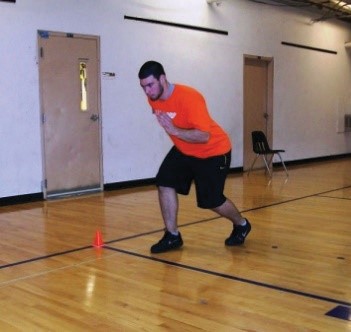
Figure 8.7: Drop low to decelerate
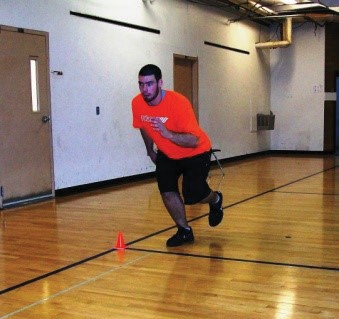
Figure 8.8: Load plant leg to stop
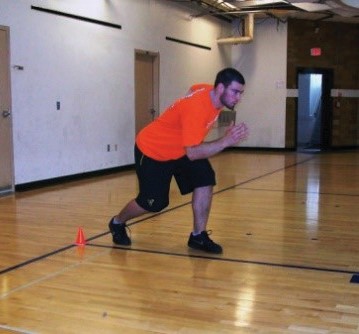
Figure 8.9: Stay low and drive off of cut leg
Speed & Power Cuts
Speed cuts develop the power, movement skills, and injury prevention of the body in the acceleration involving the inside cutting foot. In contrast, power cuts develop the power, movement skills, and injury prevention of the body in the acceleration involving the outside cutting foot. Coming out of each cut, the drive sprinting mechanics should be emphasized with the center of gravity out in front and good knee and hip angles to produce force into the ground for maximum acceleration.
Once through the agility progression, it is important to continue with at least one good transitional movement, a power cut, and a speed cut to provide repeated bouts of these for injury prevention and maximum performance when heading into the sports competition and practice season. Upon reaching this phase, you can incorporate any and all agility drills. The body should be prepared for all advanced movement as well as reaction agility drills. This is also the phase of the training program to take time to focus on position-specific drills.
Video 8.2
Video 8.3
Examples: Agility Progression and Quick Foot Drills
Agility Technique (2 or 3 cone) Drills
- 2 Cone Drill (Base Agility teaching drill): Set up two cones no more than 5 meters Athletes practice drop, stop, and drive techniques in forward, backward, and lateral movement patterns.
- Narrow cones allow for increased number of direction changes (practice of key steps)
- Drop body low and drive in new direction (drop and drive)
- To stay low, you can have athletes reach down
- Can do forward, lateral, and frontwards/backwards direction change
- 2 Cone Drill (Base Agility teaching drill): Set up two cones no more than 5 meters Athletes practice drop, stop, and drive techniques in forward, backward, and lateral movement patterns.

Video 8.4
- 3 Cone Drill (5-10-5)
Add a third cone 5m from the second cone.
Start from the middle cone and go either right or left to the outer cone.
Change direction and go to the farthest cone and then change direction and go back through the middle cone.
The longer 5-10-5 pattern allows for greater acceleration between cones which increases the challenge of changing directions.
- 3 Cone Drill (5-10-5)

Video 8.5
- Forward/Backward 5-10-5 Drill
Start straddling middle cone, then sprint 5 meters to the right
Decelerate, drop, and drive to change direction
Backpedal 10 meters to left side cone
Keep forward lean with chest over feet to keep balance
Decelerate, drop and drive to change direction
Sprint back through the middle cone
- Forward/Backward 5-10-5 Drill
Video 8.6
- Forward/Backward Ladder
Start at first cone, sprint 5 meters to the second cone
Decelerate, drop and drive to change direction
Backpedal 5 meters to back to first cone
Keep forward lean with chest over feet to keep balance
Decelerate, drop and drive to change direction
Sprint forward 10 meters to the last cone
Decelerate, drop and drive to change direction
Backpedal 10 meters through the first cone
- Forward/Backward Ladder
Video 8.7
Cutting Skills Drills
The speed cuts develop the inside acceleration foot and the power cuts develop the outside acceleration foot.
- Speed Cut: Sprint through the cones as fast as possible.
- Place five cones 5m a part in a straight line
- Perform the drill by just sprinting through the cones as fast as possible
- As you weave slightly through the cones, stay tight to the cones
- Stepping just to the side of the cone with the inside foot
- Figure 8: The Figure 8 is a more intense version of the speed cut that develops the inside acceleration foot.
- Speed Cut: Sprint through the cones as fast as possible.

- Power Cut Phase I (3 cone drills): Shuffle side to side, covering 5 meters and coming to a jump stop. Touch cones on each side with hand and keep hips The athlete should go back and forth four times to cover a total of 20 meters for the completion of one repetition of the drill.
- Power Cut Phase II (5 cone drills):
- Place five cones in a zig zag or W pattern
- Set first cone at start, go 5m then go right 5m, place second cone
- Go up 5 meters then go left 5 meters to place third cone
- Continue same pattern for cones 4 & 5
- The zig-zag, five-cone pattern allows for practice of the inside and outside foot cutting օ Sprint diagonally to the cone and then plant (using the drop, stop and drive technique), cut (inside or outside foot cut) and sprint to the next cone with the same acceleration technique as in sprinting.
- Repeat all the way through or line up one cone and work one cut at a time.
- This drill can be done utilizing sprinting, lateral, and forward/back movement patterns.
- Outside Foot Cut: Decelerate, drop, stop and drive off of the outside foot (the outside leg as you approach the cone) to change direction.
- Inside Foot Cut: Decelerate, drop and drive off of the inside foot (the inside leg as you approach the cone) to change direction (plant and drive), stepping over the top (cross over step).
- Place five cones in a zig zag or W pattern

Video 8.8
Video 8.9
Video 8.10
- Power Cut Phase III:
- Perform at 50% or 75% to first develop the proper cutting technique.
- These will be repeated cuts sprinting from one cone to the next.
- Align five cones as described in “Power Cut Phase II.”
- Cuts should be made on the outside foot with an inside lean, plant and drive step with the outside toe pointed straight ahead.
- Inside knee and toe should point in the direction of the cut
- Hips and body lean should be so low that the athlete can touch their inside hand to the ground. The athlete re-accelerates (same acceleration technique as in sprinting) to the next cone and repeats the same cutting technique.
- Power Cut Phase IV:
- Perform at 50% or 75% to first develop the proper cutting technique.
- These will be repeated cuts sprinting from one cone to the next.
- Align five cones as described in “Power Cut Phase II.”
- Cuts should be made on the inside foot, stepping up and over with an inside lean, plant and drive step with the outside toe pointed straight ahead.
- Inside knee and toe should point in the direction of the cut
- Hips and body lean should be so low that the athlete can touch their inside hand to the ground. The athlete re-accelerates (same acceleration technique as in sprinting) to the next cone and repeats the same cutting technique.
- Lateral Shuffle
- Align five cones as described in “Power Cut Phase ”
- Start at first cone and shuffle to second cone
- Decelerate, drop and drive to change direction
- Shuffle to third cone
- Decelerate, drop and drive to change direction
- Shuffle to fourth cone
- Decelerate, drop and drive to change direction
- Shuffle to fifth cone
- Power Cut Phase III:
Video 8.11
- Forward/Backward Drill
- Align five cones as described in “Power Cut Phase ”
- Start at first cone sprint to second cone
- Decelerate, drop and drive to change direction
- Backpedal to third cone
- Keep forward lean with chest over feet to keep balance
- Decelerate, drop and drive to change direction
- Sprint to fourth cone
- Decelerate, drop and drive to change direction
- Backpedal to fifth cone
- Forward/Backward Drill
Transitional Agilities
Transitional agilities start practicing and preparing the body to go from one movement into an entirely different movement. This is the phase where the coach can start using all their favorite agility drills after the speed and power cut base has been established.
- Agility Square

Video 8.12
- U – Drill

Video 8.13
Video 8.14
Video 8.15
- Sprint (Outside foot cuts)
- Place four cones in a square with 5 meters between cones
- Sprint from cone 1 to cone 2 and drop, plant, and drive performing a 90-degree outside foot cut
- Sprint from cone 2 to cone 3 and drop, plant, and drive performing a 90-degree outside foot cut
- Sprint and stop at cone 4
- Repeat drill starting with cone 4, going in opposite direction
- Sprint (Inside foot cuts)
- Place four cones in a square with 5 meters between cones
- Sprint from cone 1 to cone 2 and drop, plant, and drive performing a 90-degree inside foot cut
- Sprint from cone 2 to cone 3 and drop, plant, and drive performing a 90-degree inside foot cut
- Sprint and stop at cone 4
- Repeat drill starting with cone 4, going in opposite direction
- Sprint/Shuffle/Backpedal (Outside Foot Cut)
- Place four cones in a square with 5 meters between cones
- Sprint from cone 1 to cone 2 and drop, plant, and drive performing a 90-degree outside foot cut
- Sprint from cone 2 to cone 3 and drop, plant, and drive performing a 90-degree outside foot cut
- Backpedal and stop at cone 4
- Repeat drill starting with cone 4, going in the opposite direction
- Sprint/Shuffle/Backpedal (Pivot)
- Place four cones in a square with 5 meters between cones
- Pivot off inside foot, swinging outside foot in towards the cone (to change direction)
- Sprint from cone 1 to cone 2 and drop, pivot, and drive, performing a 90-degree inside foot pivot
- Shuffle from cone 2 to cone 3 and drop, pivot, and drive, performing a 90-degree inside foot pivot
- Backpedal and stop at cone 4
- Repeat drill starting with cone 4 going in opposite direction
- Diagonal (Backpedal to Sprint)
- Place four cones in a square with 5 meters between cones
- Backpedal diagonally from cone 1 to cone 3 and drop, plant and drive
- Sprint from cone 3 to cone 2 and drop, plant and drive
- Backpedal diagonally and stop at cone 4
- Repeat drill starting with cone 4 going in opposite direction
- Agility Square
- Place four cones in a square with 5 meters between cones
- Sprint from cone 1 to cone 2 and drop, plant and drive
- Shuffle diagonally from cone 2 to cone 4 and drop, plant and drive
- Short Carioca from cone 4 to cone 1 and drop, plant and drive
- Shuffle diagonally from cone 1 to cone 3 and drop, plant and drive
- Backpedal from cone 3 to cone 4
- Sprint (Outside foot cuts)
Quick Feet Drills
Ladders and rope/line jumping are movement tools to get a lot of repetitions with the toes and heels up to work off the balls of the feet. As with the jump rope, just a handful of movements using the ladder should be picked out to maximize performance. Another technique to use is a slight forward lean when going through the ladder so your center of gravity is out in front. Remember the center of gravity creates movement, this will force your feet to be quicker off the ground.
- Rope/Line Jump: Emphasize toes Try jumping rope with the toes down and the toes up and compare. Notice how much quicker their feet are with the toes up.
- Forward/Back Hops
- Over and Back Runs
- Heel Clicks
- Crisscross Hops
- Side to Side Hops
- and many more…
Video 8.16
Video 8.17
Video 8.18
Video 8.19
Video 8.20
- Quick Foot Ladder: Use your imagination to add rotational movement as well. And emphasize toes up.
- Forward Run
- Face the line or rope with toes positioned behind the line or rope
- Using short quick steps run touching toes over and behind the line or rope without touching the line or rope
- To improve foot speed, stay on toes and take short steps (stepping close to the line or rope)
- One Foot Run
- Two Feet Run
- and many more
- One in, One Out
- Two in, Two Out
One Foot In
- Stand laterally to the left of the ladder, run laterally through the ladder placing one foot in each box (as diagram illustrates)
- Can be performed for speed using quick steps or can be done using high knee technique
- Run through leading with the right foot, then repeat standing on the opposite end of the ladder and leading with the left foot
One Foot In, One Foot Out Run


Two Feet In
- Stand laterally to the left of the ladder
- Run laterally through the ladder, placing both feet in each box
- Can be performed for speed using quick steps or can be done using high knee technique
- Run through leading with the right foot, then repeat standing on the opposite end of the ladder and leading with the left foot
Video 8.21

One Foot In, One Foot Out
- Facing the ladder, run through the ladder placing one foot in each box (as diagram illustrates)
- Can be performed for speed using quick steps or can be done using high knee technique
- Run through leading with the right foot, then repeat leading with the left foot
Video 8.22

One Foot In, One Foot Out Run

Two In, One Out
- Face the direction of the ladder and stand to the left of the first ladder box
- Run through the ladder, placing both feet in each box and alternating the right and left feet out- side the ladder (as diagram illustrates)
- Run through leading with the right foot, then repeat standing to the right of the ladder and leading with the left foot

Video 8.23
Two Feet In, Two Feet Out Run

Two In, Two Out
- Face the direction of the ladder and stand to the left of the first ladder box
- Run through the ladder placing both feet in each box and both feet outside the ladder, alternating to either side
- Run through leading with the right foot, then repeat standing to the right of the ladder and leading with the left foot
Video 8.24
Video 8.25
Video 8.26
Two Feet In, Two Feet Out Run

- Forward Hop
Face the line or rope with toes positioned behind the line or rope
Using short, quick hops, touch toes over and behind the line or rope without touching the line or rope
To improve foot speed, stay on toes and take short hops (hopping close to the line or rope)
- Forward Hop
One in, One Out
One Foot In
Ali Shuffle
Two in, Two Out
Two Feet In
and many more…
- Lateral Hop
Face forward with feet positioned to the side of the line or rope
Using short, quick, lateral hops, touch toes over and back without touching the line or rope
To improve foot speed, stay on toes and take short lateral hops (hopping close to the line or rope)
- Cross Over
Stand straddling the line or rope with your feet crisscrossed (right foot on left side in front and left foot on the right side back)
Hop and switch foot positions (right foot to the left back and the left foot to the right front)
To improve foot speed, stay on toes and stay close to line or rope
Keep doing the crisscross hops until the exercise time has been completed
- Balance Training
- Lateral Hop
These should be performed with an emphasis and concentration of the heels and toes up, balancing on the balls of the feet.
1-Leg Balance
Balance on one leg for 30 seconds.
1-Leg Bound and Balance
Jump laterally off one foot onto the opposite foot and hold balance for five seconds.
Repeat the other direction.
Reaction Agility Drills
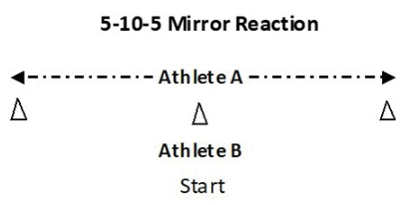
- 5-10-5 Mirror
- Set up the drill in the 3 cone 5-10-5 format as described in Level 1
- Two athletes face each other at the middle cone
- One athlete is designated the leader and the other is the follower
- The follower must mirror the leader’s movements
- 5-10-5 Mirror
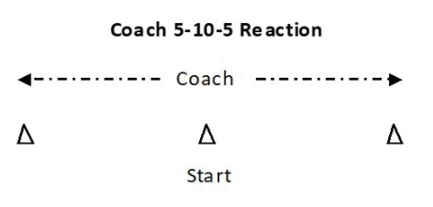
- Coach Reaction (5-10-5)
- Set up the drill in the 3 cone 5-10-5 format as described in Level 1
- One athlete lines up across from the coach behind the middle cone
- The athlete reacts to the coach to determine which direction (R or L) to run the 5-10-5 drill
- Coach Reaction (5-10-5)
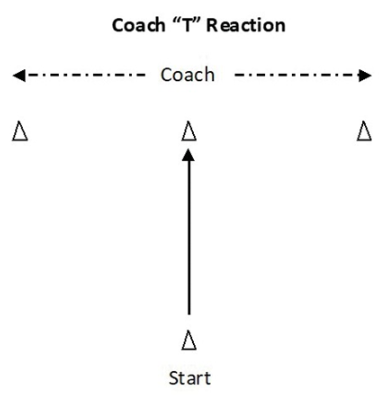
- Coach Reaction (T)
- Using a “T” formation
- The top of the “T” is spaced out like the 5-10-5
- The tail if the “T” is placed 10 meters behind the center cone
- In the normal “T” drill, the athlete sprints from the starting cone to the middle cone
- Shuffle to the right cone
- Shuffle back across the top of the “T” to the far left cone
- Then shuffle back to the middle cone
- At the middle cone, backpedal past the starting cone
- In the Coach Reaction “T” drill, the athlete starts by sprinting to the middle cone and reacts to the coach’s command to determine whether to shuffle to the right or to the left to execute the drill
- Using a “T” formation
- Coach Reaction (T)
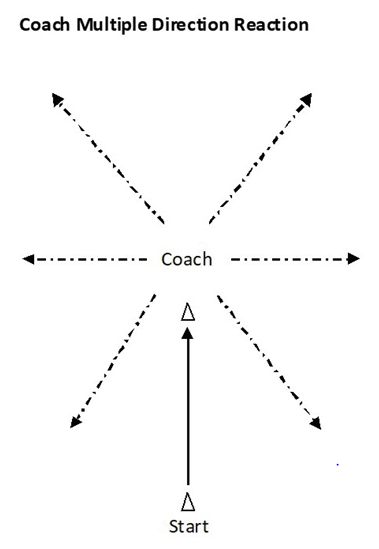
- Multiple Direction Coach Reaction
The athlete starts behind the first cone and sprints to the second cone 10 meters away
The coach will signal the athlete which direction to cut just before the athlete reaches the second cone
The coach can send the athlete:
To the right or left
Diagonally forward to the right or left
Diagonally backward to the right or left
The athlete has to react quickly and execute the correct one-step cut in the indicated di- rection
The coach can mix in different movements (shuffle, backpedal) as well
- Multiple Direction Coach Reaction
References:
- Barnes, M., and J. Cissik. Sports Speed and Agility. Monterey, CA: Coaches Circle, 2004.
- Brown, , and V.A. Ferrigno. Training for Speed, Agility, and Quickness, 2nd ed. Champaign, IL: Human Kinetics, 2005.
- Costello, , and E.J. Kreis. Sports Agility. Nashville, TN: Taylor Sports,1993.
- Foran, B. High Performance Sports Conditioning. Champaign, IL: Human Kinetics, 2001.
- Halberg, V. Relationships among power, acceleration, maximum speed, programmed agility, and reactive agility: The neural fundamentals of agility. Masters thesis. Central Michigan University, Mount Pleasant, MI, 2001.
- Radcliffe, J. C. Functional Training for Athletes at All Levels. Berkeley, CA: Ulysses Press, 2007.
- Dornemann, M. PowerRev “Four Laws of Victory” Character Development Program: Build successful teams and athletes by teaching lessons that transcend sports. Ronkonkoma, NY: Linus, 2015.
- O’Dell, S. The Power Revolution: A Sports Performance Guide to Achieving Maximum Power. Monterey, CA: Coaches Choice, 2015.