


Chapter 01: The Created World and Human Beings Then and Now (Genesis 1-3)

The Created World and Human Beings Then and Now (Genesis 1-3)
Our first encounter with the Bible is to learn and discuss the theme of creation. The first question we must ask is, what is creation? According to the Catholic definition, creation is defined as “the act whereby in sovereign freedom and out of nothing God has brought about and constantly maintains in existence all that exists.”1 In other words, creation refers to the world, the physical world or the universe, which derives from the Greek term kosmos. The actual Greek word for creation, however, is ktisis; so, in their original meanings, kosmos referred to the world, or universe, and ktisis to creation itself; two different Greek terms to speak of what today we understand as the created world, the natural world, and the universe. We are part of this infinite universe! The historian of religion Mircea Eliade explains that in all ancient religions, the existence of the world is attributed to the gods; every world is the work of the gods, or the gods created the kosmos and everything therein.
Figure – 1.1:
Mircea Eliade (March 9, 1907-April 22, 1986)
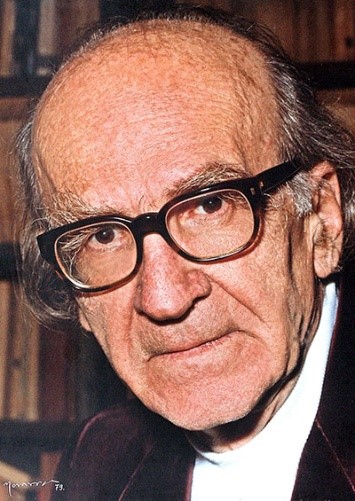
A Romanian historian of religion who studied ancient religions in the world. He is considered one of the most influential scholars of religion of the twenty-first century. He studied religious experiences as credible phenomena and manifestations of the sacred in the world. See
Therefore, in world religions, the world is a divine creation and as such possesses a sacred aspect by the fact that it reflects the work of the gods.2 When we view the created world and universe, the important question that arises is: how and why did the gods or God create the world? When did it happen? Clearly, nobody was at that time or at the time before recorded history (Latin, illo tempore), and no human being was at the very beginning (Latin, ab origine) observing or taking notes about how the creation of the world took place.
Almost all religions in sacred texts give their own accounts of how the world came into existence from the very beginning in such a way that their accounts reflect the sacred time and space when the world was created by the gods. Since no human being existed before history, religions rely on the so-called cosmogonic myth, which tells us how the kosmos came into existence, that is, the story of the primordial event that took place at the beginning of time (Latin, ab initio). Within this context, a creation story is a myth; however, we need to be careful when defining the term myth, and we must differentiate the religious definition of myth from the general definition in a dictionary. The Oxford English Dictionary, for example, defines the literary genre of myth as “a purely fiction narrative usually involving supernatural persons, actions, or events, and embodying some popular idea concerning natural or historical phenomena.” However, in ancient religions, myth is understood as a proclamation of what happened ab origine (at the beginning of time), and as an established truth that is absolute. Eliade explains that a myth is a paradigmatic model which tells what the gods or the semidivine beings did at the beginning of time and how something was accomplished or began to be. The author adds, the myth reveals absolute truth, because it relates the creative activity of the gods and unveils the sacredness of their work. In other words, the myth describes the various and sometimes dramatic irruptions of the sacred into the world.3 A good example of a cosmogonic myth apropos for our class topic is the enuma Elish, a Babylonian Epic of creation, which was annually recited on the fourth day of the New Year’s festival.
The Battle Between Marduk and Tiamat
Figure – 1.2:
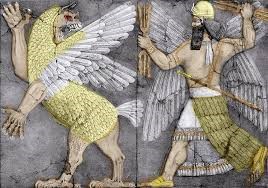
The ancient poem represents the combat between Marduk, the Babylonian god, and Tiamat, the female maker or marine monster, which occurred at the very beginning. The ritual recitation recreates how Marduk created the kosmos from Tiamat’s dismembered body and created human from the blood of the demon Kingu, Tiamat’s chief ally.4
In Catholic biblical studies, a myth is “a story developed by a group over a long period of time that tells a universal truth in a symbolic way.” In other words, biblical myth “points not to its untruth but to its universal significance.”5 This definition is important to keep in mind because, in the Old Testament, the biblical stories in Genesis 1-11 have the genre of myth and belong to the genre called mythical prehistory.
Mythical Prehistory
Table – 1.1:
| Genesis 1-11 | Mythical Biblical Story | Brief Summary |
| Genesis 1:1-2:4a | The First Creation Story | The world is created orderly in six days. Human being is created on the sixth day, and on the seventh, God rested. |
| Genesis 2:b-25 | The Second Creation Story | God creates the world and humanity harmoniously, in pairs. |
| Genesis 3 | The Story of the “Fall” | The snake or serpent disrupts the order and harmony in creation. First the woman, and then the man, falls into sin by eating from the tree of knowledge of good and evil. |
| Genesis 4 | The Story of Cain and Abel | The first two sons of Adam and Eve. Cain is a farmer and Abel is a shepherd. God is pleased with Abel’s offering. Because of envy, Cain kills his brother Abel. God punishes Cain for his murder by driving him away from the land and putting a mark on him. |
| Genesis 5 | Genealogy from Adam to Noah | It is called “the Sethite Genealogy.” From Adam to Noah, there are ten generations. |
| Genesis 6-9 | The Story of Noah and Flood | God chooses Noah to build an ark for his family and animals. God sends a great flood to the earth because of the sins of humanity. Noah and his family and animals are saved. After the flood, God makes a covenant with Noah and promises not to destroy the earth again. |
| Genesis 10 | The Nations Descended from Noah | The story of the descendants of Noah’s three sons—Shem, Ham, and Japhet—and their corresponding genealogies. |
| Genesis 11 | The Story of the Tower of Babel | An allegorical tale about the separation of languages and people. |
Interestingly, there are no historical records of the time before the Patriarch Abraham (Genesis 12). In the following sections, we are going to explore the two creation stories of the world and humanity in Genesis 1 and 2, and the first fall of humanity in Genesis 3, part of the primaveral history in Genesis. As we study how the world was created by the Jewish God, Yahweh, we will bring into our discussion the topic of evolution. Likewise, we shall engage in a deeper understanding of faith-seeking understanding by encountering human experience and reflection in the stories in Genesis 1-3, and through action, develop a critical reflection about faith as an integral part of cura personalis, or the “care for the person” as a whole. And in light of the valuable message of the stories, we promote the care for human dignity, for the mind, body, and spirit of the person.
Genesis 1-2: Two Worlds and Two Humans
Do you know that there are two accounts of the creation of the world and also two accounts of the creation of man? In this section, we will study two creation stories of the kosmos (the world or universe) and humanity. Both stories (of the kosmos and humanity) differ from each other. It is important to know that in the Bible, especially in the Pentateuch (the five books of Moses or the Torah) or the Septuagint (abbreviated LXX, the Greek Jewish Scripture), biblical scholars found contradictions, repetitions, different styles and genres. A good example of repetition and contradiction is both the mythical story of how the world came into existence and how the first human was created. As we embark into the discussion of these two creations, we will find two accounts of the creation of the kosmos and two accounts of how humanity was created. Rather than focusing on the literary disagreements in the stories, let’s focus on the following questions:
- What is the value and the significance of each of the four accounts?
- What is their relevance, especially in the understanding of who we are as human beings?
- What is our role in creation today?
- How can we understand human nature itself?
- What is the concrete value of the human-God relationship?
As we reflect on these questions, we need to remember that these stories are faith-based mythical stories. In other words, intrinsically these stories hold universal truths about the created world and human beings. Particularly, we are part of a threefold relationship: human-to-God the Creator, human-to-the natural world where we have our human experiences, and human being-to-human being.
Figure – 1.3:
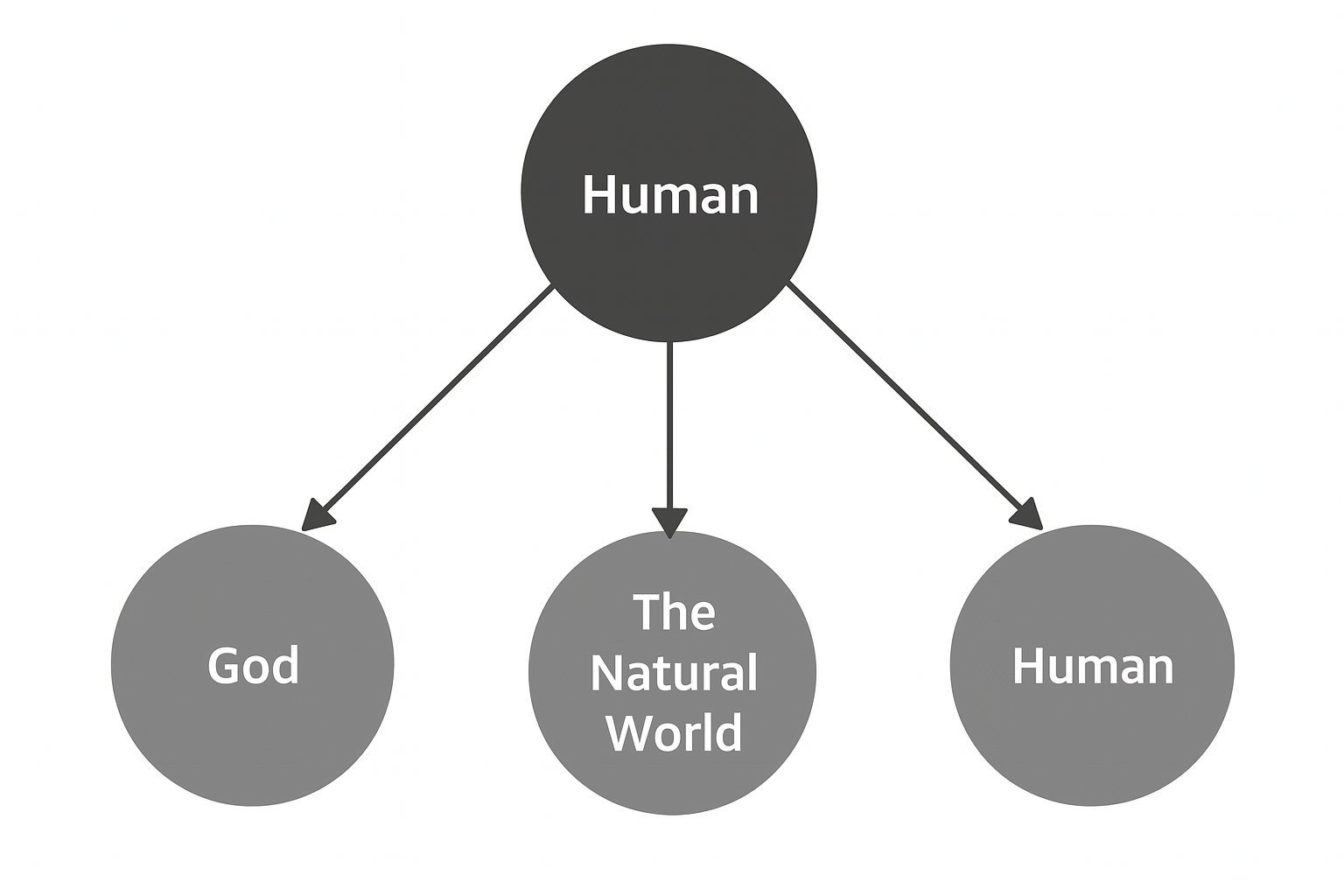
Likewise, rather than viewing faith and science as two enemies, we will see them as friends and compatibles. Indeed, we shall bring up the topic of evolution and its role in the creation of all things. Yes, in this textbook, faith and science are viewed as complementing each other! In theology, defined in this textbook as faith-seeking understanding, the human mind and knowledge must find deeper understanding and universal truth in these mythical (symbolic) stories (Genesis 1-11).
Genesis 1:1-2:4a and 2:4b-25: The Two Creation Stories
We start off noting that the mythical biblical stories in Gen 1:1-2:4a come from the Priestly traditions (P) and Gen 2:4b-25 from the Yahwist traditions (J). Biblical scholars state that the Yahwist source was written in Jerusalem around 950 BCE, and contains the best stories of the Pentateuch, such as Adam and Eve, Cain and Abel, Noah and the Flood, and the Tower of Babel. The Priestly Writer source was written probably during the time of the Exile in Babylon around 550 BCE. For the reader who is not familiar with the four traditions or sources in the study of the Pentateuch, the German biblical scholar Julius Wellhausen (1885) proposed four different sources for the development or writing of the five books of the Pentateuch: Genesis, Exodus, Leviticus, Numbers, and Deuteronomy. The four sources, the Yahwist (J), Elohist (E), Deuteronomist (D), and Priestly Writer (P), intend to explain the theological and literary differences and authorship of the Pentateuch.6 The four sources also show that Moses was not the sole author of the Pentateuch! For details about the four sources, see the chart below.
The Four Sources (Documentary Hypothesis)
Table – 1.2:
| Yahwist (J) | Elohist (E) | Priestly Writer (P) | Deuteronomistic (D) |
| 950 BCE; Southern Kingdom; Jerusalem | 850 BCE; Northern Kingdom | 550 BCE; Babylonia; Temple destroyed; written during the time of the exile | 650 BCE Northern tradition, finished in the south; priests/prophets |
| Calls God Yahweh | Calls God Elohim | Calls God Elohim | Calls God Yahweh |
| Sees God as walking and talking with us | Sees God as speaking in dreams, and so on | Has a cultic approach to God | Has a moralistic approach to God |
| Stresses blessing | Stresses the theme of Fear of the Lord | Stresses obedience to the Law | Stresses Mosaic obedience |
| Uses earthly speech about God | Uses refined speech about God | Uses majestic speech about God | Uses speech recalling God’s work |
| Stresses the leaders | Stresses the prophetic | Stresses the cultic | Stresses fidelity to Jerusalem |
| Uses narrative and stories | Uses narrative and warnings | Uses dry lists and schemata | Uses long homiletic speeches |
| Stresses Judah (Southern Kingdom) | Stresses Israel (Northern Kingdom) | Stresses Judah (Southern Kingdom) | Stresses the whole land of Israel |
| Uses the term “Sinai” | Uses the term “Horeb” | ||
| Calls natives “Canaanites” | Calls natives “Amorites” | ||
| Uses genealogy lists | Uses military imagery | ||
| Has many fixed phrases |
Fashioning an Orderly Universe from Chaos
Genesis 1:1-25 is the first story of creation according to the Priestly Writer source (P). This account of the fashioning of the kosmos took place ab origine (at the very beginning) and is centered in God, or the supreme being for the Jews named Yahweh. We will focus on three important literary characteristics. (1) In illo tempore (in that time before time and history), “the earth was a formless wasteland, and darkness covered the abyss, while a mighty wind swept over the waters” (Gen 1:1-2). God created the universe from prior existing material; for example, there was a formless wasteland, darkness, wind, and water. Significantly, the fashioning of “the heavens and the earth” (the Old Testament way to refer to the world) is from chaos, confusion, and emptiness to order. According to Gen 1:3-25, it happens systematically and orderly in the course of six days.7 In the context of science, we can say that God creates order in matter. (2) God creates the heavens and the earth by or through His Word (in Hebrew, bara’); God says “let there be …” And it happened! We can compare God not to an artisan or craftsman, but to the highest of human beings, the supreme being or deity who commands the works. The Word of God was His worker, and God needed no assistants or helpers. (3) The course of the six days of creation is narrated in an orderly fashion and with a dramatic literary style, which is common in the Priestly traditions. Imagine the following: in six twenty-four-hour days, God fashioned our whole world—sun, moon, stars, solid land, and all living creatures, including the human being. Apparently, God used only water (in Hebrew, mayim) as His raw material to fashion the world! The P source gives us an idea of God’s (or Yahweh’s) immense power and sovereignty.
The orderly structure in the narrative goes this way:
Gen 1:1-5 corresponds with the opening narrative.
First Day: Gen 1:6-8 presents the separating of the waters by the creation of the sky.
Second Day: Gen 1:9-10 continues with the dome model, and in this act of fashioning, the water remaining within the dome is put in order.
Third Day: Gen 1:11-13 is the creation of vegetation, plants, and their seeds.
Fourth Day: Gen 1:14-19 presents the creation of the sun, moon, and stars.
Fifth Day: Gen 1:20-23 is a wonderful representation of life in the sea and sky; portraying the life-giving potential of the sea, the fish come upon the scene before anything else, and all kinds of winged birds in the sky.
Sixth Day: Gen 1:24—2:1 brings the climax of creation. God calls into being all land animals and human beings.
Seventh Day: Gen 2:2 crowns the glory of God’s creation; the author makes a special note that on the seventh day, God rested from all the work God has done. In Genesis 1, God is the author through whom the universe, the world, and everything therein come into existence in six days. The following image depicts the ancient Hebrew view of the world. The image comes from the New American Bible: Saint Joseph Medium Size Edition.
Hebrew View of The World
Figure – 1.4:
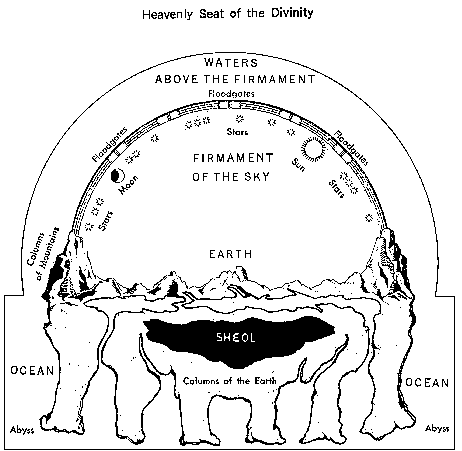
In Catholic biblical tradition, we do not take this mythical prehistory narrative literally; that is, we do believe that God created the kosmos, but we do not believe literally that God really created the universe in six twenty-four-hour days. The story is a biblical myth; thus, the story as a whole should be understood within the understanding of biblical myth; we go deeper into the theological and universal significance for us today. How do we do it? Science may help us. It is important to find a friendly connection between faith (Genesis) and science (Big Bang theory) and perceive both as sisters complementing each other rather than enemies. Science can help us fathom the unknowable and mysterious genesis (beginning), the time before recorded history, beyond human comprehension, as close as possible to the divine as we find the intrinsic connection between human beings and the kosmos and its Creator.
Interpreting the Genesis account that speaks of the fashioning of the universe (kosmos) from chaos to order in the course of six days can be quite challenging knowing the fact that evolutionary biology has convincingly demonstrated that it has taken billions of years for the earth as we know it to come into existence.8 There are two crucial questions. On the one hand, science asks: how? How do we have the universe as we see it? How did the universe, the solar system, the earth, plant, animal, and human life form? On the other hand, theology (faith) asks: why? Why a universe, a solar system, an inhabitable life-supporting earth in the first place? Why are human beings sentient, conscious, and self-reflective beings who long for completeness, salvation from death, and life without evil and suffering?9 These questions are in themselves good and right to be posed, yet answers cannot be fully and certainly given; however, science and theology (faith) can be reconciled. We must keep in mind that the human mind is and languages are limited to speak and understand the sacred time from the very beginning. The mythical story of creation in Genesis can be complemented with the theory of the Big Bang, understood as a part of God’s divine plan of creation and God as the absolute agent of everything.
The Big BangTheory
Figure – 1.5:
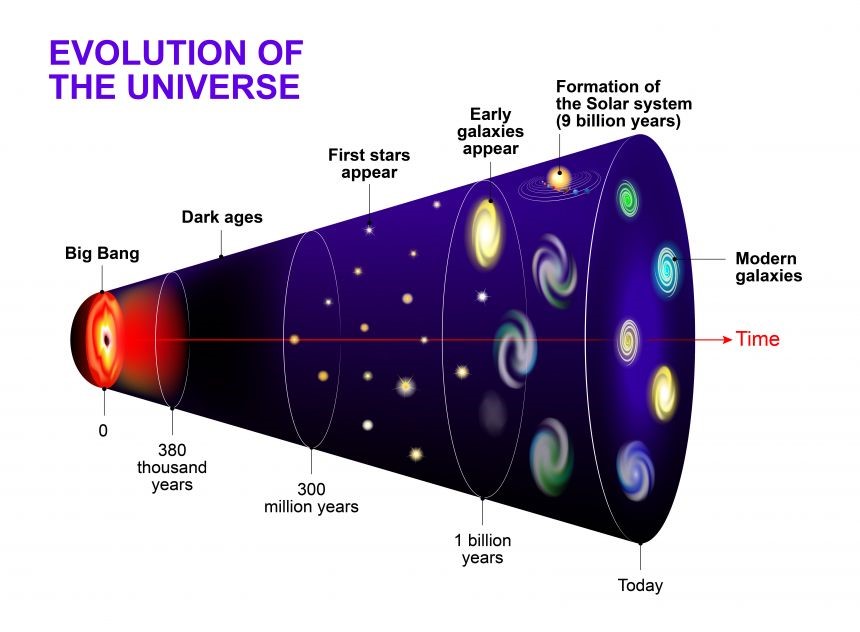
Thus, we do not focus on whether science is “right” and Genesis “wrong”; instead, we reconcile (or marry) both approaches (science and Scripture), and see God’s hand in the scientific theory of how the kosmos (world, universe) came into existence. The Big Bang theory is the idea that the universe began as a single tiny point of infinite density and finite time, then it began to expand and stretch to grow as large as it is right now—and it is still stretching! This is a scientific and rational explanation of how the universe (kosmos) is the infinite place we know today.
The agreement among scientists, astronomers, and cosmologists is that the kosmos as is perceived by our human eyes came into existence in a massive explosion that created the matter and the physical laws that govern our ever-expanding kosmos. How was our universe conceived in a massive explosion, what proof is there of this, and what does the theory say about the long-term projections for our kosmos? The Big Bang theory explains that all of the current and past matter in the universe came into existence at the same time, roughly 13.8 billion years ago. In that time (illo tempore), all matter was compacted into a very small ball with infinite density and intense heat called a Singularity, which suddenly began expanding, and the universe as we know it began. However, knowing scientifically that the laws of physics as we know them could not have existed illo tempore, it is difficult to fathom and give proof of what took place in this initial instance in time before recorded history. Like the Genesis 1 account, the Big Bang theory has its limitations too. Thus, rather than disproving what scientists say about how the kosmos came to be, their scientific studies show the complexity of the Big Bang theory, which, I believe, demonstrates the grandeur of God. Scientific theories about the origins of the universe also honor scientists to whom God has given the intelligence and abilities to prove and ponder the great mystery of God’s creation;10 thus, Catholics are invited to see God’s hand in the scientific demonstration of the formation of the universe.
As we read and interpret the mythical story of Genesis, the account goes better if we also consider the why aspect and not only the how of creation. If we look back at the orderly structure of creation in Genesis 1, this is what we see:
- On day one, as the light penetrates through the darkness, the love of God, the Creator, comes to be present in it; God is the light, or the light is God, so that the created order can follow.
- On day four, chaos and disorder are destroyed or overcome as the sun, moon, and stars appear in the firmament; God provides human beings with order as the day and night are created as well as time (past, present, and future), seasons (spring, summer, autumn, and winter), 7 days, and 24 hours.
- On day five, life on the sea and sky appears; it is the fish, though, that come upon before anything else. Evolutionary theory maintains that all forms of life originated in the oceans. A Testimony of this is fossil images of fish dating millions of years back into history.
- On day six, every life (animal and human) on land comes into existence by God’s Words. The creation of humanity is represented in prehistoric cave paintings of human images in Africa.
Zimbabwe’s Mysterious Cave Art
Figure – 1.6:
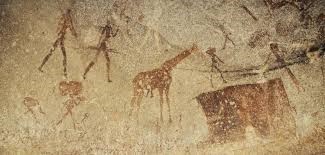
CNRS News-https://news.cnrs.fr/videos/searching-for-africas-earliest-painters
Therefore, the best course for us is to consider both science (reason) and theology (faith) approaches as acceptable and compatible.11 Faith does not contradict science; Scripture comes to help understand the mysterious, unknowable, and unprovable part, and likewise, science comes to fill the gaps of the obvious, probable, and accessible part. What is significant to us is that the acceptance of one approach does not disprove the evidence of the other; they complement each other in that faith/Scripture and science support and enhance each other. Together, they best explain, yet with limitations, what happened at the very beginning and at the beginning of time, as well as at the time before recorded history. What we can say is that Scripture and science encounter each other as they both move forward toward the same goal; thus, it is acceptable to see when these two fields of knowledge overlap; they should overlap and be seen as compatibles.
CLASS ACTIVITY
Activity Title: “Creation of the World: Exploring Faith and Science with ChatGPT”
Objective:
Students will compare and reflect on faith-based and scientific explanations of the creation of the world, using ChatGPT as a research and discussion tool.
Instructions:
- Introduction (5 minutes):
a. Briefly explain the activity and the purpose of exploring both perspectives.
b. Remind students that ChatGPT can provide information, summaries, and clarifications—but they should think critically and discuss what they read.
- Group Work with ChatGPT (15 minutes):
a. Divide students into pairs or small groups.
b. Assign tasks:
i. Group A: Ask ChatGPT about creation according to faith (e.g., “Explain the creation story in Genesis 1”).
ii. Group B: Ask ChatGPT about the scientific explanation (e.g., “Explain how the universe and life began according to science”).
c. Each group writes down 3–5 key points from ChatGPT’s answers.
- Comparison and Discussion (10 minutes):
a. Groups share their findings with the class. If students have time, they can put together a short PowerPoint presentation.
b. As a class, create a Venn diagram on the board showing similarities and differences between faith and science perspectives.
- Reflection (5 minutes):
a. Students use ChatGPT to help answer a reflective question:
i. “How can understanding both faith and science deepen our appreciation of the world?”
b. Each student writes a short response (3–4 sentences).
Optional Extension:
- Students can ask ChatGPT follow-up questions like:
- “Can faith and science ever contradict each other?”
- “How do people integrate scientific knowledge with religious beliefs?”
The Thematic Fashioning of the Earth
The Yahwist account of Genesis 2:4b-25 is a second story of creation from the Yahwist source (J), where God (Yahweh) makes the earth and the heavens not in an orderly fashion as in Genesis 1. The Yahwist account focuses on the harmony of twos and the thematic features of creation. Here, rain, animals, and plant life are not put in order, and the two humans are not brought forth simultaneously as we shall see below. Rather, throughout the narrative, important biblical motifs or themes are highlighted. For example, the two trees, the tree of knowledge of good and evil and the tree of life (v. 9), which become prominent in Genesis 3, the story of the Fall. In the ancient world, trees were symbols for a royal dynasty, a gift of life, wealth, knowledge, and fertility, and could represent the cyclical regeneration of nature. The tree of life planted in the Garden of Eden symbolizes access to eternal life; thus, its significance in the story comes to be reflected in the story of the Fall (Genesis 3), after the man and the woman disobeyed. Similarly with the tree of knowledge of good and evil, which is planted in the midst of the Garden of Eden whose fruit was forbidden to the man and woman (Gen 2:17).
Another important motif in the story that needs to be observed closely is the harmony of twos created by the phrases that are formed in pairs. This is an important literary characteristic or technique of Hebrew poetry that is meant to provide a contrast but at the same time offer a dual harmony in everything God created. In Gen 2:4a-6 God is the author, the Creator, and according to the Yahwist traditions, God creates within the context of the harmony of twos:
Harmony of Twos
Table – 1.3:
| v. 4b | The earth | The heavens |
| v. 5a | No field shrub on earth | No grass in the field had sprouted |
| v. 5b | No rain upon the earth | There was no man to till the soil |
| v. 6 | A stream was welling up out of the earth | [a stream] was watering all the surface of the ground |
| v. 7 | The dust of the ground | The breath of life |
| v. 7a | Man | v. 22 Woman |
Third, in Gen 2:8-9, we find the theme of gifts developed within the framework of a twofold relationship: human and ground. Scholars have called this relationship the horizontal axis. God planted a beautiful and pleasurable garden of delight (the Garden of Eden) and adorned it with various trees where God placed man. The Yahwist account describes that the trees “were delightful to look at and good for food” (v. 9b). We identify two gifts here: beauty (estheticism) and food (sustenance). These gifts are pleasant to the sight and good for food. If we look around us, at the created world, we can perceive the beauty of God’s creation: trees, the sun, the flowers; we can feel the fresh air and the rain; we can feel the warmth of the sun’s rays, and see the beautiful firmament at night. Likewise, we can enjoy the fruits of the plants and trees, which are good for human sustenance and health. It is in these two gifts that human beings found harmony with the ground (earth). This is explained in the following way. There is a wordplay between two Hebrew words: adam and adama. The first word translated means human or man, and the second word is translated as ground. Now, the generic word for “man” is adam, the Hebrew word for man, human, humanity, human being! The proper name of the first man, Adam, actually does not occur until Gen 4:25. The significance of the word-play is that the Hebrew word adama (ground, earth, soil) is almost identical (except for the last a letter) to the Hebrew word for human in general terms. It is in this way that the Yahwist traditions represented the human-ground relationship.
Since everything has to be balanced and in dynamic harmony, the Yahwist traditions developed another twofold relationship, the human and God. This relationship is called the vertical axis by scholars. In Gen 2:15-18, man is placed in the Garden of Eden and God gives the man two commands: (1) cultivate and care for the garden (earth) and (2) not to eat from the tree of knowledge of good and evil (vv. 15 and 16-17). In this way, God established a harmonious balance between gifts (beauty and food) and restriction (command); between the gift of all the trees for food and the restriction not to eat from the tree of knowledge of good and evil; and between the gifts and the trees for food and care for the garden (earth). Thus, in the second story of creation in Genesis 2, the human-God relationship is characterized by the gifts of God harmonized with the restrictions placed on God’s gifts. In this balance between gifts and restrictions, we find the harmony of twos.
In the same literary structure of twos, humans also have to be in harmony; thus, in Gen 2:21-22, after the animals are formed out of the ground by God and were given their names by man (vv.19-20), God builds up a “woman” (Hebrew, Ishshah) from the man’s ribs as he was asleep.
Creation of Women
Figure – 1.7:
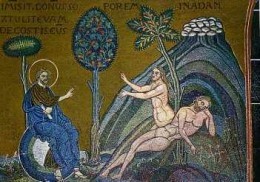
This mosaic from the Cathedral of Monreale, Sicily, depicts the creation of “woman” (ishshah). The image shows woman emerging from man’s side.
“So the Lord God caused a deep sleep to fall upon the man, and he slept; then he took one of his ribs and closed up its place with flesh. And the rib that the Lord God had taken from the man he made into a woman and brought her to the man.”
Gen 2:21-22
Besides learning about the necessity to find balance and harmony in our daily lives, Genesis 2 teaches us about the importance of relationships. Humans must be a pair and in relationship with one another. As part of the human-human relationship, or horizontal axis, we find a correlation between humanity and community, in that human beings are meant to live in society, in relationships, and not alone or in isolation. God says, “it is not good for the man to be alone” (v. 18) and builds up a suitable partner for the man. What is significant in the Yahwist account is that the “man” (Hebrew, adam) is thrilled to see a partner that looks like him. The perfect harmony between the man and the woman is shown in two ways: (1) in the man’s expression of admiration and even a flattering comment about the woman, described in poetry (v. 23); and (2) in the harmonious union of two humans (man and woman) as husband and wife. In the Catholic Church, this union is called the sacrament of matrimony; indeed, v. 24 is the foundational biblical text for the sacrament.
Class Discussion: “The Web of Connection”
· In light of the theme of “relationship” in Genesis 2 and God’s intention in creation, students brainstorm ideas that can help them understand the importance of human relationships and recognize how connections with others support personal growth, emotional well-being, and community building today. Here, ChatGPT can be a great tool to explore ideas and compare them with students’ own insights.
Gen 1:26-27 and Gen 2:7: The Two Creations of Man
As we found two accounts of the creation of the world, there are also two accounts of the creation of man or human being; Gen 1:16-27 comes from the Priestly Writer traditions (P), and Gen 2:7 derives from the Yahwist traditions (J).
The Two Creations of Man
Table – 1.4:
| Genesis 1:26–27 | Genesis 2:7 |
|---|---|
26Then God said, “Let us make humankind in our image, according to our likeness; and let them have dominion over the fish of the sea, and over the birds of the air, and over the cattle, and over all the wild animals of the earth, and over every creeping thing that creeps upon the earth.” 27So God created humankind in his image, in the image of God he created them; male and female he created them. | 7Then the Lord God formed man from the dust of the ground, and breathed into his nostrils the breath of life; and the man became a living being. |
What is interesting about both stories is that each gives a different account about how man or human was created. When we read Gen 1:26-27, we find unique details in the manner God creates man. First, according to P, the creation of man takes place on the sixth day, after everything in the world and universe came into existence, and according to J, man is formed before God planted the Garden of Eden and before the animals were created. Indeed, in the J account, rain, animals, and plant life are not put in the same order, and even man and woman are not brought forth simultaneously. Second, in Gen 1:26-27, we find that God was not alone when He was creating the kosmos; God said, “let us …” in v. 26a, alluding to the notion of the presence of “others” with God. We follow the interpretation of Philo of Alexandria in his treatise, On Creation.12
Philo of Alexandria
Figure – 1.8:

Philo of Alexandria (20 BCE-50s CE) was a Hellenistic Jewish philosopher well-known for his allegorical and philosophical interpretation of Scripture, especially the Pentateuch of the Septuagint (LXX).
Philo interprets the “us” as God’s “helpers,” who were responsible for the creation of everything from the neck down. It is an interesting interpretation because-,_Philo attributes to God the creation of the human mind only and to the “helpers” the rest of the human body. In this way, Philo disassociates any human sinful act from God, because God is perfect, and from God nothing evil or bad can come.
Third, the language of image (Greek, eikon) and likeness (Greek, homoiōs) are particularly interesting in the story; especially the word “image” is associated with Platonism. Thus, in the light of Plato’s account of creation in the Timaeus, Philo gives a Platonic interpretation to Gen 1:26-27 in this way: this is the creation of the intelligible man who is in the mind of God (the Existent One) and is used by God’s reason or logos to create human beings. The man of Gen 1:26-27 has several qualities, such as heavenly, incorrupt, immaterial, perfect, and neither male nor female (that is, sexless!). This man is superior to the man created in Gen 2:7, a text associated with Stoicism. According to Philo, the man is Gen 2:7 is the Stoic representation of the creation of man, who is formed out of the clay of the ground. To give life to this man, God blows into his nostrils the breath of life or his spirit (Greek, pneuma), and thus the man becomes a living being. This is the creation of the sensible man. The language of “breath of life” or “spirit” is a Stoic term. This man has inferior qualities in comparison to the man in Gen 1:26-27. For example, the man in Gen 2:7 is corrupt, mortal, physical, and male and female, and this man is created by the logos of God. Thus, in Genesis, we encounter a Platonic (image) and a Stoic (spirit) interpretation of the creation of man.
Genesis 1-2: The Purpose and Value of the Environment and the Created World
In the second creation account of Gen 2:9-15, we see that God creates a special garden with four rivers and trees of life and knowledge, and man is assigned to cultivate and care for it (verse 25). There is a clear reference to the intrinsic importance and value of the created world. Man is entrusted to care for creation and the natural resources; thus, the dominion language that we find in Gen 1:26 finds its balance in the restriction or command in Gen 2:17 and also in Gen 2:15, as we see in the following contrasts in Genesis 2:
God’s Gifts and his Restrictions
Table – 1.5:
| God’s Gifts | God’s Restrictions | |
|---|---|---|
| v. 9 | Beauty and food | v. 17 Don’t eat from the tree of knowledge of good and evil |
| v. 16 | Trees for food | v. 15 Care for the garden (earth) |
The relevant question for us today is in what ways does Genesis 2:9, 15-17 allude to the Catholic principle of the Care for God’s Creation? 13
Group Assignment using the Church’s teaching:
The Care for God’s Creation
Figure – 1.9:
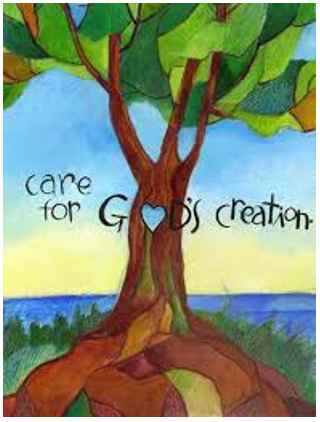
The Catholic Church defines the Principle of the Care for Creation as follows: “We show our respect for the Creator by our stewardship of creation. Care for the Earth is not just an Earth Day slogan, it is a requirement of our faith. We are called to protect people and the planet. Living our faith in relationship with all of God’s creation. This environmental challenge has fundamental moral and ethical dimensions that cannot be ignored.”
- Genesis 1 and 2 show us that God created the world as something good and entrusted it to human beings to care for. What do you think this means for us as Catholics today? How can we take care of God’s creation in our everyday lives?
- Students can create a creative 5-minute video or Power Point presentation offering a personal reflection on the theme of care for creation, inspired by Pope Francis’s Laudato Si’. This can be a wonderful group project outside the classroom to be graded.
Reflection Laudato Si – August 2020
Group Assignment: “Finding Harmony Between ‘Gifts’ and ‘Restrictions’ in Ordinary Life
- Personal Reflection
Look at your life now: What can you do to create harmony between your gifts and the restrictions (rules) you live with? - Group Sharing
Share with your classmates the “gifts” and “rules” you experience at home and at school. Why is finding a balance between these two important for a meaningful and healthy life?
Genesis 3: The Mythical Story of the Fall
The story of the fall in Genesis 3 is from the J source, written around 950 BCE. In this chapter, the first two humans get in trouble quickly. It is important to remember that this story, as are the stories in Genesis 1-11, is part of the mythical prehistory genre, thus we cannot take the story literally. We must go deeper and find its symbolic significance and universal truth. As we read the narrative in Gen 3:1-24, we see that the ability of the snake to talk to the woman is not explained, nor do we learn anything about the snake’s motives for disrupting the harmony that God created in Genesis 2. There are important elements that need to be highlighted. At the beginning of the story, the snake is introduced and described as the “most cunning of all the animals that the Lord has made” (v. 1). In the ancient Near East, and that includes Canaan (ancient Palestine), the snake was simply a snake, and not the devil in disguise, Satan, or another god.
Satan
Figure – 1.10:
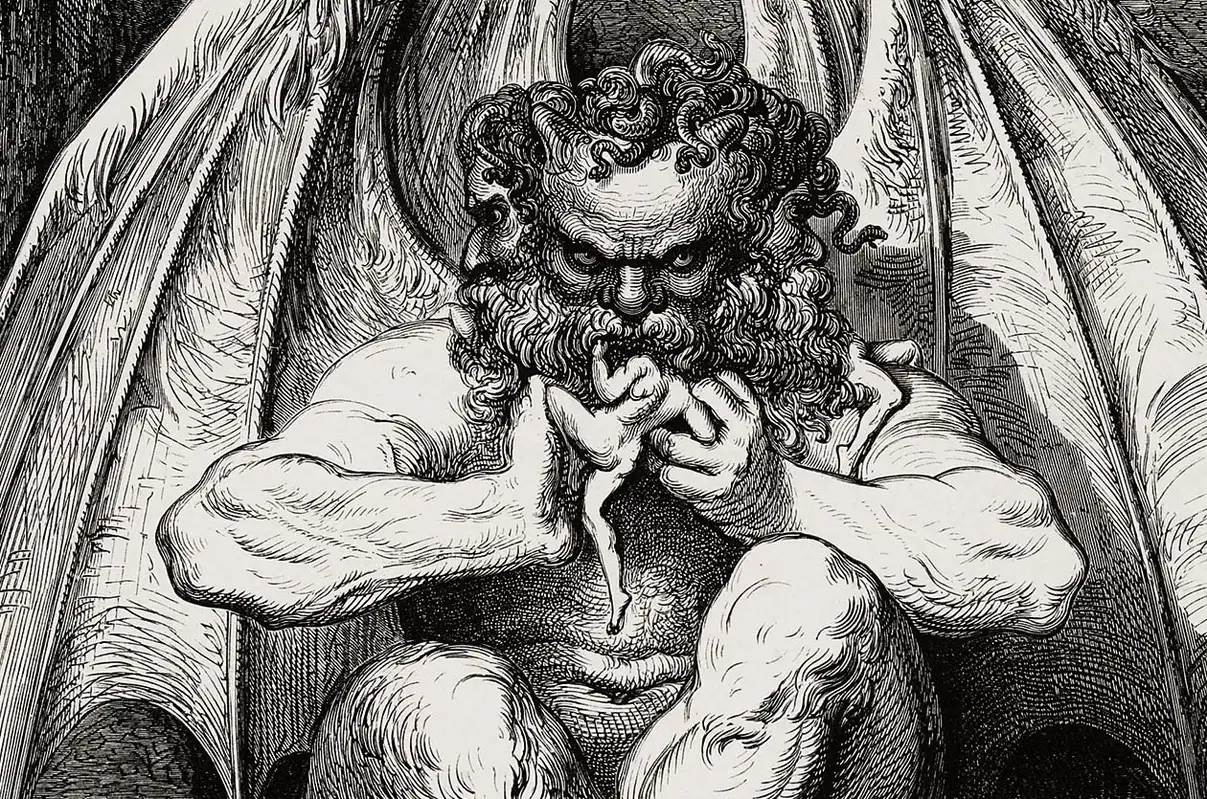
The student may be curious about the existence of Satan. The notion of Satan, the devil, or the demon in connection to the snake in Genesis 3 was introduced later in early Christianity. In the Catholic tradition, Satan or the devil does exist, and it is believed to be a “fallen angel,” who rebelled against God. It is portrayed as evil, spiritual being, once created good by God, but who willfully chose to turn against God through pride and rebellion. As the Catechism of the Catholic Church teaches: “The devil and other demons were indeed created naturally good by God, but they became evil by their own doing” (CCC 391). Certainly, Satan (called Lucifer) is considered the ultimate tempter and adversary of humanity, seeking to lead people away from God and toward sin.
ChatGPT: A good way to understand the concept of Satan in human affairs, students can explore the Divine Comedy by the Italian poet Dante Aliguieri. His narrative poetry describes a man’s journey through the afterlife—hell, purgatory, and heaven. Focusing on the man’s journey through hell (inferno), see what Dante says about Satan or Lucifer and his role in the world. Then, discuss how the devil or Satan operates in peoples’ lives today.
Going back to Genesis 3, what was characteristic and interesting about the snake is that in ancient Near East, a snake was known for being the most manipulative of all the creatures. Therefore, we can see that the craftiness of the snake seems to consist in how he manipulates the woman with lies and shows the woman how human beings can gain wisdom to become gods themselves. But the snake was also a symbol of fertility and eternity; the snake biting its tail was a symbol of eternity. The snake sheds its skin, is seemingly reborn, and never seems to die, making it a symbol of fertility and regeneration.
A Picture of a Snake as Symbol of Eternity
Figure – 1.11:

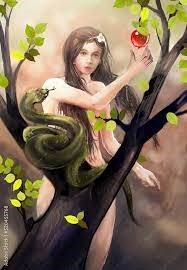
There is another important aspect to highlight in the story. When the woman responds to the snake, that they (man and woman) cannot eat from the tree in the middle of the garden in verse 3, the woman says, “… God said, ‘You shall not eat it or even touch it, lest you die’.” Interestingly, we notice two important points: first, as we connect the woman’s response with Gen 2:16, we immediately notice that when God gave man the order or commandment, God actually said, “… from that tree you shall not eat …” So, the woman reinterprets God’s command by adding the phrase “even touch it.”
Women Being Tricked By The Snake
Figure – 1.12:
Picture of God and Man and Woman in The Garden
Figure – 1.13:
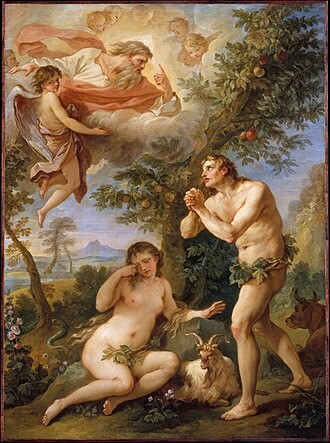
The last, not least, important point in the narrative is certainly the punishments that the woman receives in comparison to the man. In Gen 3:17-18 the man receives one punishment: toil the ground to eat; whereas in Gen 3:16, the woman receives two punishments: suffering in childbirth and submission to her husband (her husband will be her master). These punishments ruined the perfect horizontal harmony established in Genesis 2. Notice that at this point in the narrative, the woman has not been named yet. It happens in Gen 3:20, when the man called his wife Eve, which has the meaning of “mother of all the living.” Remember, God also gave the man the power to name the animals in Gen 2:20. Even though Eve receives two punishments and is not the one who gives names to animals, the significance of her name places Eve, like the man, in a preferential position before God, the Lord. Besides, she is the one who shows “appreciation” for beauty and wisdom (3:6).
CLASS ACTIVITY
Activity Title: “From Fall to Hope” – A Creative Video Reflection on Genesis 3
Duration: 3 minutes
Prompt:
Create a short video (up to 3 minutes) inspired by Genesis 3. In your video, show a situation where something bad (a mistake, failure, conflict, etc.) is transformed into something good (growth, learning, reconciliation, hope).
Reflect on this key question:
Can something good come from something bad?
Guidelines:
- Begin your video with a brief reference to Genesis 3 (e.g., the Fall, desire for knowledge and wisdom, human choice, and consequences).
- Use storytelling, visuals, or personal experience to illustrate the transformation.
- End with a short reflection on what the story of Genesis 3 teaches us today about mistakes, consequences, and hope.
Purpose: To explore how even difficult experiences—like the one in Genesis 3—can lead to learning, redemption, and growth.
Conclusion
In this chapter, sadly, the perfect harmony in creation and the relationship between God and humanity established in Genesis 2 are destroyed. That is, the first sin caused the disharmony between creation and God; between creation and human beings; and between God and human beings. The man’s and woman’s experience of sin creates disorientation in them and uncertainty about what could happen to them next in their lives. We see that Genesis 3 helps us to explain the reasons for names and practices, and human nature. Genesis 3 also invites us to think about God’s plan and our own personal role in that plan. In our Catholic tradition, Genesis 3, the story of the Fall, or the so-called Original Sin, is the beginning of the History of Salvation, or God’s plan to save humanity and restore His relationship with humanity. ,
Significantly, the story leads us to raise important questions about human life; for example,
- Why snakes crawl on the ground
- Why women have pain in childbirth
- Why people have ailments
- Why people suffer
- Why people have negative passions
- Why people are inclined to sin
- Why people have to work for a living
- Why we wear clothes
- Why we die
- Why the sexes are different
- Why people are ashamed when naked
- Why men and women feel sexual attraction to one another
Written Assignment Title: “The Implications of Human Choice: Reflection on Genesis 2–3”
Objective:
Students will reflect on the stories in Genesis 2–3, focusing on the harmony of God’s creation (Genesis 2) and the consequences of human choices (Genesis 3).
Instructions:
- Read the Passage:
a. Carefully read Genesis 2–3. Pay attention to the description of the Garden of Eden, God’s commands, and the actions of man and woman.
- Guided Questions:
Using the IPP (Ignatian Pedagogical Paradigm: Experience, Reflection, and Action), write a short reflection (3 paragraphs) answering the following:
a. How is God’s creation described in the beginning? What does it reveal about God’s intention for harmony?
b. What choice do man and woman make, and what are the immediate consequences of that choice?
c. How does this story show the power and responsibility of human freedom?
d. How can this story help us think about the consequences of our own choices today?
3. Evaluation Criteria:
- Thoughtful engagement with the text.
- Clear reflection on human choice and its consequences.
- Connection of the story to personal or contemporary experiences.
- Creativity in the optional extension (if completed).
Outcome:
Students will develop a deeper understanding of the moral responsibility inherent in human freedom and the importance of preserving harmony in God’s creation.
CHAPTER KEY TERMS:
- Big Bang Theory: The theory that scientists believe that the universe began with every speck of its energy jammed into a very tiny point. This extremely dense point exploded with unimaginable force, creating matter and propelling it outward to make the billions of galaxies of our vast universe. Astrophysicists dubbed this titanic explosion the Big Bang.
- Catholic Principle of Care for Creation: Human respect for the earth, or the natural world as believed to be the creation of God. We are called to protect people and the planet Earth, and to live our faith in relationship with all of God’s creation.
- Documentary Hypothesis: The theory that the Pentateuch (five books of Moses) is composed of material from four sources or traditions: the Yahwist (J), the Elohist (E), the Deuteronomist (D), and the (Priestly (P).
- God: Yahweh, the Jewish God.
- Moses: God’s agent to liberate the Hebrews, God’s chosen people, from slavery in Egypt, and bring them to the Promised Land, Canaan (Palestine). The story of Moses is found in the Book of Exodus.
- Myth: A literary genre in narrative form that reveals a universal truth. Myths are foundational or archetypal for a culture or religion.
- Pentateuch: (Gr. “five books”). The Catholic name for the first five books of the Bible.
- Platonism: An ancient Greek philosophy of Plato and his followers.
- Stoicism: An ancient Greek philosophical school of thought founded by Zeno of Citium.
- Torah: (Heb. “instruction,” “law”). The Law God gave to Moses at Mount Sinai and the Pentateuch that contained it.
References
2 Mircea Eliade, The Sacred and the Profane: The Nature of Religion (trans., Willard R. Trask; Orlando: Harcourt, Inc., 1987), 20-115.
3 Eliade, The Sacred and the Profane, 95-98, esp. 96-97.
4 See Alexander Heidel, ed. and trans., The Babylonian Genesis (Chicago: University of Chicago Press, 1951).
5Timothy R. Carmody, Reading the Bible: A Study Guide (New York: Paulist Press, 2004), 47.
6 See Carmody, Reading the Bible, 39-51.
8 Michael Patella, OSB, Word and Image: The Hermeneutics of the Saint John’s Bible (Collegeville, Minnesota: The Saint John’s Bible, 2005), 84-85.
9 This last important topic is discussed in chapter three, “The Problem of Evil.”
11 For a discussion about science and faith, see Gregory W. Dawes, “Could There Be Another Galileo Case? Galileo, Augustine and Vatican II.”
http://www.creighton.edu/JRS4 (2002).
http://creativecommons.org/licenses/by-sa/3.0/. October 31, 2023.
Bibliography
Eliade, Mircea. The Sacred and the Profane: The Nature of Religion. Translated by Willard R. Trask. Orlando: Harcourt, Inc., 1987.
O´Collins, Gerald, S.J. and Farrugia, Edward G., S.J. A Concise Dictionary of Theology: Revised and Expanded Edition. New York: Paulist Press, 2000.
Thomas, D. Winton, ed. Documents from Old Testament Times. New York: Harper & Brothers, 1961.
Carmody, Timothy R. Reading the Bible: A Study Guide. New York: Paulist Press, 2004.
Philo of Alexandria, On Creation. F. H. Colson. Loeb Classical Library 226. Cambridge, MA: Harvard University Press, 1929.