


Chapter 10: Speaking in Small groups
Speaking in Small groups
The first thought that crosses the mind of many individuals assigned a group project is: will this really be a group effort or will I end up doing most of the work?
This is a legitimate and reasonable concern because your group’s success or evaluation will depend on how well the group works together as a unit, the work that is produced, and the presentation that group delivers. All of these elements depend on the group dynamics and team work.
PART 1
A Small Group is a limited number of people of three (3) or more, but up to 12, who come together for a specific, common, and important purpose beyond socializing.
In public speaking, 2 individuals are not considered a group; socially, they might be referred to as a couple. In communication, 2 is called a dyad. A group, therefore, begins with 3 people.
Group Formation
Step 1: Once members are assigned to a group, the group is officially formed and the group must now set about the task of establishing the individual members as a unit.
Step 2: The group must now establish a leader or shared leadership; someone or individuals who will help to direct the affairs of the group, such as the tasks, the meetings, deadlines, and responsibilities of each member.
Step 3: Once a leader has been identified, an agenda of scheduled meetings, tasks, and deadlines must be set up; the work has begun.
Leadership
The ability to inspire and influence group members so as to help the group achieve its goal. Just like a body needs a head, a group always needs leadership.
Lolly Daskal, a leading executive leadership coach and business executive, in her blog, cites 10 signs that you are a leader, but may not even be aware of it.

10 Signs You Really Are a Leader…, Lolly Daskal
How many of these leadership qualities do you have?
- Open, minded and non-opinionated
- Give good advice
- Can be counted on
- Good listener and can be confided in
- Good example to others
- Insists on excellence
- Positive
- Respectful of others
- Genuinely cares about others
- Confident and passionate
If you are keeping score and identify with at least 8 or 9 out of the 10 listed, you are indeed a good leader. 5 to 7 out of 10, you’re well on your way. Anything less than 4 means you probably have some work to do.
These are not just qualities of good leadership; these happen to be qualities that every person should strive towards. Each of the characteristics on the list is measured against what you do or can do for others.
There are basically three ways to ascend to positions of leadership: be elected, emerge as a leader, or by implication.
- Designated Leader – the individual is elected or appointed the group’s leader when the group is This is usually done through an election process; if it’s a small group, the process could be done very quickly through a secret ballot or vote during one of the members’ meetings.
- Implied Leader – the individual is looked at as the leader and is then deferred to as the leader because of one or more of the qualities listed above, or because of their expertise or experience.
- Emergent Leader – this is a more gradual process of ascension to the leadership role. The individual emerges as the leader during the group’s meetings, but that individual also has to show leadership skills similar to some of those listed here.
Depending on the personality type, leaders will bring to the position those traits that oftentimes best suit their personalities and the group needs.
Leadership Styles
The leadership style is the main determinant of the success of the group.
Early research identified three leadership styles: Autocratic, Democratic, and Laissez-Faire (Lewin, 1939).
- The Autocratic (Authoritative) leader is a leader who would chart the course and inspire others to follow the course they have charted; this type of leader wants to be in charge. They do provide guidance, motivation, and feedback to members of the group, and are driven by the results they envision.
So as not to confuse Authoritative with the Authoritarian leader – the Authoritarian leader demands compliance without question.
- Democratic (Participative) leader – they require and accept input from all sides, and expect everyone to contribute to the decision-making process; therefore, the democratic leadership approach allows others to feel more engaged.
- Laissez-Faire (Delegative) leader – this is a leadership style with a “hands-off” approach; subordinates or other members of the group are not micromanaged, and decisions are left to the group members or employees, with leadership being available for feedback.
Other leadership styles have emerged since Lewin’s research; Transactional and Transformative Leadership styles have become part of the discussion on leadership styles.
- Transactional (Managerial) leader – this type of leadership style relies on rewards (typically financial rewards like bonuses, at times it might be promotions) and punishment (denial of promotion or financial rewards). There is give and take or bargaining, however, leaders are more concerned with efficiently following the established routines and policy guidelines.
- Transformational (Visionary) leader – this leadership style emphasizes change and transformation, and these leaders will strive to develop the strengths and abilities of members. These leaders inspire their followers.
Now that you have a clearer understanding of leadership types and styles, we will examine the functions of leadership.
Leadership functions in groups depend on the needs of the group; there are four essential needs of a group: procedural needs, task needs, maintenance needs, and to develop human relations. Based on these essentials, a leader will have to inspire trust, create a vision/change, execute planned strategy, and help develop the potential in other group members.
Leadership Functions
Group Needs
- Procedural Needs – this is the group business; the routine actions that would allow the group to function as a unit in order for business to be conducted smoothly and Leadership would set the agenda, plan and start the meetings, lead in the discussions, move the meeting along, and wrap up the sessions.
- Task Needs – these are the essential and necessary actions each group member must perform in order for the group to complete its task. Leadership must ensure that tasks are being executed and completed on a timely basis.
- Maintenance Needs – it is essential that a supportive working environment is Therefore, interpersonal relations among members must remain positive and respectful. Leaders must be able to guide discussions in ways that would help maintain a harmonious atmosphere, especially when members are not in agreement. Leadership must also be able to step in and right the course when there is disharmony.
- Human Relations – encouragement and praise is essential in allowing members to reach their full Incentives are oftentimes necessary for members to feel appreciated and for continued performance at high levels. Members look to leaders for this type of support.
- Inspiring Trust – credibility enlarges trust, and trust is the core of relationship-building and maintenance. In order to inspire trust, a leader must be trustworthy; this essentially starts with the leader’s character, which should include:
Confidence – having a belief in self and in the ability to execute the plan.
Credibility – being reliable and able to come through.
Congruity – being consistent in word and deed.
Courage – being aware of the risks, but fearlessly venturing forward.
Humility – giving credit to others, and deciding what is right.
Honesty – being truthful about your feelings and being candid with others.

Great Leaders Inspire Trust (Entrepreneur), Ray Silverstein (2010)
- Create Change – change is visionary and essential to A leader creating change, is a leader forging a new path, envisioning a new method of executing a tried plan or creating a new plan altogether, and making it work to produce the intended successful results.
- Execute planned strategy – as a leader, to execute a planned strategy, you must first be clear on the plan itself. Therefore, it is imperative that you have a plan or make a plan. You must then communicate your intentions to the group and those involved in making the plan work, set actionable goals, do follow-ups, and keep track of progress reports. Next, you must measure and manage the performance of members; you want to make sure that performance is maintained at a high Finally, link the performance to the reward outcome; the outcome should reflect the level of performance.
- Potential Development of Others – a leader’s role is to also develop the potential of other leaders. Reviewing and discussing the performance of group members enable those members to understand what they need to do in order to level-up, challenging members to accomplish more, recognizing their efforts and allowing them to work to their strengths, builds confidence, and helps members to become the next potential leaders.
PART 2
Group Characteristics
Once groups are formed and members begin to interact with each other, over time, the group will develop certain characteristics which would allow the group to either excel or falter.
Notable characteristics observed are:
- Interdependence – as group participants become more familiar with each other, members begin to know each other by name and begin to rely on each other to do their assigned part well. While communication may not be uniform or consistent at this juncture, there is clear evidence that members identify with the group.
- Cohesion – the group participants feel a connection to each other because they share a common goal, interest, and benefit.
- Commitment – the behavior of group members clearly show a sense of membership, and participants would define themselves as belonging to or members of the group.
- Roles – the group members identify themselves and are identified within the group by their roles, and those roles help them to define their participation and group allegiance.
Formal role – this is an assigned and specific function within the group that may have a title attached to it.
Informal role – this might be a non-official role, but it still serves a function.
Task role – a specific formal or informal duty to be performed.
Social role – the spark, someone who is the cheerleader.
Disruptive role – this is someone who stirs the pot, though not always in a negative way, but at times seem to be in opposition to the group productivity.
- Norms – the group’s formal and informal rules guide the participants to behave in ways the members find to be predictable, consistent, and common place.
- Culture – the group develops a group culture; this is the shared patterns of beliefs, behavior, and interactions that now guide the group’s actions.
The Group’s Performance will be affected by its cohesion, which is how well members work together, by how well participants perform their assigned tasks, how the group manages conflict, the synergy and interdependence of the participants, and of course the leadership. Be mindful of the leadership style.
When group discussions became stalled or hit that proverbial wall, a method of critical thinking developed in the 1930s by John Dewey, and furthered by the Progressive Education Association in the United States, were able to develop a five-step method of directing discussion in problem-solving small groups, relying on critical thinking. Dewey introduced the term critical thinking or reflective thought.
The Reflective Thinking Method is really a process of problem solving, requiring the use of creative insight, intellectual honesty, and sound judgment or critical thinking.
The five-step critical thinking approach used was discovered to be quite useful in generating solutions to nagging problems.
Reflective Thinking Method
- Define the problem – the first step in the approach is to be able to clearly define what the problem is that needs to be solved.
- Analyze the Problem – the second step is to scrutinize the problem by examining its history, factors, contributing factors, and major root causes.
- Establish standards/criteria – step three is to set measurable standards that can be used to come up with reasonable solutions; list contingencies as well.
- Generate potential solutions – the fourth step is to generate a master list of solutions, encouraging creative input.
- Select the best solution – a single solution must be generated and this solution applied. If it works, it is then incorporated as the best solution for the problem, and if it does not work or stops working, the next best solution is applied, or the process to generate another solution will reoccur.
PART 3
Group Speech Delivery
The group speech presentation is akin to the performances of athletes in a relay race; the hand-offs (transitions) become one of the most important aspects of the group speech.
The actual group speech is done after research is completed and the preparation outline is written. The preparation outline identifies the speech‘s purpose, thesis, main points, supportive (sub) points, and evidence. If you’re still unsure on how to write a proper preparation outline, there are samples in chapter 5.
At this juncture, participants should be aware of their roles for the actual presentation. If the group was working cohesively and interdependently, the members would know the strengths and weaknesses of each; it is wise and prudent to assign members’ tasks based on their strengths.
Group members who are strong at delivering speeches should be asked to speak. The group may also choose which members are more suited to present specific points or comments.
Practice your speech
It is recommended that you practice your speech as a group, at minimum, 3 times, but practice as many times as possible until all members are comfortable with their parts.
Practice not only what you will say, but where you will be positioned physically on stage or in front of the room, and the order in which participants will present. Incorporate all the elements the group will actually use during the presentation, including props, slides, powerPoint, and any other material.
It should not surprise you that as you practice, you will find flaws in the language you or other members have chosen; correct as you go along. Some slides may not fit in well with the points; replace them. You may discover redundancies in the information, or you might find that the direction of the data is digressing you from the speech purpose; make the necessary adjustments.
Blocking
Blocking, sometimes called staging, is the positioning and movement of speakers, actors, or performers in a space, so as to provide the best view for the audience and the greatest comfort and vantage point for the speaker/actor when delivering comments.
In group presentations, because of the number of speakers on stage simultaneously, movement by the speakers must be organized so that the transitioning between each speaker is smooth and seamless.
A simple way to perform transitioning between speakers is to have one but no more than two speakers on stage, or in the audience’s view simultaneously; the other speakers can sit in the front row of seats and await their turn. In this type of situation, each speaker will introduce the speaker that follows them.
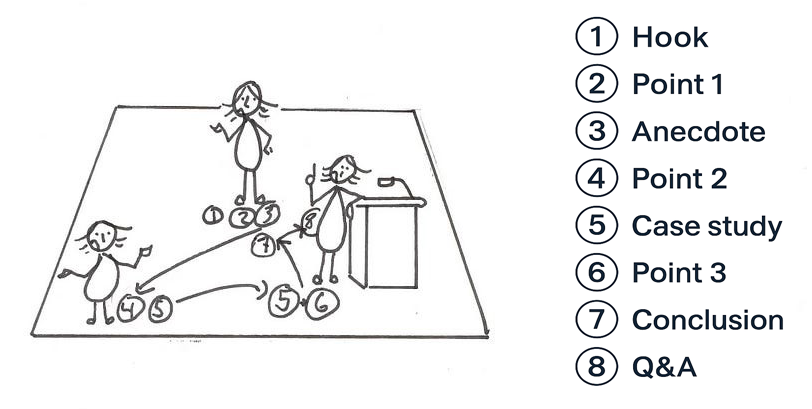
Figure 10.1 :
Transitions
For a seamless, professional-looking group presentation, the transitions between each speaker must be flawless. The preceding speaker introduces the next speaker and their topic/ discussion point, and that speaker in turn will do the same thing for the speaker that follows.
These transitions require each group member to know the script well; know what the speaker ahead of you is going to speak about and end on, and listen for your cue, the transitioning out; it is when that speaker introduces you; be prepared.
In a relay race, if the handoff is flawless, the chances of that team winning is greatly enhanced, but if the baton is dropped, or if the handoff is flawed by one of the relay team members, then the chances for success is greatly diminished. The USA Olympics Men’s Relay team failed to qualify in the 4 X100 relay due to a botched handoff.

Figure 10.2 : USA Olympic Relay Team, 4 X 100, Tokyo 2020
Rehearsals
Rehearsals are important; you get an opportunity to time each part of the speech, as well as the entire presentation. You are able to work with the inserts (pictures, slides, powerPoint, video), and this provides you with a rhythm and enables you to obtain a feel for the flow of the speech.
A speech is sped up when there are fewer visuals and the transitions between speakers move quickly from one speaker to the other. The delivery pacing by each speaker will also help to determine the pace of the speech. A speech slows down when there are too many slides, and transitions from moving images to stills or from images to talk. The pacing of the delivery, once again, can also determine the pacing of the speech. A faster or slower speech might be preferred, depending on the topic being presented.
It is recommended that you familiarize yourself with the speech cadence and pacing of your group participants who will be speaking; this will help you determine the correct rhythm of the speech for the topic.
Dress Rehearsal
A dress rehearsal is important for ironing out any remaining kinks of the speech, prior to the real show. You get the opportunity to dress the way you will for the speech, and group members get an opportunity to observe how coordinated members are in appearance, how the transitions work, and the pacing and flow of the speech with all the add-ins (slides and videos). The entire presentation is done from start to finish, exactly as it would be done on the day and time of the event. This will provide the group with a great idea of the length of the speech as well.
Treat the dress rehearsal in the same manner as you would the presentation, and while the level of anxiety and pressure might be somewhat different, you will receive a pretty good barometer of the actual speech.
Responsibilities
- Commit yourself to the goals of the group; the more you are able to identify with the other participants and the speech outcome, the greater your commitment will be. Thoroughly learn and rehearse your
- Complete your assignments; your group members are depending on you to fulfill your assigned Without your information, the presentation will be incomplete. Therefore, recognize your importance to the overall success of the speech.
- During the entire process, through the planning, research, writing, and rehearsal of the speech, avoid interpersonal conflicts. If there are disagreements, it should be about the tasks and not about the personalities within the Make sure differences are settled amicably.
- Contributing fully should be the priority of all group members. Each member should feel it their responsibility to encourage other members to fully participate, which means, attend all meetings and rehearsals, and contribute ideas in addition to the assigned workload requirements.
- Any group member should feel comfortable and responsible to intervene if the discussions are not on track, participants appear distracted, or required progress is not on
- In a group of 5-7 participants, the following responsibilities could be divided up and assigned as follows:
- Preparation outline/Speaking outline prep -1 person
- Research data (visual/material)-1 or 2 people
- Visuals prep (including slides, PowerPoint, video)-1 or 2 people
- Technical support – 1 person
- Speaker (s) (Presenter)-1,2, or 3 people
PART 4
SUMMARY
From this discussion on speaking in small groups, you learned that a Small Group is a limited number of people of three (3) or more, but up to 12, who come together for a specific, common, and important purpose beyond socializing.
Once the group is formed, leadership should be established, and leadership is the ability to inspire and influence group members so as to help the group achieve its goal.
There are basically three ways to ascend to positions of leadership: be elected, emerge as a leader, or by implication.
Designated Leader – the individual is elected or appointed the group’s leader.
Implied Leader – the individual is looked at as the leader and is then deferred to.
Emergent Leader – the individual emerges as the leader.
The leadership style is the main determinant of the success of the group. Five leadership styles identified are: Autocratic, Democratic, Laissez-Faire, Transactional, and Transformational.
Autocratic (Authoritative) leader – charts the course and inspires others to follow.
Democratic (Participative) leader – allows others to feel more engaged.
Laissez-Faire (Delegative) leader – “hands-off” approach.
Transactional (Managerial) leader – bargaining, give and take.
Transformational (Visionary) leader – emphasizes change and transformation.
The function of leadership within a group is determined by the needs of the group, which are:
Procedural Needs – the routine actions that would allow the group to function
Task Needs – the essential and necessary actions each group member must perform
Maintenance Needs – maintaining a supportive working environment
Human Relations – essential encouragement and praise
Once the needs of the group are recognized, the group leader must then Inspire Trust, create change, execute the group’s strategy, and help to develop the potential of others.
Once groups are formed and members begin to interact with each other, over time, the group will develop notable characteristics, among which are:
Interdependence – being able to rely on each other.
Cohesion – the sharing of common goals, interests, and benefits.
Commitment – showing a sense of membership and belonging.
Roles – which help to define their participation and allegiance.
Norms – specific ways of behaving by the group members.
Culture – shared patterns of beliefs.
The Group’s Performance will be affected by its cohesion, which is how well members work together, by how well participants perform their assigned tasks, how the group manages conflict, the synergy and interdependence of the participants, and of course the leadership. Be mindful of the leadership style.
The Reflective Thinking Method is a process of problem solving, requiring the use of creative insight, intellectual honesty, and sound judgment or critical thinking. The steps involved are to Define the problem, Analyze the Problem, Establish standards/ criteria, Generate potential solutions, and Select the best solution.
This method of problem solving can be applied when a group has reached an impasse on resolving a problem and needs to generate a solution.
The Group Speech Delivery or presentation is the final phase of the group’s formation and meetings. The presentation is done after research is completed and the preparation outline is written. Practicing blocking and transitioning and doing rehearsals including a dress rehearsal would allow group members to time the presentation and develop a flow or rhythm for the speech.
As long as group members act responsibly, commit to the group, contribute, participate fully, and avoid disruptions, the speech will most likely be delivered successfully.
DISCUSSION QUESTIONS
- What Leadership style do you believe best describes you? Discuss the reasons you believe that leadership style best characterizes you.
- Try to recall a situation with you being a member of a group that you were not happy to be a part of. Explain what that project was and the reason or reasons you were not thrilled to be a member of that group. How did you manage that situation, and what was the outcome?
- Were you ever a member of a social group on or off campus, such as a fraternity, sorority, club, or team? Discuss your experience, as well as your role, as a member of that group.