


Chapter 12: Diversity, equity, equality, Justice and Public speaking
Diversity, equity, equality, Justice and Public speaking
The most eloquent and passionate speeches and writings made throughout history by individuals or groups were either for causes, to redress an injustice, to protect the innocent, or to induce change, politically, economically, or socially. Many have died for speaking up and speaking out truthfully and fearlessly against oppression.
Speakers have used various tactics to drive home their messages and win support, like emotional appeals, bare knuckle facts, promises, and marches, while others have used threats, fear mongering, divisive language, lies, and other devious means to achieve their ends.
The struggle for equity, equality, and justice, as well as the distribution of power and access among the masses, often seem to be isms-centered, like sexism, ageism, heterosexism, ethnocentrism, classism, or racism; these controversies fuel emotions and add more tension to an already volatile discourse, but they seem to “en mass” individuals to action.
Most, if not all, of the isms have negative connotations, with racism and ethnocentrism appearing to create the most debate and greatest consternation. Racism, by far, has made the most indelible impact on nations around the world, and the negative residual effects remains to this day. The struggle for equality continues, so speeches about diversity, justice, equality, and equity will continue to be amplified on stages and screens around the world, and will remain a challenge for leadership in the United States until it is eradicated.
In setting the stage for diversity, equity, justice, and equality in this discourse, it is imperative for you to understand the foundation and influence upon which many great actions, protests, historical writings, and speeches reside. It is, therefore, my hope that the inspiration of those who felt the urge to fearlessly speak up and speak out, in spite of threats and other dangers to their status, liberty, limbs, and life, would inspire public speakers, students, and educators of today to cast aside fear and be emboldened by their beliefs, thereby making a difference to the lives of others who may be on their own paths of discovery, and become inspired by your writings, words, and images.
This nation (the United States) was built on slavery, therefore, racism is foundational. Racism, defined, is prejudice, discrimination, or antagonism by an individual, community, or institution against a person or people on the basis of their membership in a particular racial or ethnic group, typically one that is a minority or marginalized. The antagonizing group is of the belief that they possess superior characteristics and/or abilities that are race or ethnic-specific, making them superior and entitled.
Discrimination might include or be based on ethnicity, regional identification, skin color, physical appearance as well as other characteristics.
Speeches that played significant roles in changing the mindset and the political and social direction of the United States of America and the world over, the were espoused during periods of unrest within countries and communities, and among nations, some voices sparked and ignited actions which propelled change, while other voices seem to stifle change and further divisions.
Painful but factual and real issues of diversity, equity, equality, justice, inclusion, and belonging in the United States continue to be a struggle and a nation divider, not a builder.
Five hundred years after slaves were imported to the shores of North America, justice and equality are still being pursued and not yet attained. The social, political, and economic disparities affect the choices we make, our attitudes and behavior, and most of all, the way we communicate with each other, how we protest, how we are policed, and how we choose to resolve conflicts.
In order to justify treating another human being as subservient or less than human due to their pigmentation, the racist had to believe that the victim lacks certain racial qualities that would make them an equal. They must believe, or be made to believe that the victim’s values are so different that the treatment meted out is justified.
The culture of slavery was justified using this argument. The slave master had to be convinced that the negro was actually three-fifth of a person, and that they were simply property, like chattel, clothing, garden utensils, or a house, not quite human, but rather, possessing the value bestowed upon him by the slave master, and therefore, it was the slave master’s God-given right to enslave.
The slave would be protected by his or her owner, not out of love, but ownership or possession. That slave or bond servant could not be taught to read nor write, because the slave master knew knowledge was power, and in the hands of a slave, this could be extremely dangerous.
Meanwhile, the undercurrent of fear was constant, because humans rebel if treated unfairly; this is a natural and instinctive human reaction, and so, the constant fear was that the slave could or would exercise this instinctive human right and resist (human rights were not observed for the slave, and therefore, as far as the slave master was concerned, did not exist for the slave).
In the modern era of the 20th century, resistance would’ve perhaps initially taken the form of verbal protest, speeches, marches, and civil disobedience. However, in the 1600-1800s, no rights existed for slaves, verbal protests were unheard of (in slave States), and the only alternative for slaves was to escape the plantation and their tormentor by running away to a state where the negro was recognized as free. Some took that chance, in spite of knowing that this act would exact a tremendous price to their physical well-being.
The slave had “No Rights Which the White Man was Bound to Respect”; this was the language of the United States Supreme Court Chief Justice, Roger Taney, in the 1857 Dred Scott decision. Dred Scott had initially won a decision in the lower courts, but lost in the Supreme Court.
Chief Justice Taney’s ruling, regarded as one of the worst Supreme Court rulings ever, considered whether African Americans were citizens of the United States and, therefore, able to file suit in federal court (as Dred Scott did). In his ruling, Taney declared that African Americans were not citizens.
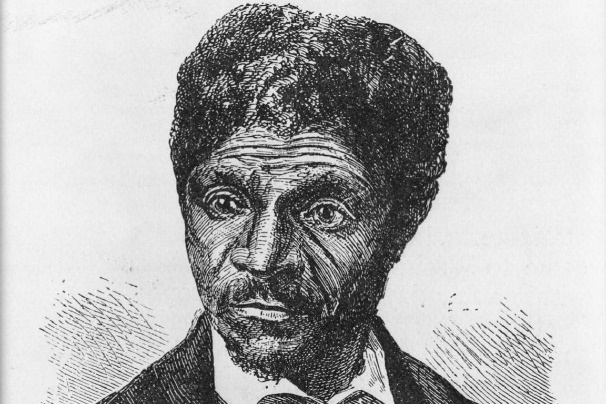
Figure 12.1 : Dred Scott, published in Century magazine, June 1887. Library of Congress, LC-USZ62-5092.
Dred Scott was an African American slave who had sued for his freedom, arguing that because he had been brought into free territories, he could not be returned to slavery.
This decision inflamed abolitionists (those who believed in the immediate and full emancipation of all enslaved people). The Quakers played a key role in the Abolitionist movement.
The Quaker Movement was founded in the 17th Century, in England, by George Fox. He and other Quakers believed that the presence of God resided in all, therefore, God was found in people, not in churches, and men and women had spiritual equality. To the Church of England, this was considered blasphemy, and Fox was jailed and the Quakers continuously persecuted for their beliefs. Quaker missionaries made their way to America in mid-1600s, bringing with them their beliefs, and almost immediately began fighting for the rights of the Native American, the Women Suffrage Movement, and the abolition of slavery.
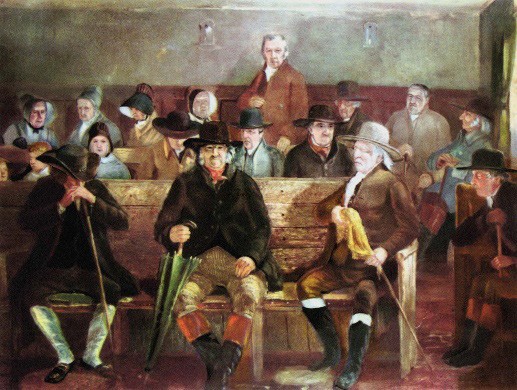
Figure 12.2 :
After being given a land grant in America by King Charles II, in 1681, to pay off a debt owed to his family, William Penn, a wealthy Quaker who was persecuted and jailed numerous times for his beliefs, founded Pennsylvania as a sanctuary for religious freedom and tolerance. A large influx of Quakers soon began arriving in Pennsylvania and the colonies of America.
In 1833, The American Anti-Slavery Society was formed by the Philadelphia Quakers, the New England Garrisonians (named after Lloyd Garrison), and the New York Reformers, with William Lloyd Garrison leading the charge towards a national Abolitionist movement to end slavery.
In 1859, John Brown, an Abolitionist, and others, in an effort to initiate a slave revolt, attacked Harper’s Ferry, a Southern Fort in West Virginia. They were all killed. However, this attack initiated the American Civil War between the North and South.
Among those fighting the cause of emancipation was a former slave named Frederick Douglas, who became one of the leading spokesmen for the abolition of slavery.
Figure 12.3 :
Born into slavery in 1818, Douglas became a fugitive after vowing to be a free man. He joined the abolitionist movement, and his freedom was eventually purchased by them. He became an advisor to President Lincoln and a tireless champion for freedom for all the enslaved.
“..The rich inheritance of justice, liberty, prosperity and independence, bequeathed by your fathers, is shared by you, not by me. The sunlight that brought light and healing to you, has brought stripes and death to me. This Fourth July is yours, not mine. You may rejoice, I must mourn..” Frederick Douglas, (1852, Rochester N.Y.).
This is an excerpt from a speech Douglas gave in Rochester, New York in 1852.
Click on the video for Frederick Douglas’ full speech.
“What to the slave is the Fourth of July”, Frederick Douglas, African American Legacy
The arguments of litigants and defendants in many court cases are persuasive speeches; the arguments of Dred Scott, Frederick Douglas, Quakers, Abolitionists, and many others who had argued eloquently for freedom, justice, and equality are no different.
Douglas went on to become a forceful and leading voice for the liberty of the negro (as African Americans were referred to at that time), and in 1870, the 15th amendment to the constitution gave the Black man the right to vote.
As Abolitionists were arguing for the emancipation of the negro and the abolition of slavery, with the formation of the first National Woman Suffrage Association (NWSA) in 1869, Susan B. Anthony and Elizabeth Cady Stanton were arguing for women to have the right to vote.
Added to the NWSA, the American Woman Suffrage Association (AWSA), a second woman’s movement was also formed in 1869, and the two associations AWSA and NWSA later merged in 1890 to become the largest woman suffrage movement in the country.
A tactic used by the Woman Suffrage movement was silent protest. Dubbing themselves The Silent Sentinels, the group used silent protest in 1917-1919, in order to try and secure the right of women to vote. Organized by Alice Paul, a Quaker woman, the women wore sashes, carried message banners and flags, and held marches in Washington DC in front of the White House.
The protests were silent, but effective; the silence combined with the banner messaging helped to amplify the point of the protest.
These women used various means to get their messages read or heard, and the following quotes help to document the story of their struggles and hopes.
”Life is a hard battle anyway. If we laugh and sing a little as we fight the good fight of freedom, it makes it all go easier. I will not allow my life’s light to be determined by the darkness around me.”
📝Soujourner Truth
“It was we, the people, not we, the white male citizens; nor yet we, the male citizens; but we, the whole people, who formed the Union…Men, their rights and nothing more; women, their rights and nothing less.”
📝Susan B. Anthony
“The young women of today, free to study, to speak, to write, to choose their occupation, should remember that every inch of this freedom was bought for them at a great price. It is for them to show their gratitude by helping onward the reforms of their own times, by spreading the light of freedom and of truth still wider. The debt that each generation owes to the past it must pay to the future”
📝Abigail Scott Duniway, suffragist 1834-1915
“The best protection a woman can have…is courage.”
📝Elizabeth Cady Stanton
“Women suffrage is going to prevail…it is not merely because women are discontented. It is because the women have seen visions of duty, and that is something which we not only cannot resist, but if we be true Americans, we do not resist. I come here to fight with you…and to congratulate you that there is a force behind you that will beyond any peradventure be triumphant.”
📝President Woodrow Wilson
In 1919, the merged associations became The League of Women Voters, and in 1920, the 19th amendment to the Constitution gave women the right to vote.
In 1908 in Springfield, Illinois, a brutal race riot fueled by a white mob which shot innocent people, burned homes, looted stores, and lynched two elderly black people, led to the formation of the National Association for the Advancement of Colored People (NAACP) in 1909.
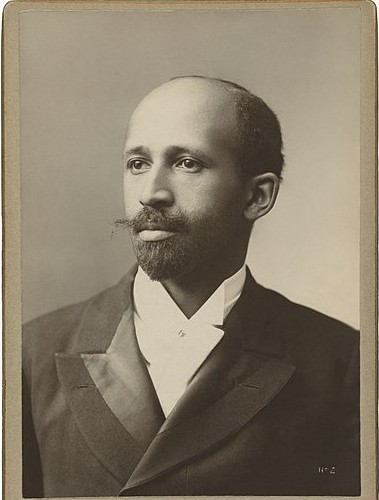
Figure 12.4 : W.E.B. Du Bois, Photo Credit Wikimedia
The NAACP was formed by an interracial group that included W.E.B . Dubois, Ida B. Wells-Barnett, Mary White Ovington, and others. They wanted to oppose racism and ensure that segregation and discrimination against African Americans in housing, voting, employment, education, and transportation was abolished.
Over the years, the NAACP has featured numerous events and many past U.S. Presidents like Woodrow Wilson and Harry Truman, Bill Clinton, and Barack Obama.
The NAACP has been actively involved in shaping and influencing policy on civil right laws and desegregation, including the case of Brown V Board of Education of Topeka, a 1954 school desegregation landmark case, which the NAACP won, and which stated that separate educational facilities for white and African American students were inherently unequal and violated the 14th Amendment to the Constitution. The case highlighted and forced greater awareness to the inequities faced by African Americans. The attorney for the plaintiffs was Thurgood Marshall who, in 1967, became the first African American to serve on the U.S. Supreme Court.
Thurgood Marshall was born in Baltimore, MD in 1908, and attended Howard University law school. He founded the Legal Defense Fund in 1940. LDF, to this day, remains a premiere organization fighting for racial justice, equality, and inclusivity, through litigation, advocacy, and public education. Thurgood Marshall died in 1993 at the age of 84, but left a legacy of his work and achievements in words and deeds.
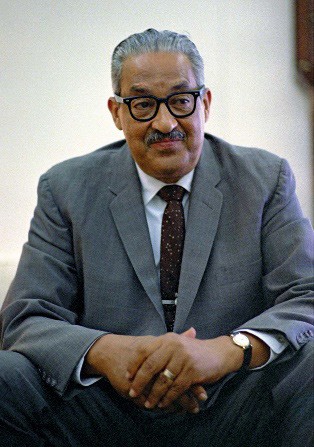
Figure 12.5 :Thurgood Marshall
It is quite amazing to note, that while the dehumanization and disadvantages of slavery should have, in many ways, severely crippled the negro, and kept him in shackles and chains long after slavery was abolished, his ability to rise in spite of the existence of hundreds of years of forced illiteracy and bondage is beyond astonishing; Thurgood Marshall’s life story epitomizes this triumph, and so does Booker T. Washington’s.

Thurgood Marshall, Speech @ the National Bar Association, 1988, C-SPAN, Washington DC
Next to freedom, education was foremost for most slaves; Booker T. Washington believed and expounded this principle in his life and writings.
Booker T. Washington’s autobiography, “Up from Slavery”, chronicles his life from slavery and finally to freedom with the Emancipation Proclamation. He became an outstanding American educator, reformer, and President of Tuskegee Normal and Industrial Institute (now Tuskegee University) and believed that through education in the crafts and industrial skills, the post-reconstruction negro would be able to attain economic security.
Washington was born in Virginia in 1856 and died in 1915, but not before making an impact on many who followed and became involved in the struggle for equality and justice.
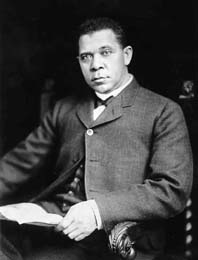
Figure 12.6 : Booker T. Washington

Explore the career of Educator & Reformer, Booker T. Washington
Booker T. Washington’s autobiography influenced many, including Marcus Garvey, who was born in Jamaica in August 1887 and while residing in London, became inspired by Washington’s self-help philosophy in his autobiography “Up From Slavery” which he read. He was also influenced by the group of black colonial writers who wrote for the “African Times and Orient Review” in London (Garvey worked for these writers as a messenger). The writings in the African Times and Orient Review stressed pan-Africanism or African nationalism.
Scholars discuss Marcus Garvey’s UNIA:
Marcus Garvey and the Universal Negro Improvement Assoc. (U.N.I.A)
Philosophically armed and inspired, Garvey travelled to the United States and, in 1917, furthered his Black nationalistic philosophy through an organization he had founded in 1914 in Jamaica, the UNIA (Universal Negro Improvement Association). Through the UNIA, Garvey pushed the “back to Africa” movement, and by the early 1920’s, there was an estimated 700 UNIA branches in 38 States in the United States.
Garvey’s race pride teachings inspired parades and an influx of members estimated at between two to six million. His largest venture was the purchase of a shipping company, “The Black Star Line”, which eventually failed due to mismanagement.
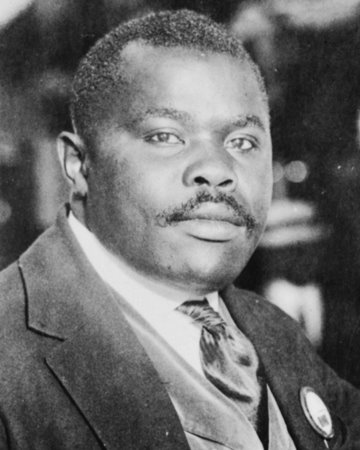
Figure 12.7 : Marcus Garvey
Garvey was able to instill black pride and the term “Black is Beautiful” years before it became a standard refrain in the United States in the hearts and minds of the negro/Black Americans and in others all across the globe. Garvey’s philosophy inspired the Nation of Islam’s philosophy as well as the Black Power Movement in the United States. He died in 1940, once again leaving words, actions, and a pathway others could follow.
The following link is Garvey’s speech on the UNIA.
Marcus Garvey Speaks, Objects of the U.N.I.A, 1921
The Nation of Islam (NOI) in the United States was founded in 1930 in Detroit , Michigan by Wallace D. Fard ( Wali Fard Muhammad). A second center was established shortly after in Chicago by his assistant, Elijah Poole ( Elijah Muhammad).
The NOI and traditional Islam have some similarities and differences; both believe in discipline, obedience, and service, but while traditional Islam teaches that all humans are equal, the NOI adapted several of its principles, spiritual teachings, and philosophy from Marcus Garvey’s UNIA philosophy of racial pride, self- sufficiency and self-reliance, black economic power, and black power.
From the 1950s through the 1960s, Malcolm X, formerly, Malcolm Little, emerged and rose to the position as the second most powerful person in the Nation of Islam, and the principal spokesman of the Nation of Islam and leader of Temple No 7 in Harlem, U.S.A.
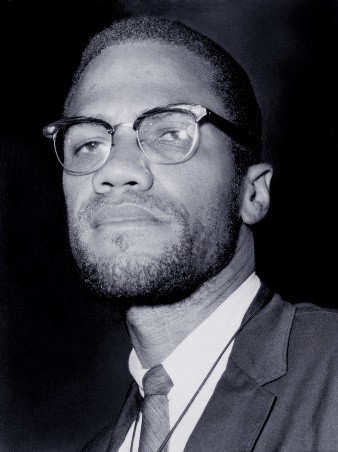
Figure 12.8 : Malcolm X
Malcolm X fearlessly spoke out against the injustices perpetrated against the black man by the white establishment, referring to the white man as the “white devil” for the historical oppression of blacks. He was an excellent orator whose fiery rhetoric incited fear and caused controversy, as he did in this speech on police brutality:
“The House Negro and the Field Negro”, Malcolm X, 1963
In 1963, after Malcolm X’s pilgrimage to Mecca, he was transformed in the way he thought about the white man; he witnessed the brotherhood of Islam and amongst Muslims of all hues, and he returned to the United States shortly thereafter, as he stated, “a complete human being”, he broke with the Nation of Islam and renounced the teachings of The Honorable Elijah Muhammad. He went on to form his own organizations Muslim Mosque Inc. (MMI), a religious organization, and the Organization of Afro-American Unity (OAAU), a secular group.
Although Malcolm X’s views initially differed from Dr. Martin Luther King’s, they were both fighting for the same causes. Even though their approach might have been different, both men wanted to see the negro, collectively, be uplifted to a state of racial justice, equality, and freedom.
Malcolm X was assassinated in 1965 as he spoke at the Audubon Ballroom in New York City.
“This religion recognizes all men as brothers. It accepts all human beings as equals before God, and as equal members in the Human Family of Mankind. I totally reject Elijah Muhammad’s racist philosophy, which he has labeled ‘Islam’ only to fool and misuse gullible people as he fooled and misused me”. Malcolm X
Led by Dr. Martin Luther King, the Civil Rights Movement became a movement for and towards change.
After attending a lecture on the life and teachings of Mahatma Ghandi, Dr. King was so impressed with Ghandi’s philosophy and efforts using non-violent protest, he was convinced that Ghandi had found the answer and the way for an oppressed minority (Black Americans) to struggle against social injustice using non-violent civil disobedience.
After Rosa Parks, a black woman, refused to yield her seat to a white person and she was arrested, the Montgomery Improvement Association (MIA) was formed in response to her arrest and the incendiary attacks on blacks in Montgomery.
A 13, month bus boycott and mass protest was organized and orchestrated by the group, and led by Martin Luther King, black residents refused to ride the buses. Despite death threats and acts of violence, the group continued their efforts, and in 1956, the U.S. Supreme Court ruled segregation on public buses unconstitutional.
In 1963, Dr. King, now President of the Southern Christian Leadership Conference, was arrested and jailed after a Birmingham march in protest of segregation. After police reacted violently to protestors who had marched to the jail, a Civil Rights Act was proposed by President John F. Kennedy.
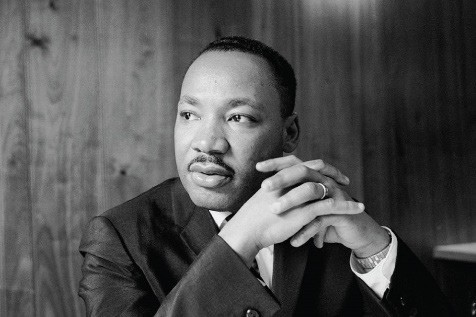
Figure 12.9 : Dr. Martin Luther King Jr.
The excerpt below is from Dr. King’s letter from the Birmingham jail to criticism he had received from six white ministers. In response, King wrote a reflection of what Christianity should be in conjunction with social justice and the social changes he sought.
“In any nonviolent campaign, there are four basic steps: collection of the facts to determine whether injustices are alive, negotiation, self-purification, and direct action. We have gone through all of these steps in Birmingham. There can be no gainsaying of the fact that racial injustice engulfs this community. Birmingham is probably the most thoroughly segregated city in the United States…. There have been more unsolved bombings of Negro homes and churches in Birmingham than in any other city in this nation… the political leaders consistently refused to engage in good-faith negotiation”. Martin Luther King, (August 1963)

Letter from Birmingham Jail, Dr. Martin Luther King Jr.
In June 1963, prominent civil rights activist, Medgar Evers was assassinated, and later that year, in November, President Kennedy was assassinated. Prior to Kennedy’s assassination, Dr. King led a civil rights march on Washington DC; more than a quarter million people turned out in support of change, and it did lead to significant changes in the law.
In 1964, Congress passed the Civil Rights Act, which prohibits discrimination on the basis of race, color, religion, sex, or national origin.
Dr. King’s “Dream Speech”, as it is often referred to, delivered in August of 1963, was instrumental in securing the passage of the Civil Rights Act through Congress, signed into law by U.S. President Lyndon B. Johnson.
On April 3rd 1968, Dr. King gave his final speech in Memphis, Tennessee in support of striking black sanitation workers, almost prophetically predicting his death; he was assassinated the next day, April 4th 1968 at age 39.
..He’s allowed me to go up to the mountain. And I’ve looked over, and I’ve seen the promised land. I may not get there with you. But I want you to know tonight, that we, as a people, will get to the promised land. And so I’m happy tonight. I’m not worried about anything. I’m not fearing any man. Mine eyes have seen the glory of the coming of the Lord!
You may have begun to witness a pattern in laying out the discourse in this chapter; violence and evil which seem to precipitate inspiration for change, still persists to this day. Inspired action takes many forms, and it also inspires others to action as well. It might be a word spoken, a song, or an act that ignites the spirit of inspiration in someone else to move the mantle forward and press on, and so the baton is passed on from one generation, inspiring passion from one generation to another, creating a new generation of thinkers, activists, orators, and leaders, with vision of how to take the movement to the next level. These individuals are already amongst us, and are perhaps already inspiring others who will be paying it forward with positive changes for the past injustices and inequities.
Dr. King posed a question to students at one of his speaking appearances; what’s in your Life’s Blueprint? As college students, public speakers, and future leaders, this is a determining quest and the question you should ponder. Dr. King emphasized three principles:
- “Don’t allow anybody to make you feel that you are nobody”
- “Have the determination to achieve excellence”
- “Have an eternal commitment to the principles of beauty, love, and justice”
Martin Luther King Jr, Greatest Speech Ever, YouTube
In the decade that spanned the 70s, there were protests and speeches against President Nixon, urging his impeachment for his role in the Watergate break-in. The burglary of the Democratic National Committee Watergate complex building, sanctioned and covered up by President Nixon, with it appearing ever more evident of his guilt and that he would be impeached, Nixon subsequently resigned from Presidency in 1974.
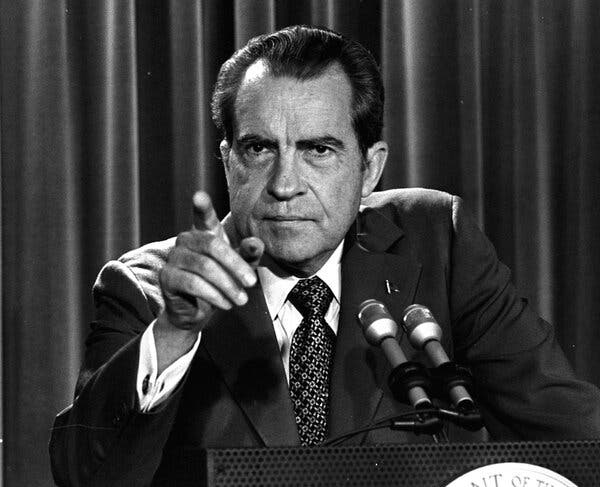
Figure 12.10 : U.S. Pres. Richard M. Nixon announcing his resignation from presidency, August 8, 1974.
In 1973, Roe v Wade became headlines, when the constitutionality of a Texas law prohibiting a woman’s right to have an abortion was challenged.
Jane Roe (a fictional name used to protect the plaintiff) filed a lawsuit against Henry Wade, the DA of Dallas county, Texas, challenging a Texas law which had made abortion illegal except by a doctor’s orders to save a woman’s life. Roe and another married couple filed a suit which argued that the state’s law was unconstitutional and vague, and abridged her right of personal privacy, protected by the first, fourth, fifth ninth and fourteenth Amendments.
The Supreme Court overturned the Texas law by arguing that a woman’s right to choose to have an abortion falls within her right to privacy, protected by the fourteenth amendment, and a state law that broadly prohibits abortion without respect to the stage of pregnancy or other interests violates that right.
In its effort to balance the argument made that a woman have the absolute right in any way and at any time to have an abortion, the court asserted that, since the state have a compelling interest in the health of pregnant women and in the potential life of a fetus, it placed a point at which the state could regulate abortion.
In the first trimester of pregnancy, the state may not regulate the abortion decision; only the pregnant woman and her attending physician can make that decision. In the second trimester, the state may impose regulations on abortion that are reasonably related to maternal health. In the third trimester, once the fetus reaches the point of “viability,” a state may regulate abortions or prohibit them entirely, so long as the laws contain exceptions for cases when abortion is necessary to save the life or health of the mother.
The oral arguments are available and accessible via the link below:

Roe –v- Wade, OYEZ
In 1979, Hip Hop became a response from the voiceless, the almost forgotten underclass living in urban New York City, Bronx. These artists had found a way to express their struggle and the conditions thrusted upon them; conditions not entirely of their own making, but ones they were forced to endure over the years.
Don’t push me, cause I’m close to the edge
I’m trying not to lose my head,
It’s like a jungle sometimes
It makes me wonder how I keep from goin’ under
A child is born with no state of mind
Blind to the ways of mankind
God is smilin’ on you but he’s frownin’ too
Because only God knows what you’ll go through
You’ll grow in the ghetto livin’ second-rate
And your eyes will sing a song called deep hate
The places you play and where you stay
Looks like one great big alleyway….
….Turned stick-up kid, but look what you done did
Got sent up for a eight-year bid
Now your manhood is took and you’re a Maytag
Spend the next two years as a undercover fag
Bein’ used and abused to serve like hell
Til one day, you was found hung dead in the cell
It was plain to see that your life was lost…
Song by Grandmaster Flash and the Furious Five
📝Songwriters: Clifton Nathaniel Chase / Edward G. Fletcher / Melvin Glover / Sylvia Robinson
The Message lyrics © BMG Rights Management, Universal Music Publishing Group

Figure 12.11 : vector/cool-disc-jockey-with-headphone-mixing-music
“The Message”, Grand Master Flash & The Furious Five, official video
Hip Hop emerged as the movement of poetry (rap) stories referred to as MCing/rapping, dance expressions referred to as “Breaking”, writing graffiti stylized art form referred to as tagging, theatre and literature which was a combination of all the Hip Hop elements- drama, poetry, and stories, style or the wear and clothing that represented the culture of Hip Hop, and the emergence of knowledge, especially knowledge of self, morally, spiritually, and socially.
The voices spoke of the social issues plaguing their communities, and the message was in the movement; it forced the powerful to listen and acknowledge, in some cases, for the first time, while being entertained. Once again, those without the means found a way to protest the social and to the political climate engulfing them.
…Got to give us what we want
Gotta give us what we need
Our freedom of speech is freedom or death
We got to fight the powers that be
Lemme hear you say…
…What we need is awareness, we can’t get careless
You say what is this?
My beloved let’s get down to business
Mental self defensive fitness
Don’t rush the show
You gotta go for what you know
Make everybody see, in order to fight the powers that be…
Song by Public Enemy
📝Songwriters: Christopher Jasper / Rudolph Isley / Ernie Isley / Marvin Isley / O’kelly Isley / Ronald Isley / Christopher H Jasper
Fight The Power lyrics © Reach Global Inc., Reach Music Publishing Inc., Songs Of Universal Inc.
Rap has since evolved, and although some of the messages remain focused on hope, respect, love, positivity, and survival, the influx of money into what is now a billion dollar industry has turned hip hop into a rap industry that leans towards glorifying social conflict, disharmony, strife, division, the accumulation of money for money’s sake, sex, and the acquisition of things, which leads some into falsely believing is necessary in order to be validated and respected.
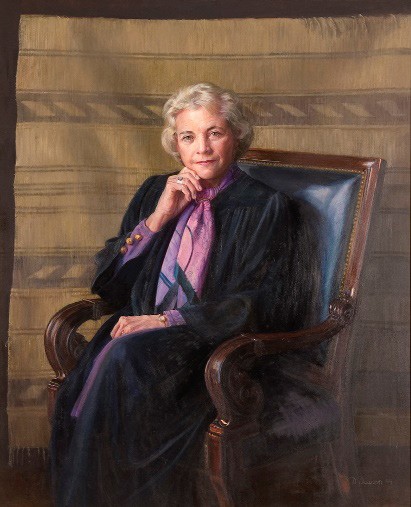
Figure 12.12 : Justice Sandra Day O’Connor by Danni Dawson, Collection of the Supreme Court of the United States
What remains valid is Hip Hop’s ability to send public messages and commentary in unique ways to listeners using prose, poetry, and music, and the audience has responded in dramatic ways, making this form of public speaking, even after over 40 years, a continued force to be reckoned with.
In the decade that spanned 1980s, Sandra Day O’Connor became the first woman to serve on the Supreme Court in 1981. In fact, she was also the first woman to lead a state senate, as well as the first woman to have her name attached to a law school; the Sandra Day O’Connor College of Law at Arizona State University in 2005.
Justice O’Connor has casted the deciding vote affecting many Supreme Court decisions, including cases involving affirmative action, civil rights, personal privacy, voting rights, protection against discrimination, and many more.
After Supreme Court rulings were made which seemed to increase the potential for racial profiling after years of civil rights laws that protected victims of discrimination, Justice O’Connor in a dissenting opinion stated,
“as the recent debate over racial profiling demonstrates all too clearly, a relatively minor traffic infraction may often serve as an excuse for stopping and harassing an individual.”
Justice Day O’Connor on Affirmative Action, “The first American Experience”
In 1989, the Berlin wall fell, marking the end of the physical separation between East and West Berlin, Germany.
In August 1961, the Communist government of the GDR (German Democratic Republic), or East Germany, began building a barbed wire and concrete wall to keep out, as they declared, Westerners from undermining the socialist state the East became a socialist state at the end of World War II, when East Germany went to the Soviet Union and West Germany to the U.S., Great Britain, and France. Berlin was split between the East and West occupational zones, separating families and friends, and thus becoming the focal point and staging of mass defections and many daring escapes by East Berliners to the West.
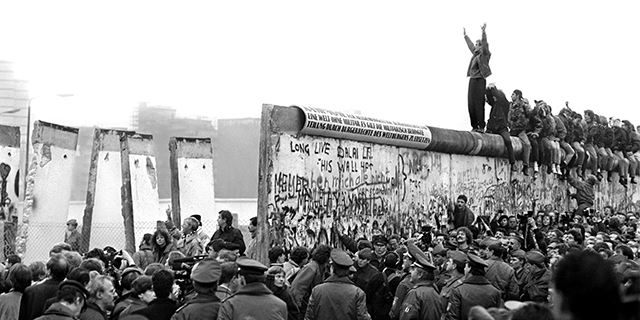
Figure 12.13 : Berlin Wall Falls, Internationalists Stand point.com
President John F Kennedy gave his infamous “Ich bin ein Berliner” speech in 1963 from the Western side of the Berlin wall.
John F. Kennedy, “Ich bin ein Berliner” speech
The 1982 movie, “Nigh Crossing”, attempted to dramatically document the escape attempt of East Berliners to the West, as East Germans desperately looked for ways to flee their imprisonment from restrictive governance. One attempt that caught the imagination of those sympathetic to West Germans’ plight to escape the repressive Government was the famous “Leap to Freedom” photo, which captured the defection of an East German border guard, as he leaped the wall to freedom, into West Berlin.

Leap Into Freedom, 1961, photo, Peter Leibing
The 1990s witnessed a rise in violent protest in the form of domestic terrorism within the United States, with bombings in New York, Oklahoma, Atlanta, and Saudi Arabia, which claimed the lives of hundreds of Americans. There was much talk about scandals within the U.S. Government, but protests took the form of violent actions.
While the Cold War ended and the USSR became insolvent, hot wars brewed in the desert, with the Gulf War between the United States and Iran who had invaded Kuwait. The United States, now the world’s superpower, sent in the military to stop Iran’s annexation of Kuwait.
In 1993, the internet became a public domain communications medium that would change the way we send and receive information and new events, and would become the start of a new way of communicating socially.
There were significant fears and firsts in diversity, equity, inclusion, and equality in the decade that spanned the dawning of Y2K (2000). The major fear was in the anticipated computer glitch expected with the formatting and storing of dates, 1900 (19, stored as 2 digits) to 2000, at the dawn of and during the 2000s (the question of storing one digit, 2), but many programmers had already anticipated the issue and had dealt with it.
Domestic violent protest occurred again this time it was in the form of the September 11th terrorist attacks by plane on the World Trade Center in New York City, the Pentagon in Washington DC, and an airline crash in Pennsylvania. In all, the 911 attacks killed over 3000 people and injured over 6000. It was the first time that level of terroristic violence had occurred within the United States. This act led to the U.S. military invasion of Iraq and the ultimate capture and death in 2006 of Saddam Hussein, Iraq’s 5th President.
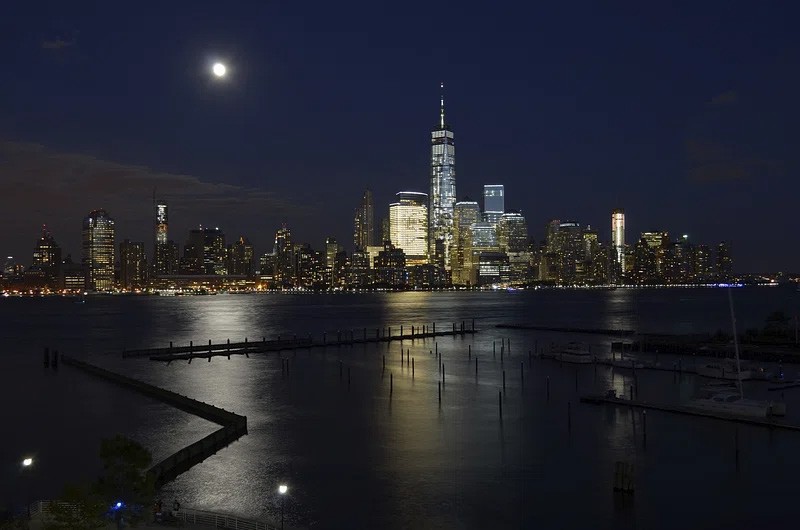
Figure 12.14 :
Protest and violence have always led to change, although not always the changes we expect or wish for, but it has always led to the emergence of leaders and the unmuting of voices.
In 2007, Nancy Pelosi became the 52nd and first female Speaker of the House of Representative. Pelosi, the daughter of a politician, grew up in Baltimore, and after marriage, she and her family moved to San Francisco where she began a Democratic Party Club, while simultaneously raising her 5 children. In 1976, she worked for the Presidential campaign of California’s Governor Jerry Brown and by 1981, was the Democratic Party Chair for the State of California.
Nancy Pelosi, as a member of the House of Representatives from California, championed LGBT rights, the AIDS crisis, and the 1994 assault weapon ban, which are all still very prevalent issues confronting the United States today.
House Speaker, Nancy Pelosi, in the House of Representatives
(Begin at 17:50)
After being named the House Democratic Whip in 2001 (the No. 2 position in the Democratic party leadership), Pelosi ascended to the leadership role when the Democratic Minority leader, Gephardt, stepped down. Nancy Pelosi became the first woman to ever lead a party in congress, and in 2006, the first woman to ever become Speaker of the House. After her ascendency to be the highest ranking legislative official in the U.S. Government, and third in line for the Presidency, Nancy Pelosi declared it a –
“historic moment for the women of America” she also added, “For our daughters and granddaughters, today we have broken the marble ceiling. .
. . Now the sky is the limit. Anything is possible.”
Nancy Pelosi served as speaker from 2007 to 2011 and again from 2019 to 2023.
There was an even more significant first in 2008; Barack Obama became the first African-American to become President of the United States. Many factors, most of which were negative, set the stage for America to select someone different, and the majority of Americans voted for a black President for the first time in its history, but he inherited the worst economic crises in the country since the “Great Depression”.
The Wall Street artificial housing bubble burst and the housing market crisis ramped up with mammoth foreclosures. In response, the stock market plummeted, and major businesses worldwide began losing millions. The economic climate in the country at the time seemed hopeless as banks, airlines, and major businesses began failing,
Once again, crises create leaders and great leaders rise to the situation to bring about positive change. The rescue plans and programs instituted by the Obama administration created a way out of the economic downturn for many businesses, and rescued the economy from certain disaster.
President Obama on 8 years of Economic Progress
Barack Obama did not just arrive on the scene out of nowhere, although some tried to falsely claim that he did, despite the fact that he was an American, born in Hawaii, to a Kenyan father and American mother.
Obama’s rise to prominence within the Democratic Party and in the nation began way before 2009. Five years prior, this gifted orator was one of the keynote speakers at the 2004 DNC convention.
Obama’s introduction speech at DNC convention 2004:
Obama’s 2004 DNC Keynote Speech, YouTube
Upon taking office as President of the United States in 2009, Obama signed the (ARRA)- American Recovery and Reinvestment Act, which helped to ease the tremendous burden and weight imposed on the American economy during the Great Recession of 2008 when he arrived in office. He won the Nobel Peace Prize in 2009 for his work in strengthening international relationships among people through diplomacy and in 2010, Obama was able to successfully navigate political pundits and naysayers to achieve the biggest Health Care Reform in 50 years in the U.S, the ACA (Affordable Care Act), and that same year, signed the “Don’t Ask, Don’t Tell” Repeal Act, which allowed gays, lesbians, and bisexuals to serve openly in the military.
Although it appeared as if the pressure was constantly on and it was just all business, Obama still had time to “let loose” and relax, and revealed that there is a humorous side to the job as well as to his personality during his last White House Correspondents Dinner in 2016.
President Obama, “The Record”, White House Correspondents Dinner 2016, C-SPAN
President Barack Obama never forgot the struggle and work of those who had paid it forward, making it possible for political, social, and economic reformation in America, thereby allowing the possibility for someone such as himself to become President of the United States, so, he paid tribute to Lyndon B. Johnson on the 50th Anniversary of the Civil Rights Act of 1964 , delivering the keynote address at the Civil Rights Symposium.
After 8 years as President of the United States, President Obama achieved many firsts and left a fitting legacy, as well as a road map for those in search of equity, equality, inclusion, and diversification; he did this in acts and deeds, and of course, in speeches.
President Obama at Civil Rights Summit, C-SPAN
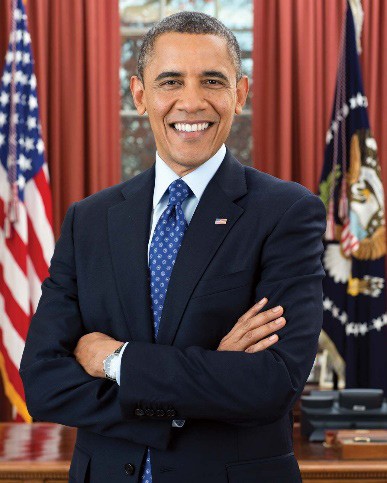
Figure 12.15 : President Barack Obama
President Obama’s Farewell Speech:
President Obama’s Farewell Address to the American People
Dissatisfaction within society abroad and in the United States continued to take many forms of protests-speeches, sit-ins, marches, and the occupation of spaces, including buildings.
In 2011, “Occupy Wall Street” became a movement in protest of social and economic inequality and the influence of money in politics, greed, inequality, and corruption. Thousands of protesters, after being forced out of Zuccotti Park located in lower Manhattan, New York City, in November of 2011, turned to physically occupying banks, social media, college and university campuses, corporate headquarters, board meetings, and foreclosed homes, bringing attention to their message.
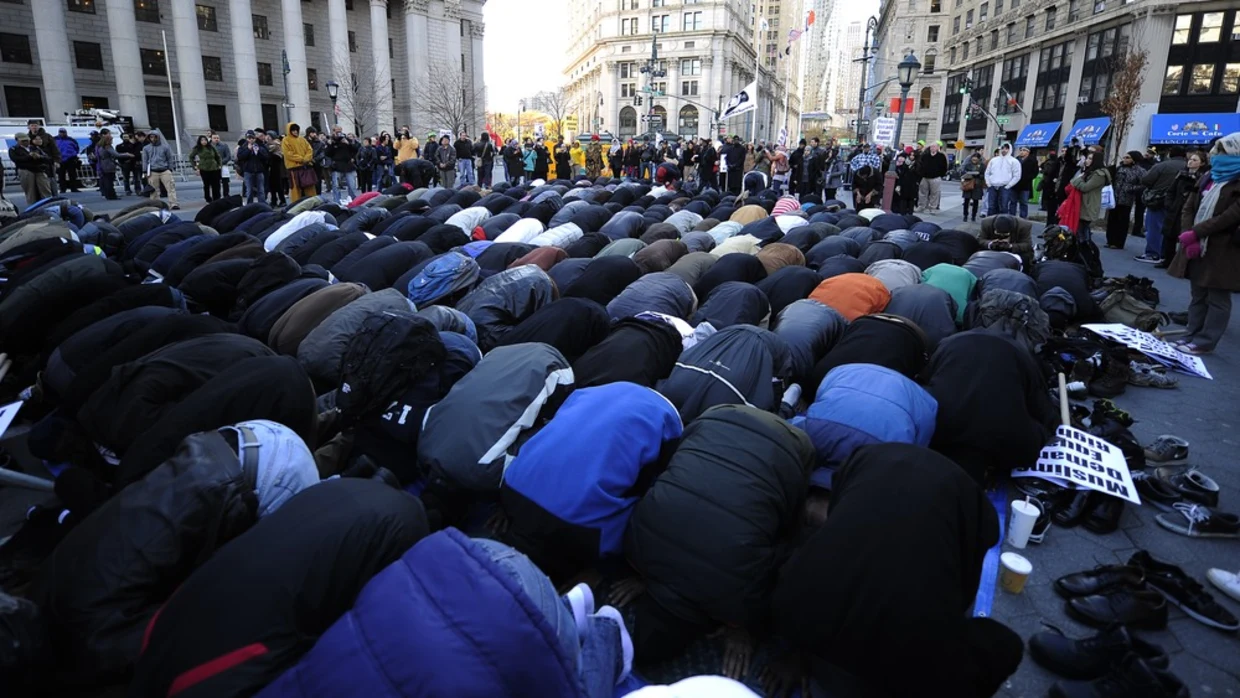
Figure 12.16 : Praying Muslims, media-cldnry.s-nbcnews.com
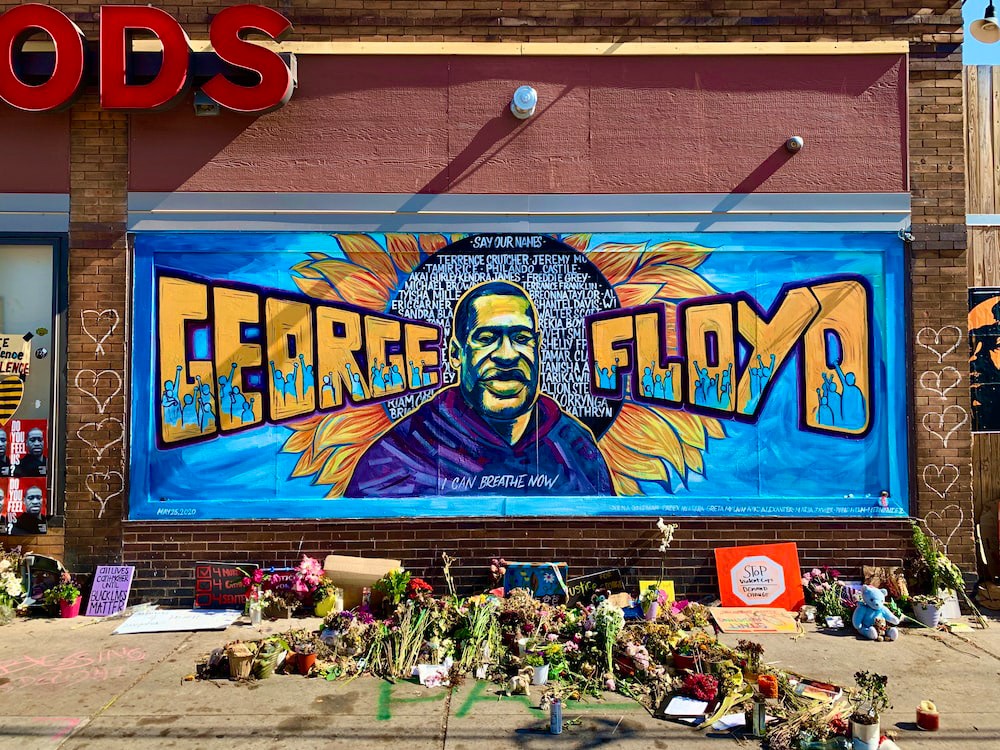
On May 26th 2020, at the beginning of the COVID-19 pandemic, George Floyd, an African American man, was murdered by white police officers in Minneapolis. The callous and reckless disregard for his life displayed by law enforcement officers, as the world witnessed via a videotape of the incident, where for 9 minutes and 29 seconds, Derek Chauvin, one of the police officers, kneeled on the neck of his victim until his life slowly slipped away and as he desperately cried out for help. “I can’t breathe”, Floyd’s last words, became a rallying cry of protesters.
Al Sharpton, civil rights activist and founder of the New York-based National Action Network in 1991, was for decades at the forefront of protests, leading the charge for justice, especially in cases of police brutality, with organized marches and the rallying slogan of “No Justice, No Peace” his organization was once again one of the leading voices fighting for justice for the Floyd family.
The injustice felt reverberated around the world and led to civil unrest and protests by many groups and organizations, highlighted by the Black Lives Matter (BLM) movement, a decentralized, social and political movement which sought to expose discrimination, racial inequality, and racism experienced by black people. BLM was organized around 2015, when an admitted white supremacist, Dylann Roof, murdered nine black parishioners in the Emanuel African Methodist Episcopal Church in Charleston, South Carolina. Roof, a white man, had entered the church with the sole intent to murder black people, and after they had invited him to pray with them, he murdered nine members. He was convicted of a hate crime and sentenced to death, and is currently in prison on death row.
SUMMARY
In this discussion, we learned that the most eloquent speeches were often made by individuals who wished to speak out against injustice and inequality, and after egregious incidents of discrimination and denial of freedom.
The United States of America, a great but flawed nation, was built on and by enslaved blacks, and the injustice these humans suffered led to various forms of protests by those being dehumanized and by others who witnessed the dehumanization.
The early protestors first found a cause or causes they believed in and for which they felt it necessary to lend their support, energy, and voices to; this inspired others to the cause and to speak out. Their messages and actions, in turn, inspired others to further action and acts, and then change happens, and that change becomes the new movement and, in some cases, the new law of the land, as in the amendments to the Constitution.
Protestors utilized various means of airing their grievances and exposing the injustices they were fighting against, or rather, the justice they were fighting for, whether it was police brutality, social injustice, discrimination, disenfranchisement, inequality, or inequity against individuals, groups, social or racial classes, or accommodations. Resistance sometimes emerged in the form of speeches, at other times, marches and civil unrest, and sometimes a combination of both.
Demonstrators would often utilize signage with slogans and messages along with lifting their voices in protest, and as they organized into larger groups and units, some groups used silence and non-violent resistance, while others used more aggressive forms of protest; some of these turned violent, in some cases leading to the destruction of property, injury, or even death, yes, there were people willing to die for what they believe in.
Successful outcome of protest is not achieved singularly; it takes many voices and constant agitation and urging to move the needle of change a mere 0.5 centimeters. Change has always required many voices in unison and consistency, therefore, organizations were important in fermenting the movement for change.
You learned that throughout history, protesters founded and formed organized groups like the Abolitionists Movement, the National Woman Suffrage Association (NWSA), American Woman Suffrage Association (AWSA), the Civil Rights Movement, National Association for the Advancement of Colored People (NAACP), United Negro Improvement Association (UNIA), Southern Christian Leadership Conference (SCLC), National Action Network (NAN), Black Lives Matter (BLM), and numerous others, and as long as there was or is injustice, there is or appears to be a need for leaders, groups, and organizations, lifting their voices in protection of freedom, and in protest of injustice and inequality.
The thread of protest woven throughout this discourse recognizes the importance of inspiration, connections, courage, and unselfishly paying it forward by those who have traveled the path before so that progress continues to be passed on to the next generation of leaders.
The means, you do own and control; it is your voice, body, energy, and courage. The outcome is unknown by those involved in the struggle; hope is what fuels the convictions of the protest and protestors, and action is undoubtedly an integral part of the struggle; without it, there is no hope for change.
DISCUSSION QUESTIONS
- Could you identify a cause for which you felt an urge to lend your support to? Describe how you became involved and the outcome of what you and/ or the group were fighting for.
- Were you ever involved in or witnessed a demonstration that turned raucous or uncivil. Are there ways to avoid these types of situations, and how did you react to a specific situation you may have been caught up in?
- Discuss ways you believe positive changes might be achieved and maintained when confronted with inequity, discrimination, inequality, or injustice.