


Chapter 13: Ethics & Public Speaking
Ethics & Public Speaking
Ethics are principles, rules, or actions that govern the way someone behaves or conducts activities with others. There are ethical guidelines for almost every field of business, including public speaking.
Morals and ethics are oftentimes used interchangeably, and while they are very similar, they are not quite the same.
PART 1
Morals are guidelines that may be subjective, based on individual or societal values and/or beliefs of what is considered right or wrong.
For example, if, during a trial, the defendant’s lawyer tells the court that his/ her client is lying, and is really guilty of the crime that client is being tried for, the defendant’s lawyer might be acting morally because he/she wants justice to be served; however, this is unethical because the lawyer has violated the client-lawyer relationship. Similarly, with a Doctor and their Patient, the doctor is restrained from revealing a patient’s medical report, except in certain special situations; otherwise, the revelation is considered unethical.
Ethics, on the other hand, are principles or guidelines agreed upon by a group, institution, organization, company, association, or even culture that members follow so as to keep in concert with the governing guidelines and principles of that association, organization, company, or group.
For example, during World War II between the U.S. and Japan; the United States dropped 2 atomic bombs on civilian populations in Japan; an immoral act. However, some make the ethical argument that it hastened the end of the war and perhaps saved more lives than a protracted war (which would have lasted much longer) would have.
Therefore, what is moral is not necessarily ethical and what’s ethical may not necessarily be moral.
“Blue Wall of Silence” is a phrase that has been used to describe or denote police officers’ informal code of silence on not to report a colleague’s errors, misconducts, or even crimes, especially when it relates to police brutality in the United States. You immediately witness a conflict between what is ethical and what is moral, and how strongly culture impacts the decision that police officer must make.
In this discourse, the importance of ethics and morals in public speaking will be examined, as well as guidelines for ethical speaking and listening in conflicting situations and circumstances.
On May 25 2020, in Minneapolis, Minnesota, Derek Chauvin, a 44-year-old Minneapolis white police officer, was found guilty of the murder of George Floyd, a 46-year-old black man. According to the Montana Innocent Project, during the trial, the Blue Wall of Silence collapsed.
The Montana Innocent Project, based out of the University of Montana School of Law, and founded in 2008 with a mission to free the innocent and unjustly incarcerated, as well as to advocate for an accurate, accountable, and a fair system of justice for all, discussed how the blue wall of silence “perpetuates racist policing and wrongful convictions”. The Project states that this unofficial agreement between law enforcement not to challenge each other’s misconduct, perpetuates “a cult of masculinity” that enforces deliberate misrepresentation and bias-motivated policing. When officers intervene or do speak out, they are punished, which in turn strengthens the blue wall of silence. Not intervening on witnessing wrongdoing is considered unethical and morally wrong.
Montana Innocent Project 2023:
Blue Wall of silence Collapses, Derek Chauvin Trial
Morality should dictate that individuals “do the right thing”, and ethics provide the guidelines regarding what should follow when someone is confronted with a situation of misconduct, but when neither morality nor ethics is being enforced or adhered to, there is often misrepresentation of justice.
The guilty verdict that was rendered for the former police officer, Chauvin, was in large part due to four factors; medical expert witness testimony, the use-of- force testimony from Chauvin’s fellow officers, the ethics of police conduct in those contexts, and the fact that so many of his fellow officers testified for the prosecutor’s case. They acted morally and ethically.
What may have also played a role was the fact that the world witnessed 9 ½ minutes of a televised murder; public opinion and the moral outrage could add pressure for individuals to do the right thing, However, morals seldom dictate a ruling in a case of law, except, in the George Floyd’s verdict, perhaps the added public pressure did cause jurors to be much more careful in rendering a verdict.
Importance of Ethics.
Trust undergirds all relationships, and the importance of ethics closely relates to the importance of trust in what others say. Public speaking is conversation, therefore, to have a good conversation, trust must be foundational to the discourse. If you are believable, more people will pay attention to your message, and be persuaded to action by your words.
Therefore, establishing trust with your listeners or audience is extremely important and reflects good ethics.
Honesty is being truthful; public speaking’s effectiveness depends on facts and/or credible support for whatever point(s) you wish your audience to believe. If you, as a speaker, intentionally use deception or distortion of the facts, you are not speaking ethically, hence the reason for the requirement of facts as supportive evidence. While nothing is new under the sun, ethical speakers are able to create their own material from existing information, much like musicians crafting thousands of new songs from the same seven (7) notes: andA,B,C,D,E,F,G.
If you borrow from the work of another artist, speaker, performer, or craftsman, you must provide that individual with credited recognition of their contribution to your new creation.
Part of being honest in public speaking is to acknowledge when you don’t know, and to recognize that your biases and conflicts of interest can easily get in the way of the facts when you’re dishonest or deceptive by presenting an opinion as a fact. Aligning your behavior and actions with morally acceptable values allows you to behave ethically.
Reputation of yourself,as you perform public speeches and engage in conversations with others over time, builds, and others begin to witness your character; some of those characteristics others may see are your thoughtfulness, fairness, thoroughness, attention to detail, integrity, and believability. Therefore, when others listen to your speeches or recommend you for a talk, it is based on those favorable characteristics you have demonstrated over time, as well as the belief those individuals have in your ability to deliver quality commentary; don’t disappoint them, live up to your reputation, ethically.
Respect for both yourself and your audience is shown by being ready and present when called upon to speak. When you take what you’re doing seriously, you will spend the necessary time to gather the facts and present them in an organized manner so that your audience, in turn, would derive the full benefit they deserve from your speech. You must, therefore, make sure that your preparation is thorough and your facts are well represented. You are representing yourself and your reputation ethically by respecting your audience as well as yourself.
The quality of the talk you provide to your audience would be reflected in the amount of preparation you have done. If you think of your audience as deserving of the best of what you have to offer, because they are intelligent, knowledgeable, sophisticated, and worthy, then you would have shown your audience full respect by delivering ethical commentary.
Showing your audience respect also means not alienating any member; you must assume that your audience is culturally diverse, and this would include variances in their values and beliefs. Therefore, do not insult, intimidate, or attack your audience, and assume the audience vary in their level of comprehension of your topic and ideas. Therefore, clarity is paramount and courtesy, a must if you wish to engage a courteous audience in return.
Take Responsibility for the words you choose to express your purpose and goal with; this must be weighed carefully, and you must determine whether you are being responsible with the language you have chosen for your message since there are unintended consequences which could ruin your reputation and the lives of others. It could also motivate others to act in dangerous, unethical, and even violent ways. Avoid name calling, demeaning, and insulting language. Taking responsibility for your language is taking responsibility for the consequences of what you say, and that’s being ethical.
Your decision to behave ethically should be guided by your values, conscience, and your sense of right and wrong.
Give Credit – if you take credit for what you have accomplished, you should also give credit to others who have helped you accomplish, and if you have borrowed from others to create your possibility, then what you have borrowed should be acknowledged as a loan, so, return the credit.
Plagiarism is intellectual piracy and an act of dishonesty, where you take someone else’s words or ideas and do not credit them, but you take credit as if it were your words and ideas.
There are various forms of plagiarism; direct/global–if you copy someone else’s entire work word for word, paraphrased–making minor changes in the author’s work and not crediting them, but instead passing it off as your own, patchwork–a combination of direct and paraphrased copying of someone else’s work with no accreditations to the authors/creators, and accidental/incremental–missing, incorrect, poor, or improperly credited work. Even if your intention was to do the right thing, if you don’t, it is also plagiarism.
PART 2
Avoiding Plagiarism
- Track your sources
The easiest way to avoid plagiarism is to track your sources as you do research. You can categorize the sources according to your points, sub-points or topic area. If it’s an essay, thesis, or term paper, you can categorize your sources based on your chapters, topics, or sub-topics, and cite your sources using a consistent citation style.
- Paraphrase and Quote
Become more aware of the difference between a paraphrase and a quote. Quoting a source requires that you accurately restate the content of what was said; the recount must be verbatim. Paraphrasing is retelling in your own words what you understood the speaker to mean by what was said. Try not to mix the two together and always credit a quote to its source.
- Use a Plagiarism Checker
There are several sources you can run your data through to check whether it is plagiarism-free, like Turnitin, Copyleaks, Quetext, Copyscape, Noplag, and Unicheck, to name a few, although there have been complaints that some of these checkers turn out plagiarisms even when the writing is original.
- Create a reference page
A citation page that lists all the sources you’ve referenced would allow you to appropriately credit your sources, thus minimizing the possible accusation of plagiarism. In-text citation would also be a good method of abbreviated source referencing.
Manage clock/time – If you are allotted 20 minutes for a speech, and it takes you 30 minutes, that’s unethical. If you’re a performer and are being paid to do a 1-hour concert and you perform for 30 minutes, that’s also unethical.
Therefore, when rehearsing your speech, use a timer each time you do a run-through, and try to accomplish a timed dress rehearsal prior to the actual presentation.
Monitor your time mentally and use a watch to also help you keep track of the time and where you are in your speech. If you’re going to be longer than the actual scheduled time, warn your audience of this, but you should not be longer than a few minutes.
PART 3
Ethical Principles, Putting it into Practice
The Topic – your choice of topic should be guided by your beliefs. You are usually arguing for or against something if your purpose is to persuade, or you are providing facts, evidence, and instructions if your purpose is to teach, explain, or inform.
Your topic being controversial should not deter you from making that speech. The more important question you should ask is whether your topic is suitable for the audience.
What determines a topic’s suitability for public speaking are the same things that determine if a topic is suitable for general conversation, and that is, appropriateness, interest, and worthiness. You will have to make the speech memorable and focused enough to be accomplished in the allotted time. Think of that particular audience and what you would like them to take away.
If you are being asked to present a speech on a topic you feel uncomfortable with because it conflicts with your moral beliefs or ethics, you are within your rights not to speak on that topic. If the rules are strict, negotiate to be allowed some flexibility in the framing of your argument(s), but as much as possible, remain relevant and on topic.
The Goal/Specific Purpose – the reasons for choosing the topic and presenting the speech should be clear and ethically sound. You should be able to state the goal of your speech in 25 words or less, if you have difficulty in doing so, review and possibly revise your goal so as to ensure its clarity. You may have several main points, but you should have a single and specific goal. Clear goals often lead to clear, measurable outcomes.
There should be no hidden agendas in your purpose. Ask yourself if you would be proud presenting this speech and sharing your motives with the audience.
The Evidence – your sources of support should be directly related, reliable, and relevant to your arguments.
Your visual and/or material support should relate to the topic’s main points or arguments, and audiences should be able to see the connection of your ideas to theirs, while simultaneously seeing the connection of the support to the overall thesis. Therefore, you cannot afford the luxury of being tangential. Let the support tell a story the audience can appreciate and hang on to. The more relatable the evidence is to the audience, the stronger and more appropriate the evidential support will appear to be, but don’t attempt to be relatable simply to appease the audience.
The evidence should also be reliable. You cannot use outdated or erroneous evidence to support your points just because it makes your argument sound better; that evidence might be outdated or skewed because it was either not independently conducted, or the study may have been paid for to produce a favorable result or outcome. Your evidence should be current, within 3 to 5 years. For evidence older than 10 years or more, scrutinize that data carefully, and try to find more updated support.
Cultivate the habit of using multiple independent sources to verify the evidence you have gathered, and find ways to test its reliability. Verify the authenticity of the evidence obtained by determining whether it is believable, and the source(s) trustworthy.
The evidence must be relevant to the topic. Merely showing pictures, slides, statistics, or a video does not mean that support is relevant. Context drives relevancy, therefore, keeping the evidence within the context of the point and overall speech helps to solidify its relevancy.
Words are powerful and can be a dangerous weapon if deliberately used to obscure the truth and paint a misleading portrait of falsehood and deceptions; this would be considered unethical.
In November 2022, George Santos, Republican Congressman from New York, won the seat to represent New York’s 3rd congressional district, which spans from the northern end of Long Island in Nassau county, and includes towns like Levittown, Glen Cove, Roslyn, Manhasset, Plainview, Bethpage, and Port Washington to name a few, to northeast Queens, which includes Astoria and Ditmars, but Santos lied his way to victory.
Santos’s lies and embellishments are classical examples of unethical and immoral speech. He even admitted to being a “terrible liar”. George Santos made false claims about his college degrees, his involvement in the production of a Broadway musical, his resume of working at prestigious Wall Street firms, his multiple real estate holdings, his heritage, college sports stardom claims, and he had irregular and questionable campaign expenditures during his run for office. Santos even lied about his mother’s death.
Representative Santos was recently indicted in New York with 13 counts of wire fraud, money laundering, and theft of public funds, in addition to lying to congress (his case is now before a congressional ethics committee) and illegally receiving unemployment benefits. He has refused to resign, stating that “he did what he had to do to get elected”.
A Congressional Research Service newsletter (IN FOCUS, August 2022) has weighed in on Federal and state legislators’ interest in regulating misinformation and disinformation, which is protected by the First Amendment. However, limited subcategories like defamation, fraud, political advertisements, and broadcast speech, legislators feel, could possibly be restricted without violating the First Amendment rights.
The Supreme Court has recognized that while false statements may not add much value to ideas within the sphere of speech, the concern is that if false speech or even the misrepresentation of facts (this has some constitutional protection) is curtailed, it would also negatively impact valuable speech. The First Amendment broadly protects false speech.
As far as campaign speeches are concerned, there are several federal laws relating to truthfulness in elections; they prohibit false statements relating to voting eligibility, knowingly procuring materially false ballots, and fraudulently misrepresenting a Federal political candidate.
The Federal Election Campaign Act (FECA) requires a disclaimer on certain political campaign Ads, requiring them to disclose funding & authorizing sources.
Elected officials and other representatives are aware that there are ethical guidelines governing behavior and communication during campaigns, yet, some still attempt to straddle the line between what is ethical and what is not.

Figure 13.1 :
George Santos was able to escape scrutiny in his unethical, fraudulent political bid to a congressional seat because of one party’s failure to uncover and expose Santos’s lies, and another party’s indifference and failure to act ethically and enforce truthfulness over party politics. Yet, a third reason could have been failure of ethical listening, which will be explored in the next few paragraphs. In either case, Mr. Santos most likely broke campaign finance laws, and if found guilty, would have to pay the price politically and legally.
Someone facing the problems and issues faced by George Santos would need to undergo major changes so as to repair an image damaged by unethical behavior if they ever hope to regain some semblance of personal dignity.
The first step is to not double down on the lies. Damage has already been done to George Santos’s political career, and he’s been exposed as being unethical, even admitting to being a “terrible liar”.
If you are going to apologize, your apology must be sincere; it should not be done because you were caught lying. Own the behavior, with the use of “I” statements to claim it. On its face, it at least shows remorse.
After the apology, the right thing to do would be to step, aside and resign so that the cloud overhanging your political and social life can be lifted, and your constituents could be provided an opportunity to be represented ethically.
Almost equally as important to ethical speech is ethical listening.
PART 4
Ethical listening
“But I want to say one thing to the American people. I want you to listen to me. I’m going to say this again: I did not have sexual relations with that woman, Miss Lewinsky. I never told anybody to lie, not a single time; never. These allegations are false. And I need to go back to work for the American people. Thank you”. – President Bill Clinton 1998
It turns out, as history unfolded, that President Clinton was being unethical and he had lied to the American people.
As a listener, one of the first questions you should ask yourself is, what is my responsibility to the speaker and why am I here in this classroom, at this event, with my television on, listening to the speech? Your answer is, hopefully, because you wish to hear what the speaker has to share.
Ethical listening involves surface and depth listening, listening for total meaning. In order to achieve this, you must be totally involved in the process, which involves several steps. The first step is a physical one, Hear; it requires that you use your physical attributes to achieve this step – your ears to hear, and your body to configure your mind into the listening mode. Ethical listeners are invested in the process, so they show the speaker respect by paying attention.
The next step is to eliminate distracting impediments (some are physiological, others psychological). The physical environmental conditions should be suitable to the listening process; select an area of reduced noise, clutter-free, and the space should be a comfortable temperature and well lit based on the speech being delivered, and if you’re in control of the physical context, it should be free of other distracting images.
Your physical demeanor should indicate that you are ready to listen ethically; assume the listening posture, which means, sit upright, maintain eye contact with the speaker, take notes if possible, and avoid personal distracting mannerisms, while simultaneously trying not to focus on the speaker’s mannerisms.
Psychological distractions are a bit harder to overcome because these are mostly internal, such as your thoughts becoming a distraction to you (referred to as semantic noise). You may find yourself pre-judging the speaker; this effectively stops the ethical listening process, because you jump to conclusions without paying close attention to the content of the speech, where the evidence and facts reside.
Be open-minded in your ethical approach to listening; whether it is listening to a friend, family member, or to a speaker, your mind should not be already made up (this is close-mindedness), and you should not judge the speaker by his/her voice tone before giving yourself an opportunity to examine the speech content, regardless of whether the topic or argument is one you disagree with.
Provide meaningful feedback; a nod, smile, or question asked provides the speaker with invaluable feedback and generally indicates to the speaker that you were listening ethically. You can be honest about your feelings on what you’ve listened to, especially if you disagree with the speaker, while at the same time, you can be respectful of the speaker’s position, and as an ethical listener, your response should indicate this point.
Offer specific, reasonable explanations for or against; whether your opinion is positive or negative, being ethical is offering an explanation to the speaker about why you felt the way you did regarding the speech, and be as specific as possible on how the speaker can improve, or give specifics about the speech that made it interesting or likeable to you.
There are serious consequences for unethical behavior. You read George Santos’ story, but there are many other cases, like Harvey Weinstein’s. CEO of The Weinstein Company, Weinstein, was fired in 2017 for sexual assault and misconduct amidst numerous complaints from women accusing him of sexual harassment and misconduct.
Weinstein’s story pushed the #Me Too Movement (founded in 2006 by Tarana Burke) to prominence in 2017, where women, who were once afraid to speak up, were coming forward in large numbers to assert their power and rights.
Burke’s Just Be Inc. was established in Alabama to build and develop self- esteem in young women, and she used the words “Me Too” in a discussion of the prevalence of sexual assault and sexual assault survival in black and brown women. The organization has grown to include supporting all survivors of all races and ages, providing a platform and a voice, and encouraging them to speak up and speak out in the fight to end sexual violence.
Women became less afraid to speak up about sexual harassment in the workplace and in general, and the #Me Too Movement became national headlines when in 2017, actress Alyssa Milano, in a tweet, urged victims of sexual assault to share their stories via social media, and they did.
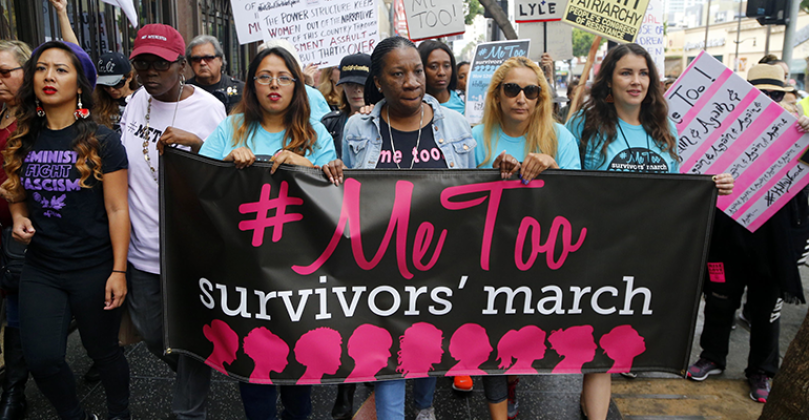
Figure 13.2 : Me Too, Survivors March
Prominent Executives who were forced to resign or fired included: Brian Krzanich, CEO of Intel, in 2018, for a sexual affair; Bill O’Reilly, terminated in 2017 from Fox News, accused of sexual harassment; Roger Ailes, CEO of Fox News, forced out in 2016, after being accused of sexual harassment; Matt Lauer, NBC morning news anchor, fired in 2017 after being accused of sexual misconduct; CBS Chairman, Les Moonves, fired in 2018, after accusations of sexual misconduct, and Charlie Rose, fired in 2017 from PBS and CBS for sexual harassment.
There were many other Executives dismissed for other forms of ethical breaches, so unethical behavior did not only occur in areas of sex. Richard Smith, CEO of Equifax, was fired in 2017, when under his watch, millions of Americans had their credit data stolen, and Dennis Muilenburg, CEO of Boeing 747, was let go in 2019, after refusing to admit that the 737 Max aircraft had a design flaw, which may have caused two crashes that killed 346 people.
The consequences of unethical behavior, as you can see from the examples cited, could affect your reputation, cost you your job, affect morale and credibility, and could be financially burdensome both to the organization and for the individual.

Figure 13.3
PART 5
SUMMARY
From the discourse on Ethics in public speaking, you learned the difference between ethics and morals.
Morals are guidelines that may be subjective, based on individual or societal values and/or beliefs of what is considered right or wrong.
Ethics are principles or guidelines agreed upon by a group, institution, organization, company, association, or even culture that members follow.
George Floyd’s murder was an example of ethics and morality eventually coming together to collapse the “blue wall of silence”, a code of silence usually exhibited by police officers traditionally not speaking up or reporting on a colleague’s misconduct, errors, or even crimes.
Importance of Ethics
Ethics are important in establishing trust with your listeners since trust is extremely important in convincing audiences of your point of view.
Your credibility rests on you being truthful; ethical speakers try to be honest in telling their story by providing credible supportive evidence. Aligning your behavior and actions with morally acceptable values builds your reputation and gives others confidence in your ability to deliver quality commentary and factual evidence.
Treating your audience and yourself with respect is shown by you being ready and present when called upon to speak; this means spending the necessary time to gather the facts and present them in an organized manner so that your audience, in turn, would derive the full benefit they deserve from your speech. Showing your audience respect also means not alienating any member by being discourteous, intimidating, or insulting.
Your ethical responsibility to your listeners is in the words you choose to express your purpose and goal. Determine whether you are being responsible with the language you have chosen for your message; it could motivate some to achieve greatness and others to act in dangerous, unethical, and even violent ways.
Take credit and be proud of your accomplishments. However, you should also credit others who have helped you accomplish, so if you have borrowed from others to create your possibility, then what you have borrowed should be acknowledged as a loan; credit those individuals, and in doing so, you avoid plagiarism.
The various forms of plagiarism are: direct/global plagiarism which is copying someone else’s entire work, paraphrased plagiarism which is making minor changes in the author’s work and not crediting them, patchwork plagiarism which is a combination of direct and paraphrased copying of someone else’s work with no credit to the authors/creators, and accidental/incremental plagiarism which is missing, incorrect, or improperly credited work.
To Avoid Plagiarism – Track your sources as you research, Paraphrase and Quote when you cite sources , use a Plagiarism Checker, and/or Create a reference page.
Ethical Speaking
The best ethical practice when speaking is to become familiar with your speech. Make sure all parts of it are ethically sound, beginning with the topic, the goal/purpose, the thesis, main points, and the evidence; your preparation should demonstrate respect for yourself and for your audience.
Ethical Listening is just as important as ethical speaking; use surface and depth listening in order to hear the speaker, be open-minded in your ethical approach to listening, provide meaningful feedback, and Offer specific, reasonable explanations for or against the speaker’s ideas.
There are serious consequences for unethical behavior, whether it’s in the area of politics, sexual assault, harassment or misconduct, or in general business practices. Being unethical may cost you your job, affect your reputation, morale and credibility, and become financially draining and devastating if you find yourself in a court of law as a defendant for intentionally or unintentionally causing injury to someone else by your unethical or illegal behavior.
DISCUSSION QUESTIONS
- Discuss a situation in which you acted unethically but, at the time did not realize that your behavior was unethical. What would you have done differently?
- Can you recall an incident involving plagiarism, not necessarily being committed by you? What type of plagiarism was being exhibited, and what was the consequence of the behavior, if any?
- Do you have a “Me Too” story you’d like to share, or do you personally know someone who has, or shared a ”Me Too” story? Describe what that was like to share the experience or to hear that story being told.