


Chapter 08: Markets for Agricultural Commodities: Production subject to marketing orders
Markets for Agricultural Commodities: Production subject to marketing orders
“If we will not endure a king as a political power, we should not endure a king over the production, transportation, and sale of any of the necessaries of life.”
Senator John Sherman
With the advent of industrial agriculture, there was a mismatch between buyers and farmers. Buyers tend to be large and fewer in number and farmers relatively small and numerous. The result was a mismatch in bargaining power between buyers and sellers. Farmers sought to remedy this through voluntary marketing agreements that allowed them to negotiate as a single entity. The goal was to be able to match the bargaining power of buyers of agricultural products.
There were several pediments to the success of these efforts by farmers. First, if an insufficient number of farmers sought to join the marketing agreement, it would not be of sufficient size to counter buyer market power. The second was the free rider problem. A farmer could elect not to join the marketing agreement and thereby take advantage of the marketing agreement by selling at a slightly lower price than the farmers in the marketing agreement. The free rider could thereby obtain most of the benefits of the marketing agreement without its costs. The third problem was a legal problem. That was the 1890 Sherman Act [July 2, 1890, ch. 647, 26 Stat. 209.].
The Sherman Act was named for Senator John Sherman of Ohio. Sen. Sherman was a 19th century Progressive and the younger brother of General William Tecumseh Sherman, the Civil War general most noted for burning Atlanta and thereafter a swath of land 60 miles wide all the way to Savannah. The Sherman Act prohibited trusts. A trust is a combination of businesses that act for marketing purposes as a single entity. The purpose of doing so is to enable owners of the businesses to extract monopoly profits. The Sherman Act made such efforts illegal and imposed criminal penalties on those that attempted to collude to obtain monopoly profits.
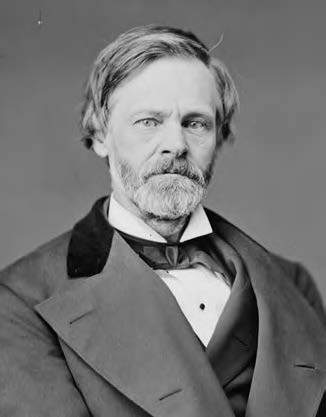
Figure 8.1 : Senator John Sherman
The Sherman Act criminalized farmer marketing agreements. Farmer marketing agreements were not the intended target of the Sherman Act. After much debate and some previous legislative “If we will not endure a king as a political power, we should not endure a king over the production, transportation, and sale of any of the necessaries of life.” Senator John Sherman attempts to correct this problem, Congress passed the 1922 Capper-Volstead Act [Feb. 18, 1922, ch. 57, § 1, 42 Stat. 388.] that allowed “farmers, planters, ranchmen, dairymen, nut or fruit growers [to] act together in associations … in collectively processing, preparing for market, handling, and marketing in interstate and foreign commerce …”
Example 8.1. The bailed hay producers of the Orange Valley formed a farmer cooperative through which they marketed their hay. One of the farmers that sold mostly in the north end of the Orange Valley did not join the cooperative. The cooperative sold below the cost of production in that farmer’s sales area but not elsewhere in an effort to force the farmer to join the cooperative. The farmer sued the cooperative and the farmer members individually for injunctive and monetary relief, alleging a prohibited anticompetitive practice. The farmer won because price suppression is not an anticompetitive practice that is exempt from antitrust laws under the Capper-Volstead Act.
What remained was to address the free rider problem. This effort began with various pieces of legislation in 1933 that were consolidated and enacted as the Agricultural Marketing Agreement Act of 1937 [June 3, 1937, ch. 296, 50 Stat. 246.] (here in after, the AMAA). Congress declared that the purpose of the AMAA is to avoid the disruption of the orderly exchanges of agricultural entities in interstate commerce. The harms that Congress listed that result from the failure exchanges include impairment of the purchasing power of farmers, destruction of the value of agricultural assets, and damage to the credit structure that supports agriculture.
The AMAA gives the Secretary of Agriculture the authority to compel all producers of the commodity within a geographic area to comply with a marketing agreement. This eliminates the free rider problem. For an order to be enforceable, all producers of that commodity within covered geographic area must approve the order by a supermajority all the affected producers.
MILK
The market structure for fluid milk is like no other and is undoubtedly the most complicated market structure in the agricultural product. It has been said that only five people understand how milk prices are set and four of them are dead. There are at least half a dozen federal agencies that have a role in the market structure for fluid milk and its products. Each of these federal agencies has agency-specific authorizing legislation for their respective programs. Typically, Congress has made no provision for coordination of these programs between agencies. These agencies can be thought of as a dysfunctional orchestra where every musician is playing from sheet music for a different symphony. Personnel in these various agencies seldom even talk with each other. States and even local governments may play an important role in the structure of local milk markets. For example, the market for raw milk is almost entirely determined by state governments.
Figure 8.2 :
This chapter will not attempt to be comprehensive. It focuses almost entirely on the federal role in the following areas: marketing orders; income support through either price support, direct income support or both; risk reduction; and market expansion.
Marketing orders
A Federal Milk Marketing Order (FMMO) is established under regulations developed by the USDA Agricultural Marketing Service (AMS). Establishment or amendment of an FMMO is initiated by petition to the Secretary of Agriculture. The petition may be made by either dairy farmers or their dairy farmer cooperative association. Public hearings and a referendum must be held for an FMMO to be approved. USDA is required to make formal notice of the public hearing by publishing the notice in the Federal Register. Voting is either by individual dairy farmers or through block voting by their dairy farmer cooperative association. At least two-thirds of the dairy farmers (either individually or through their dairy farmer cooperative) must vote to approve for the FMMO to be established.
To summarize, the procedure for either adoption or amendment following receipt of a petition, USDA AMS must conduct a preliminary investigation. USDA then conducts a public hearing to allow dairy producers, milk handlers, and consumers to testify. USDA then prepares a recommended decision upon which it takes comments from interested parties. It then issues a final decision. Producers then vote on the final decision and USDA issues a final order. Once the FMMO is final it is legally binding upon all handlers or processors that dispose of (by processing or delivery) fluid milk in the geographic area covered by the FMMO. It is the point of disposal not the point of production that determines which FMMO applies. These marketing agreements are expressly exempt from antitrust laws when farmers are operating through a qualified farmerowned cooperative.
Example 8.2. The American Farm Bureau Federation has recently proposed certain changes to federal milk marketing orders. It has not petitioned the AMS to make these changes because it is a farmer advocacy organization. The AMAA allows only dairy farmers or milk handlers to file a petition. The Farm Bureau is hoping to circumvent this by lobbying Congress to make legislative changes to the AMAA that would require AMS to amend existing marketing orders.
There are two grades of milk, Grade A, which may be subject to a FMMO, and Grade B, which is not. Grade A milk is suitable for fluid consumption. Grade B milk suitable only for manufacturing into products such as butter and cheese. The health and sanitation standards applicable to Grade A milk are higher than for Grade B milk. The amount of Grade B milk produced has steadily declined to the point that less than 1% of all US milk production is Grade B.
Grade A milk is categorized for classifications based upon the use of the milk. The four classifications are as follows:
- Class I: fluid milk used for whole, low-fat, and skim milk, flavored milk, eggnog, and buttermilk;
- Class II: milk used for soft products such as cottage cheese, yogurt, cream, and ice cream;
- Class III: milk used for hard cheeses and cream cheese; and
- Class IV: milk used for butter and dry products, primarily nonfat dry milk.
Under the Federal Milk Marketing Order (FFMO) system, milk prices are based upon the use class above. Typically, class I milk receives the highest price. USDA determines the minimum price for each class based upon milk components that include butterfat, protein, nonfat solids, and other solids. It should be noted that different marketing orders use somewhat different formulae for calculating class prices. Rather than using component pricing, some orders base pricing upon skim milk and butterfat content. There are also transportation differentials that reflect the cost of transportation between milk surplus areas and milk deficit areas. Milk pricing is a complicated topic that few dairy farmers understand fully.
Farmers receive a uniform pool price. Prices are based on the weighted average of the class composition in the month for which the farmers are being paid. There is a Producer-Settlement- Fund (PSF) into which milk handlers either pay money or take money out depending on the class composition of the milk that they purchased.
Example 8.3. Bottling plants that purchased class I milk pay money into the fund whereas cheese processing plants take money out of the find to reflect that the milk they purchased was class III milk.
The key to making all of this happen is the Federal Milk Market Administrator (Market Administrator). When an FMMO is established, the Secretary of Agricultural appoints a Market Administrator for the FMMO. This is the responsibility of the USDA Agricultural Marketing Service (AMS) with the Secretary having ultimate authority. The Market Administrator for each FMMO establishes an office and hires staff to perform statutorily required duties. The costs of the Market Administrator’s operations are paid from fees that the Market Administrator collects from milk handlers. Assessment rates are no more than $0.05 per hundredweight (cwt.) of milk. The Market Administrator calculates the minimum price for each class of milk; collects reports from handlers on the quantity of milk received and the products made from that milk; verifies the accuracy of handler reports and the payments made to producers; and reports market information. The AMS publishes market information to benefit handlers, producers, and others with an interest in milk and milk product markets. Market Administrators have other duties that will be discussed below under price support.
There are three types of handlers. The first type receives, processes, and distributes fluid milk. The second type of handler includes all of those that manufacture dairy products. The third type is farmer-owned dairy cooperatives that either process fluid milk or manufacture dairy products. Unlike the first two categories of handlers that must pay the minimum prices set by USDA, the third category is not required to pay those minimum prices. The prices that dairy cooperatives pay are determined by their agreements with their members. Not all dairy cooperatives are handlers. Some serve as conduits between the farmer and handler. The role of such cooperatives is that of a collective bargaining agent for its member dairy farmers.
The pricing of milk is dependent on the most complicated pricing systems used in agriculture. The marketing order system is not a price support system, nor does it guarantee that all available milk will be sold. As happened during the covid lockdown, surplus milk is occasionally dumped for lack of buyers. It is a system that allows for collective bargaining by dairy farmers with processors. Through collective bargaining, farmers may receive a higher price depending upon market conditions. The primary role of milk marketing orders is to ensure orderly marketing of a highly perishable commodity. The collective bargaining is done by farmer owned cooperatives. Cooperatives, ideally, are expected to operate at cost with any excess earnings remitted to the farmer owners. The federal government does provide price and income support to dairy farmers. This will be discussed in the second half of this chapter. The pricing of milk is extremely complicated. This chapter will not attempt to explain all the nuances of the milk pricing system throughout the United States.
There are now 11 Federal marketing orders covering dairy. The following figure shows geographic areas covered by each of these marketing orders.
California dairy producers voted to establish an FMMO in 2018. Over 80% of the US milk supply is now covered by FMMOs. Areas not covered are either under state marketing orders or have no marketing agreement. Alaska and Hawaii have no federal orders.
There is a complex system for transferring milk between FMMOs. The purpose of this is to allow the transfer of milk from surplus areas to deficit areas. The minimum price that producers receive is based upon where the milk is used not where it is produced. It is therefore advantageous for producers in surplus areas to have their milk used in deficit areas where the minimum price is higher. The price differential between surplus areas and deficit areas has created incentives for ‘gaming’ the system. It is possible to create transactions that, albeit not in violation of the law, increase the minimum price received but which do not reflect the actual flow of milk between regions.
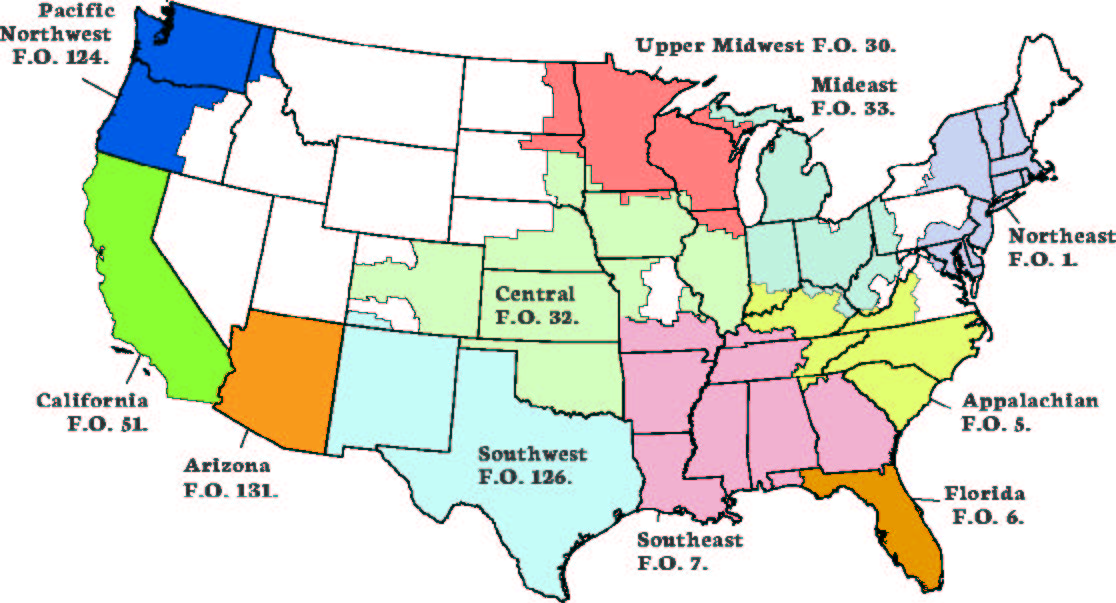
Figure 8.3 : Geographic Coverage of the Federal Milk Marketing Order (FFMO) system
Source: USDA, Agricultural Marketing Service (AMS). Map is available at https://www.ams.usda.gov/sites/default/files/ media/Federal%20Milk%20Marketing%20Orders%20Map.pdf.
Organic milk producers have expressed dissatisfaction with the FMMO system. Most organic milk is marketed under long-term contracts with handlers. Handlers of organic milk typically pay well above the class I price. Handlers of conventional milk are not set up to handle organic milk and cannot substitute conventional milk in the event of a shortage of organic milk. The Organic Trade Association (OTA) estimates that about 65% of all organic milk is class I. FMMO statistics suggest that organic milk represents about 6.5% of all class I milk. Handlers of organic milk pay into FMMOs but receive no proportionate benefit. In 2015 the OTA submitted a proposal to USDA requesting a hearing on amending the rules under which FMMOs treat certified organic milk. The OTA proposal was that organic milk handlers receive a producer-settlement fund credit. The National Milk Producers Federation (NMPF) and 10 milk producer cooperatives opposed the OTA proposal in their comments to USDA. Their objection was that the OTA proposal would exempt organic milk handlers from revenue sharing without guaranteeing producers share of the savings to the handlers. The OTA drew its petition on January 12, 2017. The OTA has continued to express concerns but has not resubmitted its petition.
The dairy farmer cooperatives that form an integral part of the FMMO system have merged. Most dairy farmer cooperatives have become large organizations serving diverse groups of dairy farmers. Despite theoretically being owners of the dairy farmer cooperatives, some dairy farmers have felt that the dairy farmer cooperatives have poorly served them.
On July 29, 2022, a group of dairy farmers filed a lawsuit in federal district court against their dairy farmer cooperative, Dairy Farmers of America (DFA), Inc. Vermont dairy farmers have requested class action status. The suit alleges anticompetitive activity on the part of the defendant, Dairy Farmers of America. Specifically, the suit alleges that by expanding into dairy processing, DFA created a conflict of interest with its core function of serving to facilitate farmer members with collective bargaining with dairy processors. The complaint further alleges that DFA has engaged in a series of mergers for the purpose of monopolizing the processing market in the Northeast. Thus, according to the complaint, FFA has asserted control over members and nonmembers alike.
Since it is a common practice for dairy farmer cooperatives to engage in processing, this lawsuit has the potential to modify the market for fluid milk. If the plaintiffs prevail, dairy farmer cooperatives will either have to modify their approach to milk processing or exit the milk processing business.
Dairy farmer cooperatives that are also processors have an inherent advantage over the other two types of processors because dairy farmer cooperatives do not have to pay the minimum pool price. It is possible that this lawsuit may push Congress to modify the legislation upon which the FMMO system is based.
Price and income support
Much of the dairy price support legislation was created by temporary legislation under the 2018 Farm Bill. Farm bills are primarily temporary legislation that typically lasts for five years. There is a great deal instability in the structure of price and income support for dairy farmers. Historically price support has been indirect through federal purchases of dairy products. These products have typically been cheddar cheese, nonfat dry milk, and butter.
There has been a movement in the last two farm bills away from purchases of dairy products and toward income support for dairy farmers. Purchases of dairy products ignores the cost of inputs and therefore does not necessarily keep dairy farmers in business by supporting their incomes. Moreover, commodity operations are expensive with expenses going well beyond the cost of acquisition of dairy products. Costs include transport, storage, and disposition required dairy products.
Typically, disposition is been accomplished by providing these dairy products to indigent consumers, both domestically and abroad.
Dairy Margin Coverage (DMC)
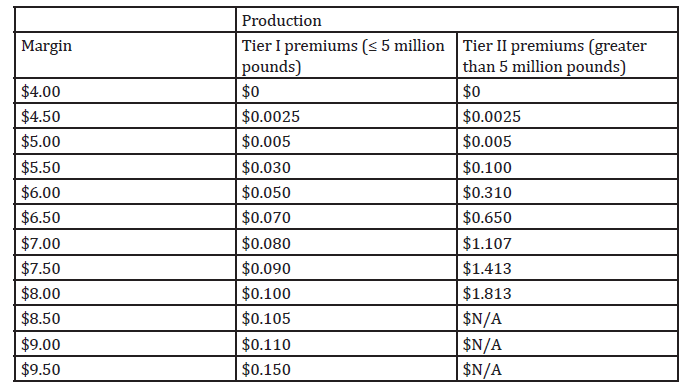
Table 8.1: DMC Premium Rates
The 2018 Farm Bill (P.L. 115-334) created the Dairy Margin Coverage (DMC) program. The DMC replaced the Margin Protection Program (MPP) that was created by the 2014 Farm Bill as well as additional legislation. The DCM is a federally subsidized insurance program that provides protection for dairy farm incomes. Margin is defined as the difference between the US Department of Agriculture national all milk price and a calculated feed cost. Note that only the dairy farmer’s feed cost is included in this calculation. The US Department of Agriculture national all milk price is a national composite price so that the actual amount of margin protected for individual dairy farmers varies from farm to farm and geographic region to geographic region. To qualify for DMC payments, the farmer must be a US citizen or permanent resident of the United States. If that is not met there is an exception for individuals that make a substantial contribution of active personal labor, capital, and land to the farming operation. Entities that are more than 10% foreign owned are generally ineligible to receive DMC payments. Coverage under an FMMO is not required for eligibility in the DMC. Dairy farms subject to state marketing orders or no marketing order are all eligible if all the above eligibility requirements are met.
For Tier I production dairy farmers may select margin coverage ranging from $4 per cwt. to $9.50 per cwt. Tier I is 5 million pounds or less. Tier II, production of over 5 million pounds is limited to a margin of $8 per cwt. There is no charge for the dairy farmer margin coverage at the $4 per cwt. level. Table 8.1 lists premium rates.
To participate, a dairy farmer must have established a production history for the covered farm and pay the $100.00 annual administrative fee to participate in the program. Production history is sometimes called milk base. Production history is generally based upon the highest milk marketings in 2011, 2012, and 2013. Any marketings above historic production is not eligible for DMC payments unless the dairy qualified for the Supplemental Dairy Margin Coverage. Under the Consolidated Appropriations Act of 2021 (P.L. 116-260), certain small dairies were allowed to use actual 2019 milk sales to receive payments on 75% of the difference between 2019 actual sales and historic sales volume.
Dairy farms eligible for the Supplemental Dairy Margin Coverage were required to have been enrolled in the DMC for 2021 and have actual milk marketings of 5 million pounds or less. These producers may obtain additional coverage for 2021 through 2023 by paying the additional Tier I premium.
Risk reduction
Risks that dairy farmers face can broadly be divided into market risks and physical risks. Market risks include both price risk and inability to get a perishable product to market in a timely fashion. Price risk is much more common than the complete lack of a market. Price risk is the risk that the price received for milk will be less than some anticipated price or price range. Less common is the situation where there is some event that causes no market at all to exist for fluid milk.
Example 8.4. During the Covid lockdown many dairy farmers had to dump milk . With restaurants, hotels, schools, and other institutions closed, the demand for milk dropped dramatically. Since cows must be milked at least twice per day in order to maintain cow health and future production potential, farmers cannot simply stop milking because there is no market. The milk must be collected and then dumped.
Dairy farmers also face physical risks such as chemical contamination of milk. In addition to the programs discussed below, Congress often passes ad hoc disaster relief legislation in the wake of major disasters.
Dairy Revenue Protection (Dairy-RP) Program
The Dairy Revenue Protection (Dairy-RP) Program is government-subsidized insurance that provides protection against unexpected declines in quarterly revenue. It allows dairy farmers to purchase protection against unexpected changes in the price of milk. It does not cover death of dairy cattle or other physical damage. The USDA Risk Management Agency (RMA) manages the Dairy-RP Program. Farmers may purchase this insurance from authorized crop insurance agents. Premiums are due in the month after the quarter covered by the insurance.
Two pricing options for revenue are available. The first is the Class Pricing Option that uses a blend of Class III and Class IV milk prices to determine coverage levels. The second option is the component pricing option that is based upon butterfat, protein and other solids.
At any given time, sales may be open for as many as 5 quarters. Those quarters farther in the future may not be open if USDA lacks adequate market information. Insurance is available for a particular quarter if coverage prices and rates are published on the RMA website by 4:30 PM Central time. The availability of that insurance ends at 9:00 AM the next day. Coverage prices and rates change every business day. Should no information about a particular quarter be published on the RMA website by 4:30 PM, it means that insurance for that quarter cannot be purchased during that period. On the days that the monthly USDA Milk Production, Dairy Products, and Cold Storage reports are released, no Dairy-RP is sold. No Dairy- RP is sold on days when milk or dairy commodity price futures hit the daily up or down limit. Exchanges halt trading when up or down limits are reached, which deprives USDA of the necessary market information to set premiums.
Coverage that a dairy farmer purchases for a particular quantity of milk for a particular quarter is called an endorsement. A dairy farmer may purchase an endorsement for only a portion of their expected quarterly production.
A later endorsement may be purchased to cover additional production. Any volume may be selected for an endorsement and there is no limit on the number of endorsements that may be purchased for a quarter. To receive full payment for any claims, the farmer must deliver 85% of the covered milk volume or 90% of the components to be delivered. This limitation prevents dairy farmers from purchasing coverage on more than their expected production. There is a protection factor that ranges from 1 to 1.5. For a higher premium, a higher protection factor may be used to purchase increased coverage for a specific volume of milk.
Table 8.2 lists the coverage levels available and the levels of subsidy available at each level.
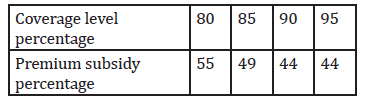
Table 8.2: Coverage levels and premium subsidies.
Dairy Forward Pricing Program (DFPP)
Dairy farmers can also manage price risk through forward contracting. Forward contracting involves entering into a contract with a milk handler for future delivery of milk at a price established at the time the contract was entered. This can be used to lock in a good price rather than accept the pool price at the time the milk is delivered.
The DFPP allows dairy farmers and dairy cooperatives to voluntarily enter into forward contracts for Class II, III, and IV milk. This allows dairy farmers and cooperatives to receive a negotiated contract price rather than the FMMO calculated minimum producer price. This can be advantageous to both farmer and processor (handler). The farmer can lock-in a future price thereby reducing revenue volatility and processors can be assured of adequate supplies needed to keep their plants operating efficiently. A producer may enter into forward contracts with more than one handler.
To be exempt from paying the FMMO minimum price the handler must have first submitted a copy of the contract to the Market Administrator for the FMMO. The contract must be dated and be signed by the handler, and the producer or cooperative. The contract must be signed before the first day of the month for which it is to be effective and submitted to the Market Administrator by the fifteenth day of that month. The contract must contain a disclosure statement required by regulations attesting to the voluntary nature of the contract. It is the responsibility of the Market Administrator to receive complaints from producers and cooperatives that handlers coerced them into signing the contracts. Since this is a program created under the 2018 Farm Bill no contract can be entered into after the expiration date of the 2018 Farm Bill, September 30, 2023. Extension through September 30, 2026, of existing agreements is allowed by the 2018 Farm Bill. The Market Administrator verifies weights and tests milk of producers who are not members of cooperatives in the same manner that it would if the producer had no forward contracts. (Cooperatives handle these tasks for their members.) The Market Administrator is not responsible for enforcing forward contracts. That will typically be done through arbitration or through the courts depending in part upon the terms of the contract and the state law applicable to the contract.
Futures and options for dairy farmers
Futures contracts are standard contracts for the sale and purchase of a wide variety of commodities and other property such as currency. There are several factors that make a dairy futures contract different from a dairy forward contract. First, unlike a dairy forward contract, all dairy futures contracts for a particular dairy product have the same terms, including the same quantity.
Example 8.5. All Class III milk futures traded through the CME Group are standardized on a quantity of 2,000 cwt. (200,000 lbs.).
Second, dairy futures contracts are publicly traded whereas dairy forward contracts are difficult or impossible to sell. Third, whereas dairy forward contracts are negotiated between the dairy farmer and the milk handler or processor, there is a neutral intermediary called a clearing house that is the initial party to every futures contract. Its role is first to ensure that all buyers and sellers of futures contracts are financially sound and then to randomly match buyers and sellers of contracts when the time comes for delivery. Most futures contracts do not mature into the delivered physical commodity since most positions are closed prior to maturing. Holders of futures contracts either to take profits or limit losses prior to the delivery date. Cash-settled futures never mature into a physical commodity because they are settled financially. The risk that dairy farmers take is that they will not produce enough milk to cover their delivery obligations under the futures contracts that they have sold. Under such circumstances dairy farmers would be required to buy milk to cover their obligations, or to settle the contract financially. Their losses would be measured by the difference between the cash price and the futures price. Good practice therefore dictates that one’s entire expected production should not be sold through futures contracts. The percentage of milk production sold through futures contracts depends upon the risk preferences of the dairy farmers.
Figure 8.4 :
A variety of dairy futures contracts are available through the CME Group. The CME Group is a private for-profit company that includes several exchanges that facilitate the buying and selling of futures contracts. It is the leading exchange for buying and selling agriculture derivatives including both futures and options. Available futures contracts include Class III milk futures, Class IV milk futures, nonfat dry milk futures, dry whey futures, cash-settled butter futures, cash-settled cheese futures, block-cheese futures.
An option contract is a contract that provides the right, but not the obligation to buy or sell a futures contract. A dairy farmer would typically buy a put option that gives the farmer the right to sell a milk futures contract. Should the farmer elect not to exercise that right the only loss to the farmer is the premium charged for the contract and the brokerage fee to execute the transaction. Call options that provide the right but not the obligation to buy a milk futures contract are typically purchased by milk handlers (processors). Option contracts allow dairy farmers to hedge their entire production because the maximum possible loss is the amount of premium paid.
Futures and options, when properly used, allow dairy farmers or milk handlers to hedge their market price risk. Hedging allows dairy farmers to lock in some future a price range for their milk at some time in the future. It is a tool for managing price risk. Dairy farmers should avoid speculating. Speculators (also called traders) have no interest in the underlying commodity and hope to profit from price volatility. However, speculators are also exposed to large, sometimes unlimited, losses. While enormous fortunes can be made in mere minutes speculating, dairy farmers and milk handlers are wise to avoid speculation. Enormous fortunes can also be lost in mere minutes.
Livestock Gross Margin Insurance Plan for Dairy Cattle (LGM-Dairy)
The Livestock Gross Margin Insurance Plan for Dairy Cattle (LGM-Dairy) provides insurance for when feed prices rise, or milk prices drop. It is an alternative for dairy farmers to purchasing options to hedge their price volatility risk. It is federally subsidized and is often a less expensive way to manage price volatility risk. There is also less complexity using LGM-Dairy rather than hedging with options.
Figure 8.5 :
The LGM-Dairy program provides protection that has some similarities to the FSA’s DCM program. Nonetheless, the 2018 Farm Bill allows the use of both LGM-Dairy and the FSA’s DCM program. The LGM-Dairy program provides protection when feed prices rise, or milk prices drop. Gross margin is calculated as the difference between the market value of milk before cooperative deductions and feed costs. Only milk sold for commercial or private sale that is intended primarily for human consumption is eligible for coverage. Unlike the DMC program, coverage is not limited by production history (milk base). There is no minimum or maximum amount of milk that may be insured.
LGM-Dairy policies are sold each week for a rolling 11-month period. Policies are sold on Thursdays starting when coverage and prices are posted on the RMA website and ending at 9 AM Central time the next day. Premium payments are due at the end of the 11-month insurance period. Policies are available through private crop insurance agents. A deductible ranging from zero to two dollars (in 10 cent increments) per hundredweight may be selected. The subsidy ranges from 18% for a zero deductible policy to 50% for a two-dollar deductible policy.
The expected gross margin and the actual gross margin are calculated by RMA using CME Group futures prices for corn, soybean meal, and Class III milk. Indemnity payments are made based upon an eleven-month average of the monthly difference between the gross margin guarantee and the actual gross margin, less any deductible. Dairy farmers making claims must submit an application that includes proof of monthly marketings. Dairy farmers’ actual gross margins are irrelevant to indemnity payments since payments are calculated based upon CME Group futures prices.
Futures and option prices are based upon national market conditions as a whole, not upon the individual market factors that may affect a particular dairy farmer. Dairy farmers must estimate the variation of their individual gross margins for either the option period or the 11-month LGM-Dairy to determine whether hedging or use of LGM-Dairy is worth the cost. The difference between an individual farmer’s gross margin and the national gross margin is called the ‘milk basis’.
Since predicting future volatility is difficult, estimates of monthly gross margins over an 11-month period are likely to be different than the actual. Both hedging (using futures and options) and LGM-Dairy reduce price volatility risk. Neither option reduces all of the risk.
Dairy Indemnity Payment Program (DIPP)
Fluid milk is highly regulated at the federal, state, and local level to protect consumer health. The Federal Food and Drug Administration (FDA) has responsibility to prevent the introduction of adulterated foods and food products into interstate commerce. It sets maximum levels of contaminants that constitute adulteration.
States, and in some instances local governments, are free to set more stringent standards than those set by FDA. Most enforcement of safety standards for milk is carried out by state and local governments. Milk that is contaminated by prohibited levels of pesticides, nuclear radiation or fallout, or toxic substances and other chemicals may not be sold and is usually destroyed. When a public regulatory agency directs this, the dairy farmer may receive compensation for milk not fit to market through the Dairy Indemnity Payment Program (DIPP). The DIPP does not provide compensation for milk whose bacterial content requires it to be sold as Grade B milk or, with even higher bacterial counts, destroyed.
Disaster assistance
The FSA’s Livestock Indemnity Program (LIP) is a 2018 Farm Bill program that provides payments of 75% of the value of livestock that is killed or impaired in value by an eligible adverse weather event, an eligible disease, or attacks by animals reintroduced into the environment or protected by federal law. These animals include wolves and various avian predators. Dairy farmers must apply for indemnity and prove both that an eligible cause of loss occurred and that cause directly caused the death or loss of value to the animal. A notice of loss must be filed with the FSA within 30 calendar days of when the loss of livestock is first apparent, and the claim must be filed within 60 days of the end of the calendar year in which the loss occurred. Those producers with an adjusted gross income in excess of $900,000 are ineligible for payments. There is no cost to the dairy farmer for this program. Since this is a 2018 Farm Bill program it does not cover losses that occur after September 30, 2023. It has been the practice of Congress to provide this type of disaster relief in prior farm bills and it is likely to do so in in the 2023 Farm Bill, albeit with modified provisions and even a new name.
Emergency farm loans are available through the FSA to dairy farmers that have losses from a federally recognized natural disaster. Producers with existing federal loans that are unable to make loan payments as the result of a disaster may have the payment schedule extended for up to one year. With major disasters, Congress typically enacts ad hoc disaster relief.
Example 8.6. Relief to businesses including farms was passed to alleviate impacts of the Covid lockdown in 2022.
Such relief can be through USDA, the Small Business Administration (SBA), the Federal Emergency Management Agency (FEMA), or other entities designated by Congress. Tax relief may also be part of an ad hoc disaster response package. Deadlines are typically short, and the programs are often difficult to navigate. Disasters are excellent opportunities for scam artists, so caution is advised. State Cooperative Extension offices, which are a part of the Land Grant University system, are a good starting point for identifying legitimate available disaster programs.
Market protection
The domestic market for milk and milk products is protected from foreign competition by tariffs collected on imported milk and dairy products by U.S. Department of Homeland Security, Customs and Border Protection. By treaty some countries are entitled to lower tariffs on some portion of their dairy exports to the United States. Imports of dairy products subject to the lower tariff must apply for an annual import license through the USDA Foreign Agricultural Service. Imports in excess of a country’s quota are subject to the full tariff and do not require a license.
Market Expansion
Dairy Promotion and Research Program (DPRP)
The DPRP is a program designed to expand the demand for dairy products. The program is more commonly called the Dairy Checkoff Program. It is funded by dairy farmers and importers of dairy products through a 15-cents-perhundredweight assessment on milk marketed. Importers are charged a 7.5-cents-per-hundredweight assessment on dairy products imported.
The US dairy industry has been faced for many years with declining fluid milk consumption. The DPRP is a critical part of the effort both to promote milk and milk products, and to develop new milk-based products. The checkoff is an important source of funding for dairy research at Land Grant universities.
Export Promotion
The Office of the United States Trade Representative, headed by the US Trade Representative (USTR), has primary responsibility for both negotiating trade agreements with other countries and for enforcing those agreements. Milk and dairy products have seen major increases in exports to Canada as the result of the United States-Mexico-Canada Agreement (USMCA) that entered into force on July 1, 2020. It replaced the North American Free Trade Agreement (NAFTA).
The first dispute resolution under the USMCA was brought by the United States against Canada in objection to its restrictions on US exports of milk and dairy products to Canada. The United States prevailed. Professor Schaefer of Oklahoma State University has estimated that without the USMA and this successful enforcement action, US dairy farmers would have lost $1.27 billion in trade with Canada over the decade covering the period from 2021 to 2030.
The USDA Foreign Agricultural Service (FAS) is the lead USDA agency that promotes exports of milk and dairy products. It collects information on dairy production and manufacturing in many countries to track market conditions. It monitors new laws in existing markets for US dairy products to determine whether those laws unfairly disadvantage imports of US dairy products. The FAS provides a tariff tracker service to US agricultural exporters. It operates a number of services that can be of great assistance to exporters of US dairy products. These programs include cost-share to help US agricultural exporters develop new markets, an export credit guarantee program that protects US banks that loan to foreign banks that are financing the import of US agricultural products, direct promotion activities in various countries, a program to provide small samples of US products to potential customers, and others. In countries of particular importance to agricultural imports of US products, FAS posts agricultural attachés to the relevant US embassies. This ensures in-country support for US agricultural exports. FAS agricultural attachés have diplomatic status.
To actually export milk or dairy products, the exporter must meet the health requirements of the receiving country. Primary federal responsibility for providing these health certifications for dairy products lie with the USDA Agricultural Marketing Service (AMS) and the U.S. Food and Drug Administration (FDA). Some state departments of agriculture also provide required certifications.
FRUITS, VEGETABLES, SPECIALTY CROPS, AND MISCELLANEOUS COMMODITIES
In addition to milk, the Secretary of Agriculture has authority (Agricultural Marketing Agreement Act of 1937, 50 Stat. 246, as amended) to issue and administer marketing orders for fruits, vegetables, nuts, and others. To issue an order, the Secretary must have one or more of the eleven statutory purposes listed below. Note that two of those purposes are commodity specific.
Figure 8.6 :
“(A) Limiting, or providing methods for the limitation of, the total quantity of any such commodity or product, or of any grade, size, or quality thereof, produced during any specified period or periods, which may be marketed in or transported to any or all markets in the current of interstate or foreign commerce …
(B) Allotting, or providing methods for allotting, the amount of such commodity or product, or any grade, size, or quality thereof, which each handler may purchase from or handle on behalf of any and all producers thereof, during any specified period or periods …
(C) Allotting, or providing methods for allotting, the amount of any such commodity or product, or any grade, size, or quality thereof, which each handler may market in or transport to any or all markets in the current of interstate or foreign commerce or so as directly to burden, obstruct, or affect interstate or foreign commerce …
(D) Determining, or providing methods for determining, the existence and extent of the surplus of any such commodity or product, or of any grade, size, or quality thereof, and providing for the control and disposition of such surplus, and for equalizing the burden of such surplus elimination or control among the producers and handlers thereof.
(E) Establishing or providing for the establishment of reserve pools of any such commodity or product, or of any grade, size, or quality thereof, and providing for the equitable distribution of the net return derived from the sale thereof among the persons beneficially interested therein.
(F) Requiring or providing for the requirement of inspection of any such commodity or product produced during specified periods and marketed by handlers.
(G) In the case of hops and their products …
U.S.C. 251–256) and the Standard Containers Act of 1928 (15 U.S.C. 257–257i)
(I) establishing or providing for the establishment of production research, marketing research and development projects designed to assist, improve, or promote the marketing, distribution, and consumption or efficient production of any such commodity or product, the expense of such projects to be paid from funds collected pursuant to the marketing order [with pro rata credit for any direct marketing expenses of handlers of certain commodities, and a saving provision allowing similar state promotion programs]…
(J) [special provision for pears for canning or freezing]…
7 U.S.C. § 608c(6).
Although the statutory list of agricultural products, other than milk and dairy products, that may be subject to marketing orders is a long one; not all products for which Congress has authorized orders have one. There are certain conditions that have to be met in order for an order to go into force. In all cases proposed orders are subject to public hearings. In general, the Secretary of Agriculture will issue an order after having held referendums of both producers and handlers. Marketing orders can be terminated by a similar statutory process.
(C) Allotting, or providing methods for allotting, the amount of any such commodity or product, or any grade, size, or quality thereof, which each handler may market in or transport to any or all markets in the current of interstate or foreign commerce or so as directly to burden, obstruct, or affect interstate or foreign commerce …
(D) Determining, or providing methods for determining, the existence and extent of the surplus of any such commodity or product, or of any grade, size, or quality thereof, and providing for the control and disposition of such surplus, and for equalizing the burden of such surplus elimination or control among the producers and handlers thereof.
(E) Establishing or providing for the establishment of reserve pools of any such commodity or product, or of any grade, size, or quality thereof, and providing for the equitable distribution of the net return derived from the sale thereof among the persons beneficially interested therein.
(F) Requiring or providing for the requirement of inspection of any such commodity or product produced during specified periods and marketed by handlers.
(G) In the case of hops and their products …
U.S.C. 251–256) and the Standard Containers Act of 1928 (15 U.S.C. 257–257i)
(I) establishing or providing for the establishment of production research, marketing research and development projects designed to assist, improve, or promote the marketing, distribution, and consumption or efficient production of any such commodity or product, the expense of such projects to be paid from funds collected pursuant to the marketing order [with pro rata credit for any direct marketing expenses of handlers of certain commodities, and a saving provision allowing similar state promotion programs]…
(J) [special provision for pears for canning or freezing]…
7 U.S.C. § 608c(6).
Although the statutory list of agricultural products, other than milk and dairy products, that may be subject to marketing orders is a long one; not all products for which Congress has authorized orders have one. There are certain conditions that have to be met in order for an order to go into force. In all cases proposed orders are subject to public hearings. In general, the Secretary of Agriculture will issue an order after having held referendums of both producers and handlers. Marketing orders can be terminated by a similar statutory process.
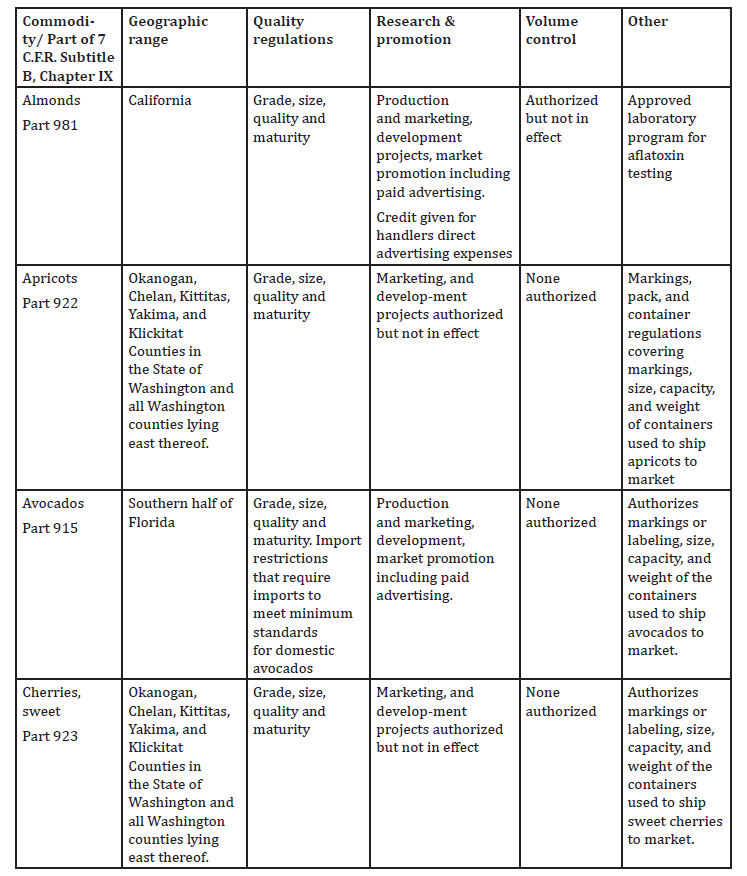
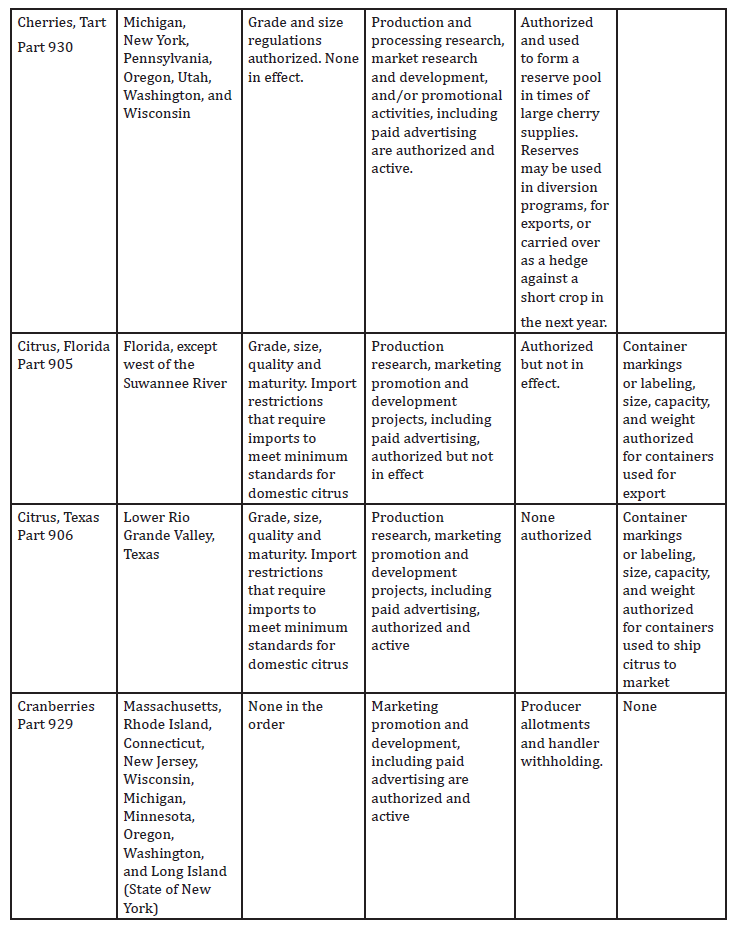
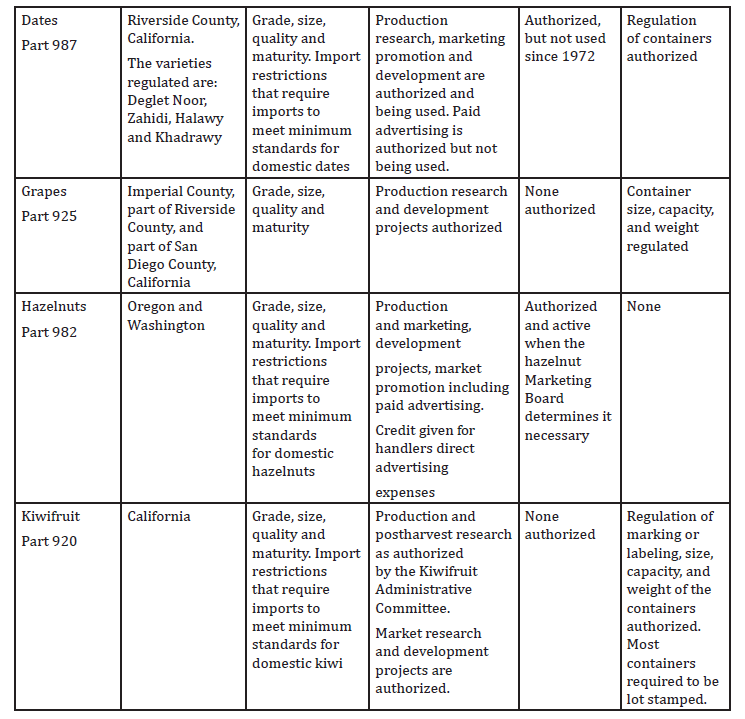
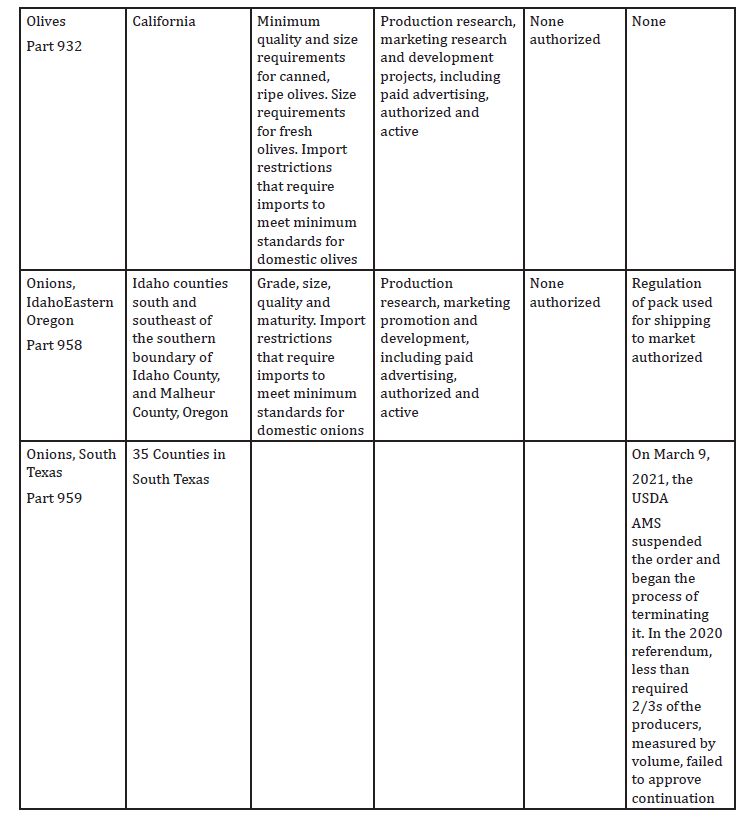
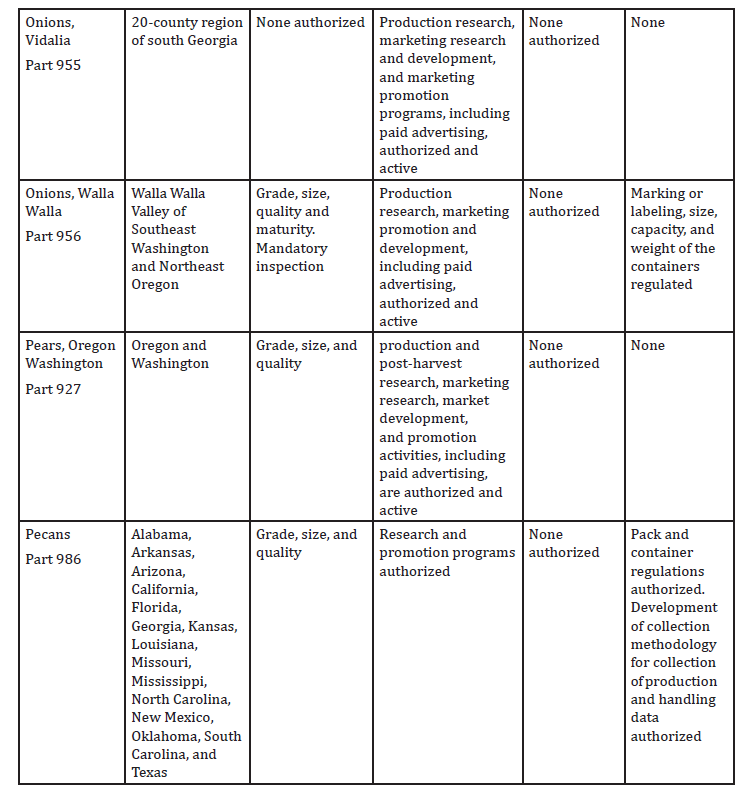
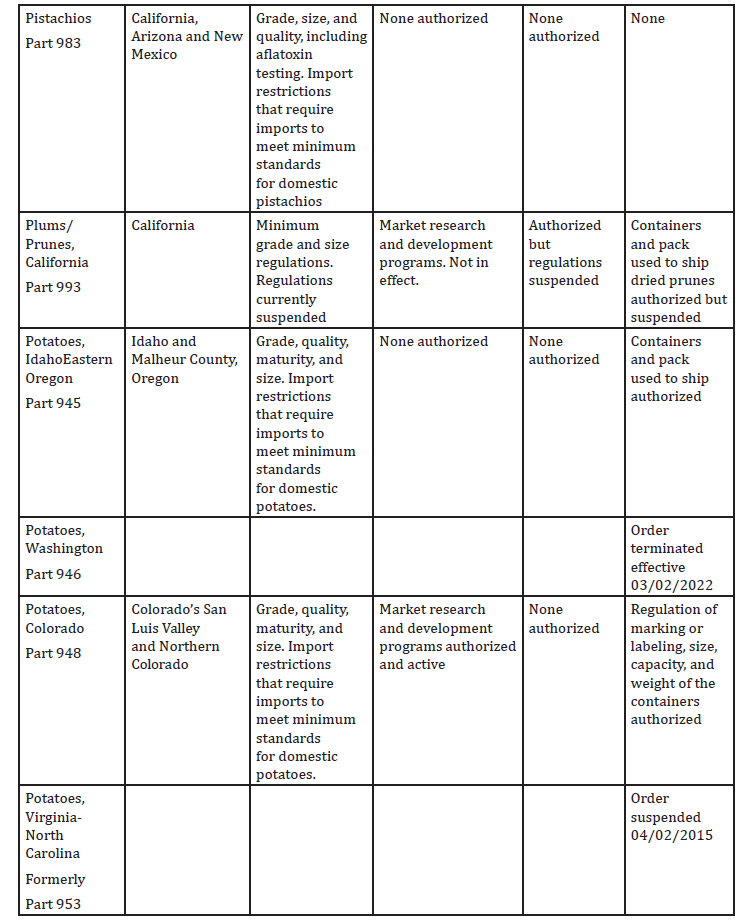
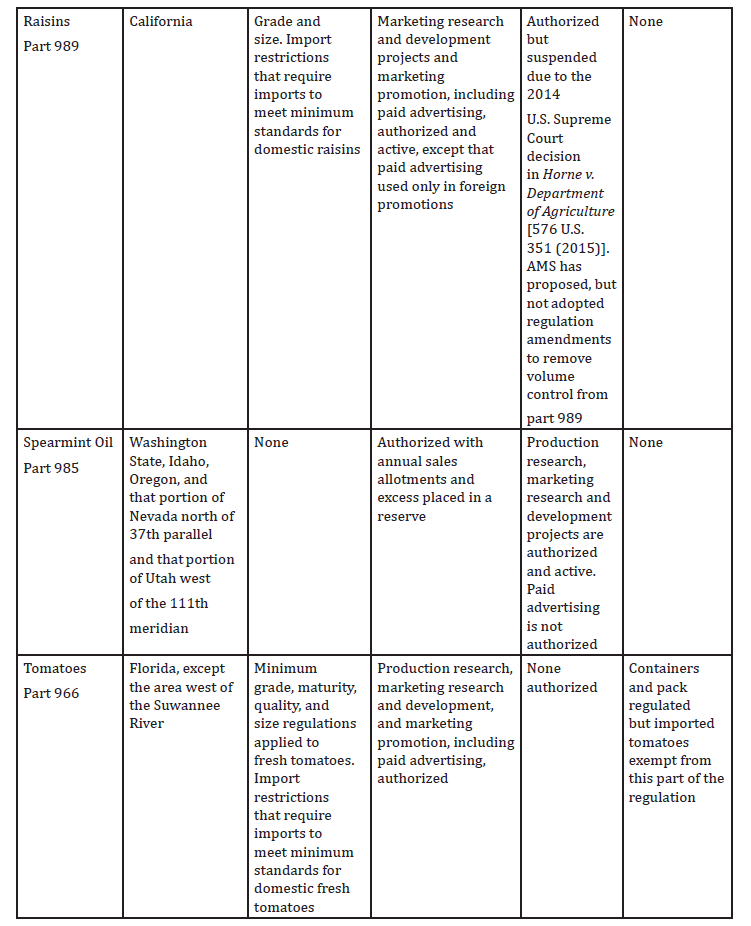

Table 8.2: Fruits, vegetables, specialty crops, and miscellaneous commodities with marketing orders
As Table 8.2 illustrates, the marketing orders covering fruits, vegetables, specialty crops, and miscellaneous commodities are varied and many. What they have in common is generally a focus on quality, production and market research, market promotion, and packaging and labeling standards. The ability to limit imports by applying US quality and packaging standards established under the marketing orders is an important part of the market structure for many of these products. All of these orders are supervised by boards whose membership is composed of a substantial majority of producers. The boards are regulated and advised by the USDA AMS.
A few of these orders attempt to use volume control to raise prices in hopes of increasing producer incomes. Typically, volume control consists of a marketing allotment with excess placed into a reserve. The reserve may be released to the market in years of crop failures, diverted to charitable use at domestically or internationally, or diverted to lower value processing uses.
There are two reasons why volume control is disfavored. First, the demand for most of these products is elastic, making this an unworkable strategy. This was discussed in greater depth in
Chapter 2. Second, the U.S. Supreme Court held in its 2014 decision in Horne v. Department of Agriculture that forcing a party to place excess production into a reserve constituted a violation of the Fifth Amendment takings clause. If the government (USDA AMS) forces a party to do that, the USDA AMS must pay compensation for the fair market value of the property. As discussed in Chapter 7, this is what the government does in some of the programs for supported commodities. However, for the products subject to marketing orders listed in Table 8.2, Congress has not authorized such payments. The Hornes produced raisins and were subject to the marketing order for California raisins. When the Supreme Court held that the Hornes were entitled to compensation for the raisins that they were forced to place in the reserve, the response of USDA AMS was to suspend the volume control part of the order. USDA AMS had no other choice since Congress had not authorized such a payment. USDA AMS has proposed regulations to permanently remove the volume control provisions from the raisin marketing order. As a result of the Horne decision, any volume control regulations that remain active in other orders listed in Table 8.2 are likely to be suspended if challenged.
FURTHER READING
Basic Importing and Exporting. (2022, October 20). U.S. Customs and Border Protection. https:// www.cbp.gov/trade/basic-import-export
Farm Bureau Dairy Working Group. (2022). Priorities, principles and policy
considerations for dairy policy reform. American Farm Bureau Federation. https://www. fb.org/files/2022_AFBFDairy_Working_ Group_Report.pdf
Frederick, D.A. (2002, September). Antitrust Status of Farmer Cooperatives:
The Story of the Capper-Volstead Act. USDA Rural Development. https://www.rd.usda.gov/ files/CIR59.pdf
National Agricultural Law Center. (2022). Marketing Orders. https://nationalaglawcenter.org/ research-by-topic/marketing-orders/
The National Agricultural Law Center (NALC) is part of the University of Arkansas System Division of Agriculture. It is funded in part by federal appropriations. It is intended to be a national resource for agricultural law. The materials on the site are reviewed for accuracy every six months. This topic page is typical of all the topic pages on the NALC. Each topic page begins with an overview. This one covers all types of marketing orders: dairy; fruits, vegetables and specialty crops; and miscellaneous commodities. Following the overview are sections that include major statutes, regulations, case law, administrative law decisions, Congressional Research Service reports, the Agricultural Law Bibliography, various resources and publications.
Statutes are laws passed by Congress. Regulations are created by agencies, such as the USDA Agricultural marketing Service, to explain how the agency intends to implement the statute that authorized its activity. Case law includes those published judicial decisions of the Federal court system. Administrative law decisions are decisions made within agencies in the process of resolving disputes between those served or regulated by the agency. The Congressional Research Service is an agency of Congress that prepares nonpartisan research reports at the request of either Members or Committees of Congress. These reports support the legislative process.
The focus of the National Agricultural Law Center is national with emphasis primarily on the Federal government; however, every state to varying degrees has the equivalent of these federal resources. State statutes, regulations, and court administration decisions are restricted in geographic scope to the territory of the state that created them. The various resources and publications included at the end of these topic pages include many of these state resources.
Disaster Assistance. (n.d.). Farm Service Agency. https://www.fsa.usda.gov/programs-andservices/ disaster-assistance-program/index
Programs. (2022). Foreign Agricultural Service. https://www.fas.usda.gov/programs USMCA. (2021). Office of the United States Trade Representative. https://ustr.gov/usmca The United States-Mexico-Canada Agreement (USMCA), that entered into force on July 1, 2020, is a trade agreement between the United States, Mexico, and Canada. It covers a wide range of trade issues. Agriculture was one of the major focusses of the negotiations. It has resulted in a significant expansion of export opportunities for US farmers.
Milk
Dairy Futures and Options. (2022). CME Group. Retrieved October 19, 2022, from: https:// www.cmegroup.com/trading/agricultural/ dairy.html
Dairy Revenue Protection. (2019, April). USDA Risk Management Agency. https://www.rma. usda.gov/Fact-Sheets/National-Fact-Sheets/ Dairy-Revenue-Protection
Extension of Dairy Forward Pricing Program. (2019, March 1). USDA Agricultural Marketing Service. https://www.ams.usda.gov/ rules-regulations/dfc
Livestock Indemnity Program. (2022, July). Farm Service Agency. https://www.fsa.usda.gov/ Assets/ USDA-FSA-Public/usdafiles/Fact- Sheets/2022/fsa_lip_livestockimdemnityprogram_ factsheet_2022.pdf
Greene, J.L. (2022, June 15). Federal Milk Marketing Orders: An Overview. Congressional Research Service. https://crsreports.congress.gov/ product/pdf/R/R45044
The Congressional Research Service (CRS) is a nonpartisan agency of the US Congress. It does analysis for Members and Committees of Congress.
Greene, J.L. (2022, August 29). Farm Bill Primer: Support for the Dairy Industry. Congressional Research Service. https://crsreports.congress. gov/product/pdf/IF/IF12202
Hardbarger, C. (2022, July 15). About Over-Order Premiums and Minimum Milk Pricing in Pennsylvania. Lancaster Farming. https://www. lancasterfarming.com/farming-news/aboutover- order-premiums-and-minimum-milkpricing- in-pennsylvania/article_6765fe5bd1d9- 569d-9d9079f40605cf8e.html
This article explains over-order premiums. It is also an excellent example of the role of states in fluid milk prices. As noted in the article, the Pennsylvania Milk Marketing Board, acting under the authority of the Pennsylvania Milk Marketing Law, sets minimum wholesale and retail prices for fluid milk. The purpose of this statute as stated by the Pennsylvania General Assembly is to ensure that Pennsylvania dairy farmers produce enough milk to meet consumer needs.
Harper, J.K. and Dunn, J. (2016, October 24). Milk Basis and Its Importance in Dairy Risk Management. Penn State Extension. https://extension. psu.edu/milk-basis-and-its-importancein- dairy-riskmanagement
This article provides an excellent explanation of the calculation of milk basis. Examples are included. Hartschuh, J. (2022, September). Assessing Milk Price and Risk Management for 2023. Buckeye Dairy News.
https://dairy.osu.edu/newsletter/buckeye-dairynews/ volume-24-issue-5/assessingmilkprice- and-risk-management-2023
Livestock Gross Margin Insurance Plan for Dairy Cattle. (2022, April). USDA Risk Management Agency. https://www.rma.usda.gov/ Fact-Sheets/National-Fact-Sheets/Livestock- Gross-Margin-Insurance-Dairy-Cattle
Milk Market Administrator Web Sites. (n.d.). USDA Agricultural Marketing Service. Retrieved October 8, 2022, from: https://www.ams. usda.gov/rules-regulations/moa/dairy/ mmadmin
Nepveux, M. (2019, June 10). How Milk Is Priced in Federal Milk Marketing Orders: A Primer. Farm Bureau Market Intel. https://www.fb.org/ market-intel/how-milk-is-priced-in-federalmilk- marketingorders-a-primer
This brief publication of the American Farm Bureau Federation provides a layperson’s explanation of milk pricing under the Federal Milk Marketing Order System. The American Farm Bureau Federation is a federation of 51 associations in the 50 states and Puerto Rico. These are advocacy and educational associations of farmers and others. Most of the state associations have associated mutual insurance companies that provide insurance especially suitable to farmers and ranchers.
Sandeen, A. (2022, October 4). Dairy Revenue Protection October 2022. PennState Extension. https://extension.psu.edu/dairy-revenueprotection
Schaefer, K. A. (2022, June 16). The Economic Costs of Canadian Dairy Quota Restrictions Under USMCA. Southern Ag Today. http://theeconomic- costs-of-canadian-dairy-quotarestrictions- under-usmca/
Shaw, C.N., and Levine, S.G. (1978, March). Government’s Role in Pricing Fluid Milk in the United States, Agricultural Economic Report no. 397. USDA, Economics, Statistics, and Cooperatives Service. [Available through AgEcon Search https://ageconsearch.umn. edu/record/307678/files/aer397.pdf]
S.R.J.F., INC., Individually and on Behalf of Others Similarly Situated v. Dairy Farmers of America, Inc. United States District Court for the District of Vermont. Class Action Complaint. (2022, July 29). https://npr.brightspotcdn. com/fe/4e/e1ba76f149e7af987f96e600e- 5df/dfa-class-action-complaint-20220729. pdf
Thraen, C. (2001, May). Your Milk Check is Under Attack! Where are all the Federal Order 33 Pool $$’s Going?. Buckeye Dairy News. https://dairy.osu.edu/newsletter/ buckeye-dairy-news/volume-4-issue-3/ your-milk-check-under-attack-where-areall- federal
USDA Disaster Assistance Programs at a Glance. (2022, July). USDA Farm Service Agency. https://www.farmers.gov/sites/default/files/2022-07/farmersgov-disaster-assistance- brochure-07-21-2022. pdf
USDA, Farm Service Agency. (n.d.). Foreign persons. https://www.fsa.usda.gov/programs-andservices/ payment-eligibility/foreign_persons/ index Fruits, vegetables, and miscellaneous
Commodities covered by marketing orders. (n.d.). USDA Agricultural Marketing Service. https:// www.ams.usda.gov/rules-regulations/moa/ commodities