


Chapter 04: Overview of U.S. Agricultural Industry: Labor
Overview of U.S. Agricultural Industry: Labor
At the outset of English (and subsequently British) colonization of North America, agricultural labor was generally less than free. Large land grants were made by the British Crown with the vision that a system similar to the landed aristocracy of England would be established in North America. From this began the system of plantation agriculture that characterized much of agriculture in the British North American colonies and the United States prior to the Civil War. Labor employed in plantation agriculture was less than free, and at its widely practiced extreme, enslaved. The system of royal grants and subgrants led to relatively few landowners.
With the Northwest Ordinance of 1787, the Continental Congress rejected this model. Under its authority provided by the first U.S. constitution, the Articles of Confederation, it authorized the creation of three to five states from the Northwest Territory. The Northwest Territory was ceded to the United States by Great Britain at the conclusion of the Revolutionary War.1 The states of Ohio (March 1, 1803), Indiana (December 11, 1816), Illinois (December 3, 1818), Michigan (January 26, 1837), and Wisconsin (May 29, 1848) were created from the Northwest Territory. Minnesota (May 11, 1858) was created from the remaining portion of the territory plus land from the Louisiana Purchase.
What was revolutionary about the Northwest Ordinance was that it provided a means for creating new states coequal with existing states, banned chattel slavery, created a means for funding education, and guaranteed the rights to demand a writ of habeas corpus and a trial by jury. Other rights including freedom of religion were protected. At the time of enactment of the Northwest Ordinance only three (Maine, Vermont, and Massachusetts) of the thirteen states banned chattel slavery.
1 The treatment of the indigenous population that lived in the Northwest Territory that had not agreed to cede it to the United States is beyond the scope of this text. The high ideals that the Northwest Ordinance prescribed for the U.S. relationship to indigenous nations were ignored in practice.
The impact on agricultural labor was profound. Education of the populous was encouraged through the Northwest Ordinance and the Land Ordinance of 1785 by setting aside a certain portion of the land granted to the new states for the purpose of funding education. With the elimination of competing enslaved labor, the stage was set for an alternative model of free, educated agricultural labor that competed with the model of less than free labor employed on plantations. Most of the land grants to individuals were too small to support plantation agriculture. Small farm size together with the scarcity of hired labor on the frontier encouraged the use of family labor. That the model of free, educated agricultural labor prevailed (albeit haltingly at first) set the stage for the labor market that we have today where family labor predominates.
The composition of the U.S. agricultural workforce and its relationship to the U.S. workforce as a whole
The majority of labor employed on farms is family labor. Figure 4.1 illustrates the composition of the agricultural labor force from 1950 to 2020.
The total employment on farms has dropped precipitously over time. The proportion of family labor as a fraction of the total has also shrunk over time. Both the proportions of family labor and the total number of workers stabilized in the last quarter of the 20th Century.
Figure 4.1 does not reflect an important seasonal characteristic of hired labor on farms. Figure 4.2 illustrates this important seasonal characteristic of hired labor.
In this quarterly analysis of the USDA National Agricultural Statistics Service, the seasonal nature of hired labor can be seen.
From the percentage (less than 1%) that hired farm hourly (wage) and salaried workers make of the total US hired labor force, that labor would seem insignificant. Nothing could be farther from the truth. Some sectors of agriculture could not function without hired labor. These sectors include dairy, orchard crops, and other perishable products. The overall share of total production expenses represented by hired and contract labor is 12 percent (2017 Census of Agriculture). For greenhouse and nursery operations, the percentage was 43%, and for fruit and tree nut operations, 39%.
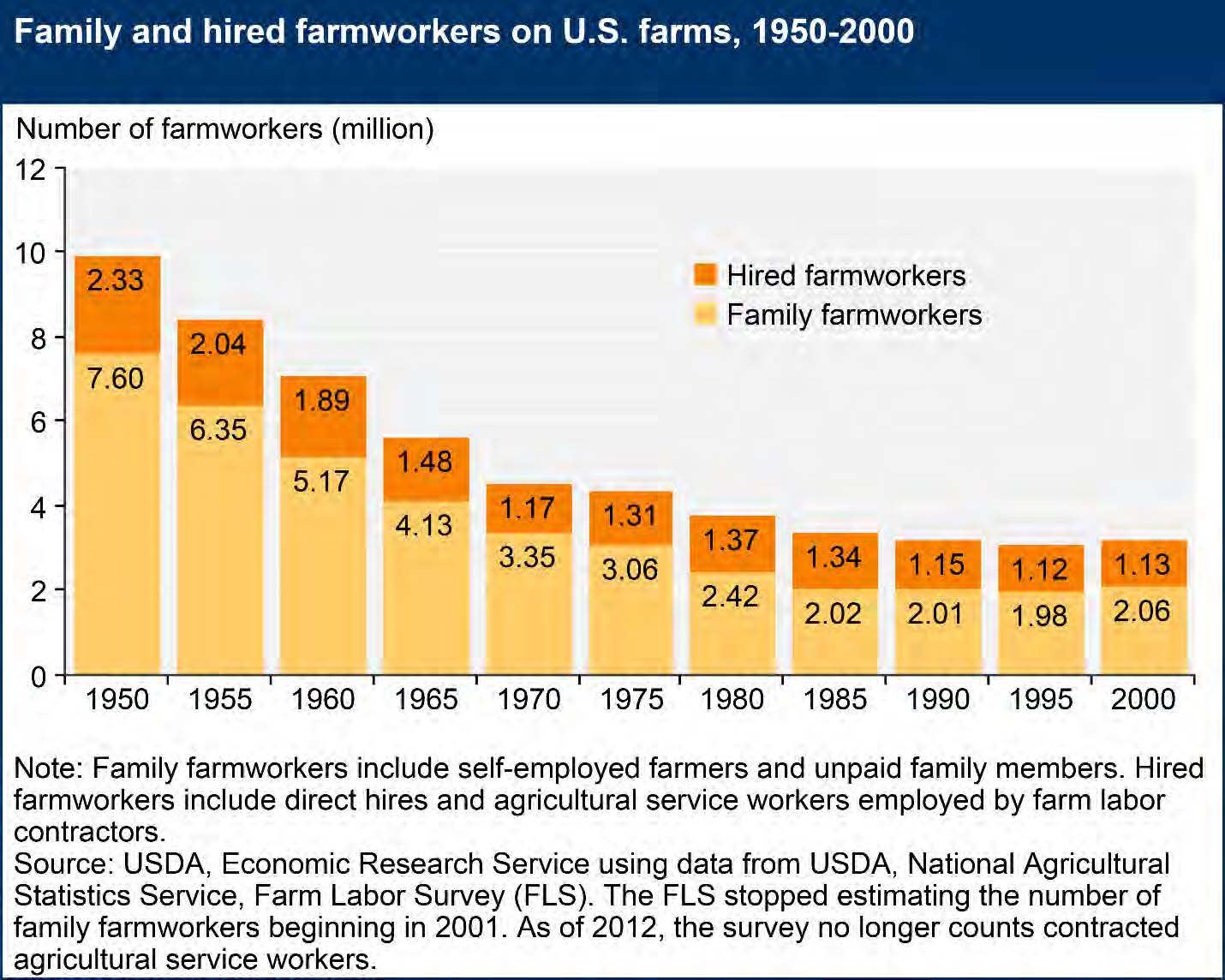
Figure 4.1 :
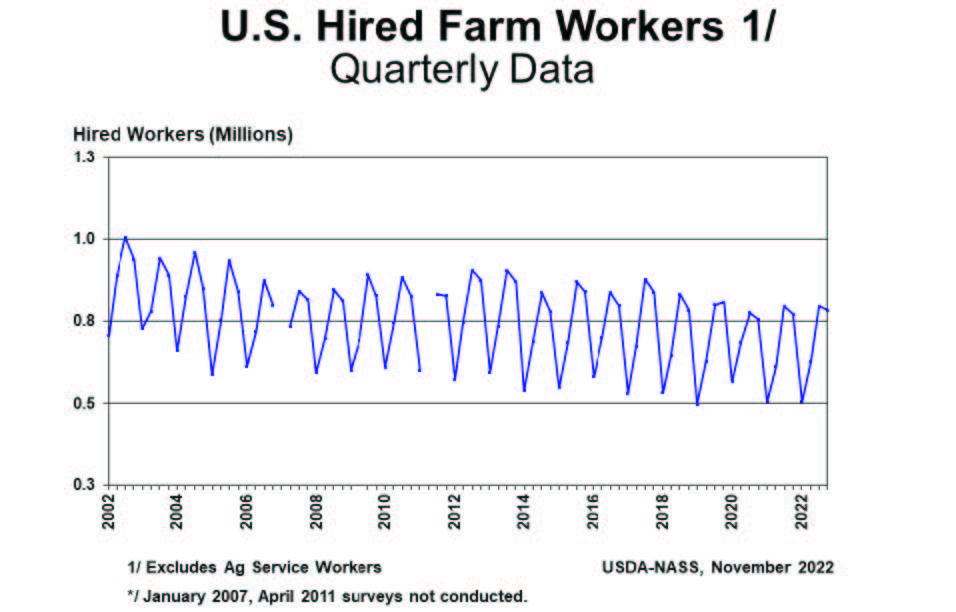
Figure 4.2 :
More recent information in more detail can be found in the Quarterly Census of Employment and Wages, collected by the US Bureau of Labor Statistics. Data is available by county and NAICS (North American Industry Classification System) code. NAICS 11 covers agriculture, forestry, fishing, and hunting. NAICS 115115 covers farm labor contractors and crew leaders. The US Bureau of Labor Statistics website allows users to build custom tables. Reported data usually is available one to two quarters behind.
Example 4.1. The most recent quarter available at the time of this writing was third quarter of 2022. It showed total US third quarter wages for agriculture, forestry, fishing, and hunting, to be about $15 billion. The average weekly wage was $851.00 ($44,252.00 on an annual fulltime basis). By contrast the total third quarter wages for farm labor contractors and crew leaders were about 1.8 billion with an average weekly wage of $659.00.
While most hired farm workers are employed directly by farmers, a significant portion are employed by farm labor contractors, custom harvest operators, integrators, and management service providers. Farm labor contractors are often used to provide short-term migrant labor for tasks such as picking berries. Such labor is often but not always foreign labor. Custom harvest operators typically provide the necessary machinery as well as the harvest labor. The custom wheat harvesters that follow the wheat harvest from the beginning of the season in Texas to its conclusion in Canada are probably the most famous examples of custom harvesters. Integrators are companies that are engaged in vertically integrated livestock and poultry production. They typically perform some of the functions that were once provided by farms prior to integration of those industries. Examples of tasks performed by integrators include mixing feed and providing livestock and poultry health services. Management service providers provide a wide range of services. Some manage payroll ensuring that farm employees are paid and that all taxes are properly withheld and remitted to taxing authorities. Some help farmers manage soil fertility and plant health. Crop scouting services monitor crops for pest and disease.
FACTORS DRIVING THE CHANGES IN THE AGRICULTURAL WORKFORCE
What one sees when one looks at the changes in farm numbers, reported by the USDA National Agricultural Statistics Service (NASS), between 2012 and 2017 is a substantial increase in very small farms, a reduction in mid-sized farms, and an increase in very large farms. Farms of 9 acres or less increased in number by 49,691 to a total of 273, 325 (2017 Census of Agriculture). Farms over of 2000 acres or more increased by 2900 to a total of 85,127. Total farms in the United States shrank by 67,083 to a total of 2,042,220 farms. The reduction in farm numbers was entirely from mid-sized farms. The change in farm numbers has profound implications for the market for farm labor. Small farms tend to rely entirely on family labor whereas very large farms are heavily dependent on hired labor, much of it foreign.
The increase in production on a few large farms has been a driving force in the overall reduction of labor used on farms. Large farms have economies of scale that make substitution of technology for labor viable.
Figure 4.3 :
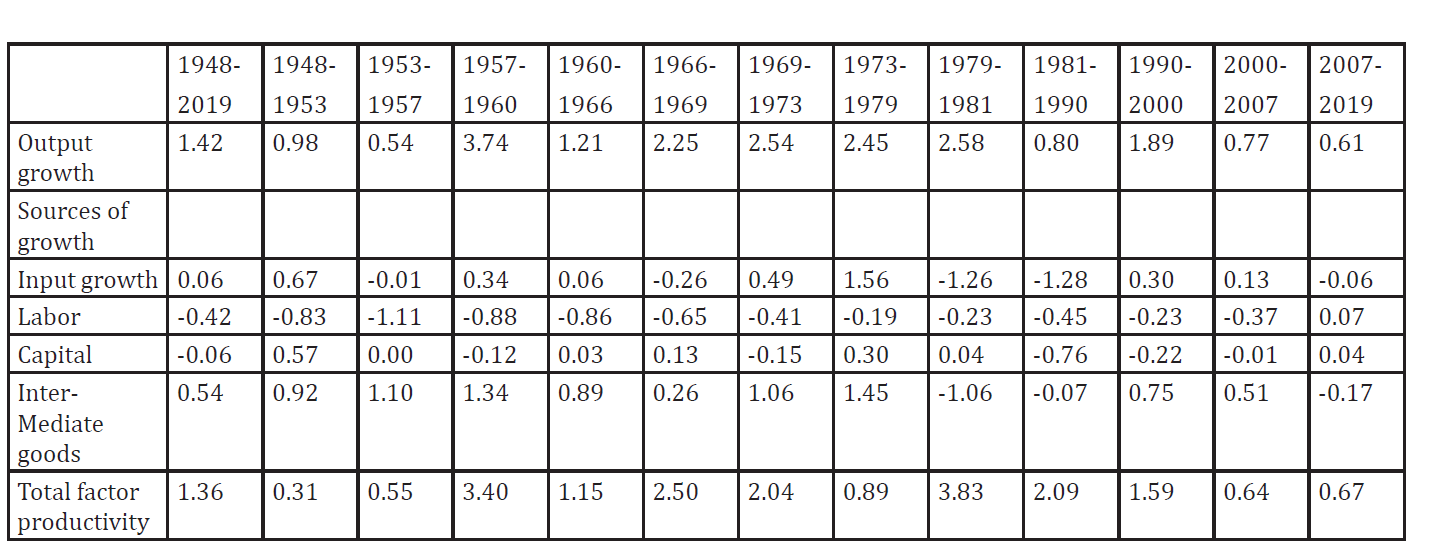
Table 4.1 : U.S. farm sector, average annual growth rates (percent), 1948-2019
Note: The subperiods are measured from cyclical peak to peak in aggregate economic activity. Land is included as part of the capital input in this table. Intermediate goods include feed and seed, energy use, fertilizer and lime, pesticides, purchased services, and other materials use. Labor, capital, and intermediate inputs aggregate across different attributes within each input aggregate (including gender, age, educational attainment and employment types for labor; durable equipment, including autos, tractors, trucks, and other machineries, service buildings, land, and inventories for capital; and feed and seed, energy, fertilizers, pesticides, purchased services, and other materials for intermediate goods). The contribution of an input aggregate to growth reflects changes in the quantity of the aggregate, and changes in the quality (composition of specific components) of the aggregate.
Source: USDA, Economic Research Service, Agricultural Productivity in the U.S. data product, updated January 2022.
Example 4.2. Large farms can afford the equipment that makes possible rapid planting, cultivation, spraying and harvesting. On large farms with flat land and large, regularly shaped fields, it is not uncommon to see 120 feet wide planters. Smaller farms do not have enough production to spread the high fixed cost of such equipment over. Most small farms do not have large enough fields to make use of such equipment. As a result, small farms require more labor per unit of production than large farms.
Large farms employ technology that has shifted some production steps from farm to off farm. The adoption of GM soybean seed in the last quarter of the 20th Century shifted seed saving and production activities from the farm to seed companies. The increase in the number of large farms and the increase in production of those farms has been accompanied by an increase in contract agriculture. Where hog farmers once mixed their own feed and farrowed their own pigs, those activities are now done by some one else. While some of these activities are done on other farms, a significant portion is done off farm where the labor employed does not count as agricultural labor.
Accompanying these shifts in farm size has been an overall increase in productivity. As can be seen from Table 4.1, from 1948 through 2019 agricultural output grew at a rate of 1.42 percent per year while inputs grew at a rate of 1.36 percent per year. The difference represents the increase in agricultural productivity. The difference is reflected in the increases in agricultural productivity. Labor and capital (including land) were the two factors of production that dropped over the 1948-to-2019-time frame. Labor saw the most reduction at a rate of 0.42 percent per year.
CATEGORIES OF HIRED LABOR
There are three broad categories of hired labor. These are citizens and permanent residents, nonresident, temporary labor with authorization to work, and those without authorization to work. The latter category includes both those legal in the US but without authorization to work, and those not legally in the US.
All employers and their employees must complete Form I-9. Form I-9 is used by the US Citizenship and Immigration Services to verify employment eligibility. A separate form must be completed for each person hired. It is required for both citizens and non-citizens.
Newly hired employees must complete and sign the Form I-9 by the first day of employment. Required documents must be submitted to the employer by the third day of employment unless employment was for less than three days. Such short-term employees must submit the required documents on the first day of employment. Documents must prove identity and authorization to work. Some documents such as a US passport prove both.
If the documents submitted are facially valid, the employer must accept them. The failure to accept such documents may give rise to a federal discrimination complete. The federal government recognizes citizenship status, immigration status, or national origin are among the likely grounds for a discrimination complaint or lawsuit. Given that there is no bright line test for facial validity, the employer also faces potential liability for accepting documents later deemed not facially valid.
Citizens and permanent residents
Citizens are either citizens by birth or through naturalization. In either case, citizens are authorized to work. Permanent residents have what is known as a Green Card. The Green Card is officially known as the Permanent Resident Card.
Temporary work visa programs
There are several categories of individuals that are authorized to work but are neither citizens nor Green Card holders. The first are those that are on temporary work visa programs. By far the most important of these temporary visa programs is the H-2A Temporary Agricultural Worker Program. There are also those authorized to work due to their status. Some of those may be required to complete Form I-765, Application for Employment Authorization, to document their status.
The H2-A program is the temporary work visa program of choice for the majority of temporary agricultural workers. It allows nonresident seasonal agricultural workers to come to the United States to work for the season, then return to their home country. Some of these workers make this migration to the same farm year after year.
Three federal agencies manage the H-2A program. These are the Department of Labor (DOL), USCIS, and the Department of State (DOS). DOL issues H-2 labor certifications and ensures compliance with federal labor laws. USCIS adjudicates H-2 petitions. DOS issues visas to workers at consulates overseas.
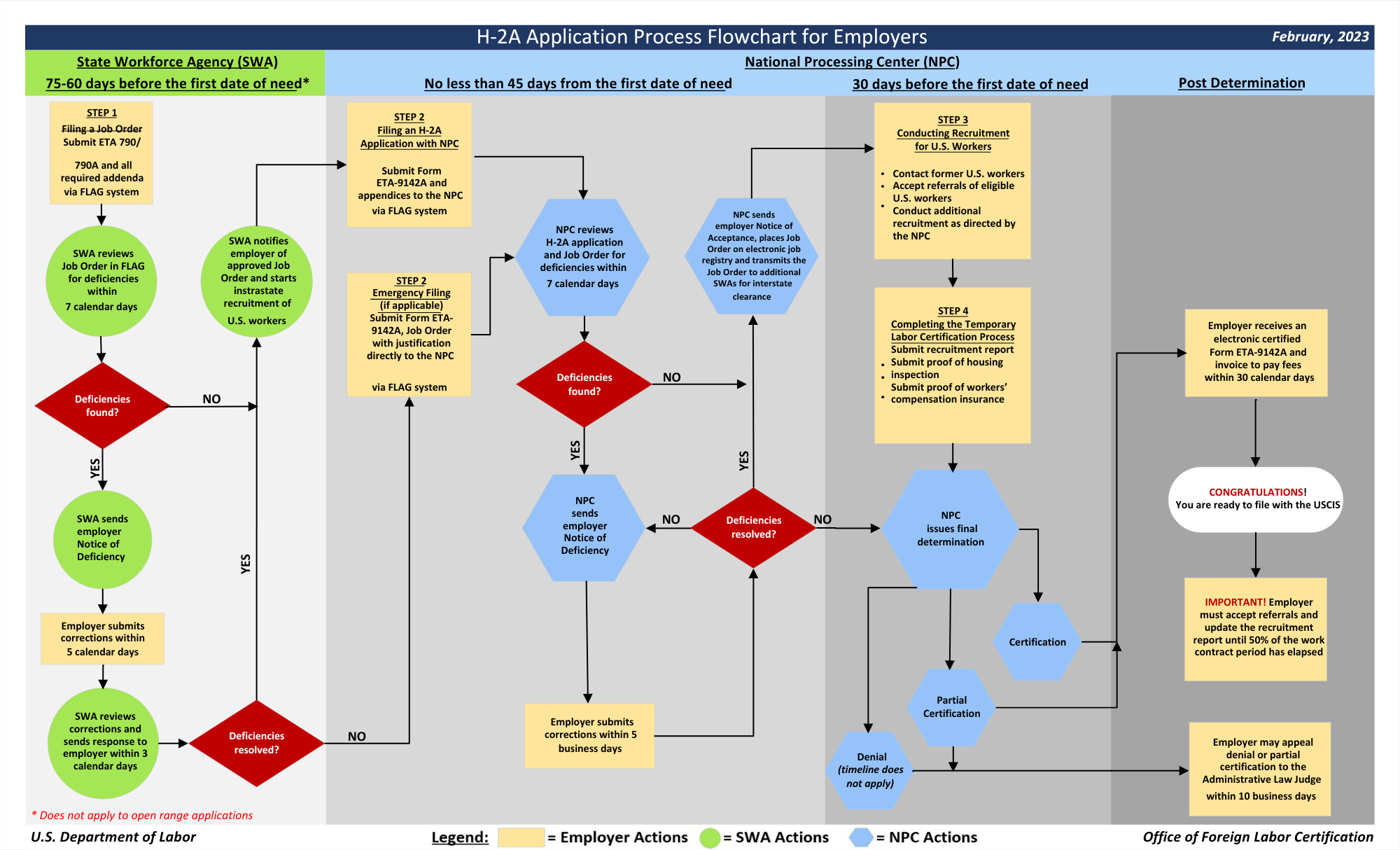
Figure 4.3 : H-2A Application Flowchart
As a condition of using temporary nonresident agricultural labor the DOL is required by Congress with determine that two conditions exist:
“There are not sufficient able, willing, and qualified United States (U.S.) workers available to perform the agricultural labor or services of a temporary or seasonal nature for which an employer desires to hire temporary foreign workers (H-2A workers); and
The employment of the H-2A worker(s) will not adversely affect the wages and working conditions of workers in the U.S. similarly employed. (H-2A Temporary Agricultural Program, 2022).
All applications must be filed electronically with DOL through its Foreign labor Application Gateway (FLAG). Employers that employee H-2A workers must meet certain minimum requirements. They must pay the prevailing wage rate that is defined as the average wage rate paid to similar workers, in similar work, in the same geographic area. H-2A workers must be covered under the employer’s workers compensation insurance. Employers of H-2A workers must comply with all applicable labor laws.
The basic steps are to submit an H-2A job order through FLAG. Where there are joint employer situations, only one application should be submitted. This situation is fairly common in seasonal agricultural work where migrants follow the work to different farms as production moves north with the advancing season or where workers work on more than one farm in a geographic area.
The second step involves applying for a Temporary Employment Certification. The third step is to conduct recruitment for US workers. The failure to obtain an adequate number of workers is evidence of a shortage requiring temporary foreign labor. At the completion of the temporary labor certification process the certificate is automatically forwarded to USCIS. Figure 4.3, developed by the US Department of Labor, Office of Foreign Labor Certification, provided a detailed visual of the flow of the application through the DOL.
USCIS processes the petition (Form I-129, Petition for a Nonimmigrant Worker) after it is received from the DOL. H-2A visa holders must come from an eligible country. Those eligible to file the petition are a US employer, a US agent as defined by the regulations, or an association of US agricultural producers as joint employers.
The initial H-2A classification lasts for one year, and may be extended for up to three years. After three years, the H-2A visa holder must return to their home country for a period of at least 3 months. The H_2A worker’s spouse and unmarried children under the age of 21 may join the worker by obtaining an H-4 nonimmigrant classification. Those under the H-4 nonimmigrant classification may not take employment.
Once the USCIS has processed the petition, the applicant must complete Form DS-160 on the US Department of State website and upload a photograph. Once this is complete the applicant may schedule an interview at the US Embassy or Consulate in the country where they live. The DOS website provides a tool to obtain an interview at the local US embassy or consulate.
The Migrant and Seasonal Agricultural Worker Protection Act (MSPA) governs worker protection for both migrant and seasonal farm workers. It governs wages, housing, transportation, disclosures, and recordkeeping. It requires farm labor contractors to register with the US Department of Labor.
Temporary protected status
There are various visa types that allow a person to work without being a permanent resident. These are individuals legally in the United States under temporary protected status. Although not permanent residents, they are authorized to work. Though the authorization to work is included within the status conferred by the visa, such individuals must generally file the USCIS Form I-765, Application for Employment Authorization.
Cubans, Haitians, Nicaraguans, and Venezuelans are not automatically authorized to work once paroled into the United States. They must first file Form I-765 and receive authorization to work. Some of these workers are filling critical agriculturally related jobs, particularly in slaughter plants.
The second important category that agricultural employers are likely to encounter are those that have received Deferred Action for Childhood Arrivals (DACA). Such individuals are not legally in the United States but may remain in the United States under the USCIS’ discretion to defer removal. Such individuals may work if they complete Form I-765 and show that working is an economic necessity. Individuals that qualify for DACA were brought to the United States as children. In addition to that requirement there is an application process that they must complete with USCIS in order to receive DACA status. Receipt of DACA status is not automatic. There are other deferred action categories that agricultural employees are less likely to encounter. Employment rules for those other categories are treated in the same manner as for DACA.
There is some work that those with deferred action status cannot take. Federal law (18 U.S. 922(g)(5)(A)) generally prohibits such individuals from transporting or possessing firearms or ammunition. Such individuals may not work in any activity that constitutes a federal crime. That means that they cannot be employed by any farm growing cannabis (marihuana), or any business processing or selling it. This is true even where those activities are authorized by state law. Although hemp is legal under federal law, those under deferred action status would be best advised to avoid such employment. Although the risk is low, hemp that tests above the THC limit in federal law must be destroyed because it is cannabis, not hemp. An individual who handled such material would be in technical violation of the conditions of deferred action.
Employers are not allowed to discriminate against those under deferred action. Employers may require only that information and documents required by Form I-9.
Undocumented workers
Undocumented workers are those that are not legally authorized to work in the United States. Some may be legally in the United States under a visa category that does not authorize them to work. Others may not be legally in the United States.
Example 4.3. Patrick is a citizen of the United Kingdom. He was studying at a US university under a student visa that does not allow him to work. He took a job at a local bar as a bouncer to earn some spending money. Patrick was legally in the United States but not authorized to work. Based on his social media posts, the US Immigration and Customs Enforcement (ICE) initiated removal proceedings against him. Since Patrick had completed his requirements for graduation, he agreed (without consulting legal counsel) to voluntary departure. Several years later Patrick was offered his dream job in the United States. Based upon his earlier unauthorized employment, Patrick’s application for a work visa was rejected.
Example 4.4. Joe was in the United States under an H-2A visa. He agreed to his employer’s request to stay on for a few months beyond his expected departure date. Neither he nor his employer applied for an extension of his H-2A visa. Without an extension of his visa, Joe was not legally in the United States and unauthorized to work in the United States. If detected, he could be deported and/or denied reentry to the United States to work at a later date. His employer could face civil penalties for violations of immigration laws.
There is a large category of workers that entered the United States illegally without ever having had a visa. The largest number enter the United States by illegally crossing the US border with Mexico; however, an increasing number are crossing unguarded sections of the US border with Canada. Some also come by boat to Florida.
Analysis by USDA’s Economic Research Service (ERS) of data collected through the National Agricultural Workers Survey, administered by the US Department of Labor, suggests that half of all crop workers employed by US farmers are not authorized to work in the United States. Estimating the number of unauthorized workers in any industry is difficult because neither the workers nor their employers readily admit to their violations of law. ERS estimates that an astounding half of all agricultural workers in crop production are not authorized to work in the United States. This estimate does not include other areas such as dairy and slaughter where the number of unauthorized workers is believed to be high.
Nonetheless, the existence of many employers willing to flout the law can be inferred from the millions of potential entrants being apprehended at US borders. The numbers reflect both the level of desperation of migrants and the vast numbers of employers willing to provide them with jobs. Both workers and employers face significant risks. For workers the risks include deportation, debarment from future entry, and for repeat offenders, imprisonment.
Employers face both civil and criminal penalties for both immigration and tax violations. Employers also face reputational and operational risks. Loss of a farm’s work force at harvest can be disastrous. ICE has limited resources for enforcement, so it tries to maximize the publicity that it receives from enforcement activities. The goal of ICE in doing this is to discourage farms from hiring undocumented labor. Targeting large or prominent farms tends to maximize the effectiveness of ICE’s enforcement dollars.
Being raided for labor violations does not enhance a farm’s reputation with buyers of its products. For farmers that employ these undocumented labors through brokers, there is the risk of entanglement in a 13th Amendment (slavery) prosecution. It is unfortunately not rare for brokers of undocumented labor to accept payment from farmers and fail to pay workers some or all of what the workers were promised. Such workers have little or no legal recourse to address their plight. These situations often come to light when there have been serious injuries or deaths among the workers.
It is disheartening to be discussing these issues in the 21st century; however, this is the reality of much of the agricultural labor market. It is not a situation likely to be resolved in the near future. Many farms either cannot obtain legal workers or are operating at tight margins that make legal workers too expensive. There are segments of agriculture that would cease operations without undocumented labor. According to ERS, the number of undocumented workers in the crop sector has increased from a rough estimate of 14% in the 1989-91 to 55% in 1999-2001, with a decline to 40% in 2018- 20. The trend has been for more workers, both unauthorized and authorized to work, to be settled rather than migrant (following the crop). According to ERS, about 85% of crop workers are settled.
Example 4.5. The QSQ Fruit Farm has been raising sweet cherries for five generations. Much of their workforce is undocumented. The cherry crop was one of the best in years. On the second day of harvest, ICE agents presented the manager of the farm with a search warrant. Many of the undocumented workers were arrested and the rest fled. QSQ limped along with its documented workers and family labor; however, the majority of the crop was lost for lack of harvesters. ICE sent a press release documenting the raid to all of the major press outlets in the region, so knowledge of the raid was widely known. One of QSQ’s major buyers cancelled its contract with QSQ based upon a contract provision that required QSQ to observe all applicable laws and regulations.
BASIC RULES GOVERNING AGRICULTURAL EMPLOYMENT.
Both the federal government and the states regulate agricultural labor. The Fair Labor Standards Act (FLSA) is the primary federal statute giving the DOL the authority to regulate minimum wages, overtime pay, employment of minors, and the use of volunteers. The Migrant and Seasonal Agricultural Worker protection Act (MSPA) provides additional authority to the DOL to regulate employers of seasonal and migrant laborers. Migrant laborers move to follow the work. Typically, they travel north as the as the year and the harvest advances. Seasonal workers do not move but work only during the season when the work is available.
On most farms, determining whether an employee is an agricultural employee is simple; however, it can be a complex multistep process. As agriculture has become more specialized, with some steps done under contract, making this determination more difficult. To make this determination several questions must be answered. Was the activity a primary or secondary agricultural activity? Was the activity done on a farm? Were those engaged in the activities employees?
Example 4.7. Ernie raises Christmas trees in eastern Tennessee. He pays overtime to any worker that works more than 40 hours in a calendar week. Under the FSLA, Christmas tree production is considered forestry which is not an agricultural activity. Forestry is not covered under the agricultural exemption.
Example 4.8. Ernie’s sister, Ernestine, raises Christmas trees in North Carolina. She does not pay overtime because North Carolina is in the US Court of Appeals for the Fourth Circuit that held that Christmas tree work is agricultural labor. The Fourth Circuit encompasses Maryland, North Carolina, South Carolina, Virginia, and West Virginia.
Example 4.9. Wally is employed in raising Christmas trees by Ernestine. As an agricultural laborer is not entitled to time-and-a-half. She bought a small plot of land adjacent to her farm but across the state line in Tennessee. She asked Wally to spend an hour a week tending the Christmas trees on the land in Tennessee. Since Tennessee is in the 6th Circuit, Christmas tree labor is not exempt. All of Wally’s labor in a calendar week is not exempt despite the fact that his non-exempt labor was only an hour per week. Earnistine must pay Wally time-and-ahalf for all of his labor over 40 hours.
A primary agricultural activity is one that is clearly a typical farm activity. A secondary agricultural activity is one that is agricultural if done to support a primary agricultural activity. If the same activity was done without direct association with a primary agricultural activity, that activity is not agricultural.
Example 4.10. Johnny operates a broiler farm. He buys grain and other feed ingredients. He uses a small mill to blend those ingredients and produce feed for his broilers. The worker that operates the mill is engaged in agricultural labor that is exempt from the overtime rules.
Example 4.11. Johnny decided that there was an opportunity to produce feed for his neighbors as well as for his own broilers. Work done operating the feed mill is no longer exempt agricultural labor because it is not engaged in exclusively to support a primary agricultural activity. All of the hours worked by any worker that spends any time working in the feed mill during a calendar week are not exempt for that week. There is no de minimus amount of non-agricultural labor below which the agricultural exemption will not be lost for that week.
Example 4.12. Mega Chicken owns a vertically integrated broiler operation that controls every step in the production of broilers through contracts with farmers. Eggs for hatching are produced on farms under contract with mega to produce hatching eggs, that are then transferred to a hatchery. Once chicks are hatched, they are grown out on farms by farmers under contract with farmers that specialize in growing. Mega continues to own the chickens, except for those that die. Those that die become the property of the farmer that assumes disposal responsibility. Mega owns a central feed mill that produces feed for both the layer operations and the several thousand farms under contract to grow out the chicks. Labor required to operate the feed mill is not exempt agricultural labor despite Mega’s retention of title to the chickens.
Farm workers are subject to the federal minimum wage of $7.25 per hour. Many states and some localities have their own minimum wage laws. State and local governments may set minimum wages higher, but not lower, than the federal minimum wage.
The parent, spouse, child, or other member of the agricultural employer’s immediate family are not considered employees for purposes of the FLSA. None of the FSLA provisions, including those restricting child labor, apply to family members. For non-family labor the minimum age for agricultural labor is 16. Youths aged 14-16 may work in agricultural labor that has not been declared hazardous by the US Department of Labor. Youths aged 14 to 16 may not be employed during school hours. Youths 12-13 of ages may work in non-hazardous jobs during non-school hours on the farms that also employ their parent or parents or with written parental consent. Youths under 12 years of age may work outside of school hours in non-hazardous jobs with parental consent if none of the employees working on the farm are subject to FLSA minimum wage requirements.
CONCLUSION
Farm labor markets are both international and very local. Family labor is governed more by family relationships than market forces. It is the largest component of agricultural labor. Domestic hired labor tends to be very local and is often tied to a particular locality by family relationships. Documented foreign labor is governed by a myriad of federal rules that sometimes require considerable documentation. The undocumented labor market is large but as a result of its prohibited nature difficult to document.
REFERENCES
2017 Census of Agriculture. (n.d.). National Agricultural Statistics Service (NASS).
https://www.nass.usda.gov/Publications/AgCensus/2017/ Full_Report/Volume_1,_Chapter_1_US/
Castello, M. and Simnitt, S. (2023, March 22). Farm labor. USDA Economic Research Service.
https:// www.ers.usda.gov/topics/farm-economy/farmlabor/
Foreign Labor Application Gateway. (2023, January 3). US Department of Labor.
https://flag.dol.gov/
Green Card. (n.d.). US Citizenship and Immigration Services.
https://www.uscis.gov/green-card
H-2A Temporary Agricultural Program. (2022, November 17). US Department of Labor.
https://www.dol.gov/agencies/eta/foreign-labor/programs/h-2a
H-2A Temporary Agricultural Workers. (2022, November 10). US Citizenship and Immigration Services.
https://www.uscis.gov/working-inthe-united-states/temporary-workers/h-2atemporary- agricultural-workers
I-9, Employment Eligibility Verification. (n.d.). US Citizenship and Immigration Services.
https:// www.uscis.gov/i-9
Less, Mike, (2021, June 6). 3 John Deere 72 Row Planters planting Soybeans in Ohio. Farmhand Mike YouTube Channel.
https://youtu.be/_escSKXqqV0
Mercer, M. (2022, August 22). Yes, slavery is on the ballot in these States. Stateline (Pew).
https://www.pewtrusts.org/en/research-and-analysis/ blogs/stateline/2022/08/22/yes-slavery-is-onthe-ballot-in-these-states
Migrant and Seasonal Agricultural Worker Protection Act (MSPA). (2023). US Department of Labor, Wage and Hour Division.
https://www.dol.gov/agencies/whd/agriculture/mspa#
National Agricultural Workers Survey. (2020). US Department of Labor, Employment and Training Administration.
https://www.dol.gov/agencies/eta/national-agricultural-workers-survey
Northwest Ordinance (1787). (2022, May 10). National Archives.
https://www.archives.gov/milestone-documents/northwest-ordinance
Number 118, Volume 37 F.R. 12083 (June 17, 1972) (to be codified at Volume 29 C.F. R. § 780).
https://www.govinfo.gov/content/pkg/FR-1972-06-17/pdf/FR-1972-06-17.pdf
This interpretive rule provides the Department of Labor’s guidance regarding agriculture employment including exemptions. While guidance is not a definitive interpretation of the law, it provides a safe harbor to employers in enforcement actions.
O’Donoghue, E., MacDonald, J.M., Vasavada, U., and Sullivan, P. (2011, December 01). Changing farming practices accompany major shifts in farm structure. USDA Economic Research Service.
https://www.ers.usda.gov/amberwaves/2011/december/changing-farmingpractices/
Ohio land and property. (2022, December 12.) Family Search.
https://www.familysearch.org/en/wiki/Ohio_Land_and_Property
Price, C.A. (2023, March 28). Enforcement and removal operations. US Immigration and Customs Enforcement.
https://www.ice.gov/about-ice/ero
Quarterly Census of Employment and Wages. (2022, September 7). US Bureau of Labor Statistics.
https://data.bls.gov/cew/apps/bls_naics/v3/ bls_naics_app.htm#tab=hierarchy&naics=2022&hier=default
Surveys: Farm labor. USDA National Agricultural Statistics Service.
https://www.nass.usda.gov/Surveys/Guide_to_NASS_Surveys/Farm_Labor/
Temporary worker visas: overview. (n.d.). US Department of State, Bureau of Consular Affairs.
https://travel.state.gov/content/travel/en/ususvisas/ employment/temporary-worker-visas. html
Thompson, M. (2019, November). The new generation of farmers and ranchers infusing U.S. agriculture. Farm Foundation Issue Reports.
https://www.farmfoundation.org/wp-content/uploads/2020/02/FINAL-Beginning-Farmer-Issue-Report-Nov-2019.pdf
Treaty of Paris. (1783, September 3). National Archives.
https://www.archives.gov/milestonedocuments/treaty-of-paris
Usher, A. (2011, April). Public schools and the original federal land grant program. Center on Education Policy.
https://files.eric.ed.gov/fulltext/ED518388.pdf
Vielkind, J. (2022, October 17). New York apple growers fume over overtime rules. The Wall Street Journal.
https://www.wsj.com/articles/new-york-apple-growers-fume-over-overtimerules-11665999004
Beginning in 2020, New York required a rate of time-and-a-half for agricultural labor in excess of 60 hours per calendar week. It plans to gradually lower the threshold to 40 hours by 2032. Seven states require overtime. Only two other states set a 40-hour threshold. The California threshold was set at 40 hours in 2022 and the Washington 40-hour threshold will begin in 2024.
Wang, S.L., Mosheim, R., Njuki, E., and Nehring, R. (2022, January 6). Agricultural productivity in the U.S. USDA Economic Research Service.
https://www.ers.usda.gov/data-products/agriculturalproductivity-in-the-u-s/