


Chapter 07: Markets for Agricultural Commodities: The role of farm programs for supported commodities
Markets for Agricultural Commodities: The role of farm programs for supported commodities
“An army marches on its stomach.”
Attributed to both Napoleon and Frederick the Great
INTRODUCTION
This chapter addresses markets for covered commodities. Covered commodities are those for which the 2018 Farm Bill, as extended, provides support to those farmers that grow them. The commodities covered by various types of support in the 2018 Farm Bill include wheat, oats, barley, corn, grain sorghum, rice, soybeans, sunflower seed, rapeseed, canola, safflower, flaxseed, mustard seed, crambe and sesame seed, seed cotton, dry peas, lentils, small chickpeas, large chickpeas, and peanuts. Sugar beet and sugarcane are covered under separate provisions. They will also be discussed in this chapter.
The trend in support for covered commodities, with some exceptions discussed below, has been to decouple production from income support for farmers. The purpose of this approach has been to allow supported commodities to trade at world market prices. The Agriculture and Consumer Protection Act of 1973, (hereinafter, the 1973 Farm Bill) shifted from the parity approach adopted in the 1930s to a production incentives policy that partially decoupled production from farm income support. Congress made this shift because it encouraged production for export while having limited on the federal budget. While the theoretical impact of a shift to deficiency payments and target prices was high, the practical impact was negligible because agricultural commodity prices were historically high and rising.
PARITY AND THE NEW DEAL PROGRAMS
Parity was the system of choice adopted under FDR’s New Deal programs. The parity system was based upon supporting commodity prices at some percentage of their historical high, usually the period starting in 1914 with the outbreak of the First World War in Europe and ending with the conclusion of that war. Parity was accomplished through a variety of tools that included allotments, marketing quotas, import tariffs and controls, and marketing loans or outright purchases, both of which resulted in the government acquiring supported commodities.
Allotments limited the amount of land that a farmer could use for growing a supported crop. The allotment system required that USDA set a total amount of land for growing a supported commodity. Using a complex process, USDA allocated to each farmer the right to grow the supported commodity (based upon prior planting history) on a certain acreage (the allotment). Each farmer was required to ensure that the acreage for growing the supported commodity did not exceed the allotment. Enforcement was done through aerial photography with follow-up on the ground to inspect suspicious fields. The process of establishing, measuring, and enforcing allotments was expensive and sometimes dangerous – it was not unheard of for the planes photographing fields to be shot at.
Marketing quotas limited the amount of the covered commodity that the farmer could sell in any given crop year. Marketing quotas were typically designed to work with allotments. Farmers with excess production were required to either store or destroy surplus commodities. As with allotments, marketing quotas required vigorous enforcement to prevent leakage through fraud.
Import tariffs and controls were designed to prevent imports of the supported commodity from undermining price support. Import controls more directly limited imports by setting import quotas for the supported commodity or by outright prohibitions on imports. Marketing loans and outright purchases are similar. Both are designed to remove excess supported commodities from the market.
Marketing loans continue to be an important tool in the marketing of supported commodities. Both marketing loans and purchases are made through the Commodity Credit Corporation (CCC). The CCC is a federally owned corporation that makes marketing loans and purchases of commodities. The CCC takes ownership of farmers’ commodities when the commodities pledged under nonrecourse marketing loans are forfeited by the farmers. The government offers loans at some set price per bushel (or other unit) to farmers (or processors as in the case of sugar). Farmers have until a set date to redeem the commodity under loan by repaying the loan. If the farmer does not repay the loan, the government takes ownership of the commodity. The loans are nonrecourse, so the farmer has no obligation repay the government for any deficiency. Farmers will usually redeem the commodity if its price is above the loan rate and default if the price of the commodity is at or below the loan rate. Defaulting has no impact on the farmer’s credit worthiness because federal marketing loans are nonrecourse.
Outright purchases of supported commodities were once a common means of supporting the price of supported commodities; however, with the shift to market-oriented farm policies, outright purchases have not been frequently used in recent decades. Congress has moved toward market-based programs to make U.S. agricultural commodities competitive on world markets. This shift in policy has made the United States a major exporter of agricultural commodities.
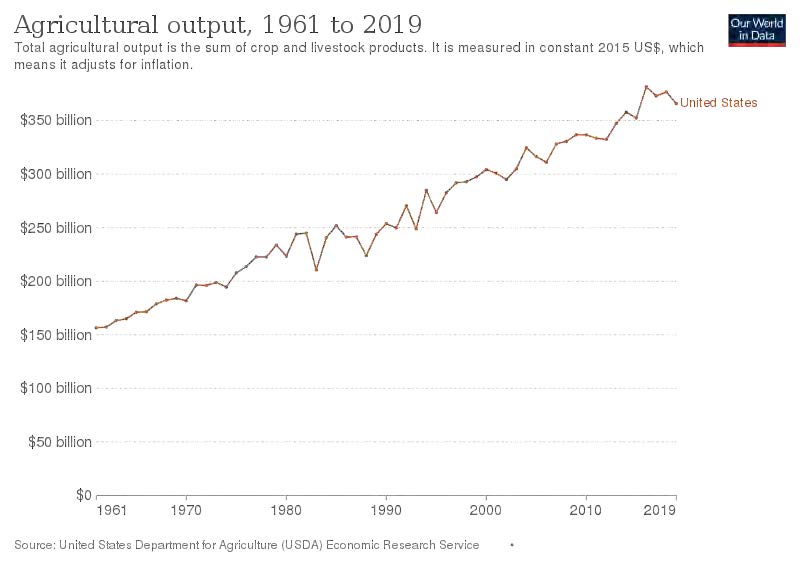
Figure 7.1 : Development of agricultural output of the US in 2015 US$ since 1961
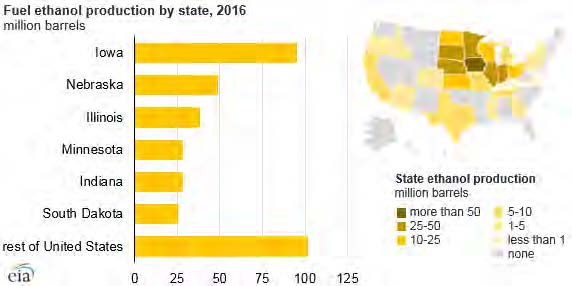
Figure 7.2 : Ethanol fuel production by state
Both marketing loans and outright purchases have sometimes burdened the federal government with large quantities of commodities that cannot easily be disposed of without undermining price support. There are four ways of handling these surplus commodities: charitable gifts or below market sales domestically, charitable gifts or below market sales abroad, destruction of the commodities, and continued storage until it can be sold. The CCC may sell surplus commodities only when the market price exceeds the current price support level. All these methods have been used either in combination or individually. All have advantages and disadvantages. In the case of sugar, a fifth method of disposal has been used. It is converted to ethanol and then the ethanol is sold. That practice continues in the sugar program.
Both domestic and foreign gifts or below market sales have provided important nutritional support to at-risk populations. Leakage is a problem. It is not entirely possible to prevent these surplus commodities from re-entering commercial channels and thereby undermining price support. Foreign gifts or sales have the added risk of undermining farmers in the recipient countries and stifling needed agricultural development. Nonetheless, foreign gifts or below market sales have served foreign policy goals and created considerable goodwill. Destruction of commodities is very effective at supporting price support because leakage is impossible. It is a lowcost option compared to storage. It suffers from being politically unpopular. Storage of surplus commodities has been used in the past. It isexpensive and requires the government to engage in massive commodity operations. Monitoring of storage both to ensure that commodity quality is maintained and to prevent fraud requires considerable personnel and funding. At times of low prices, finding storage can be difficult. The author recalls efforts of his colleagues at USDA to find empty barrages on the Mississippi River that could be used for storage of surplus commodities. Sales of surplus commodities through ordinary market channels when commodity prices are above the support level tend to dampen price swings. This is beneficial to consumers of commodities but not to farmers. There is a tradeoff between risk avoidance and profitability. Greater price volatility tends to increase profitability at the expense of a higher risk of farm business failure.
MARKET-BASED PROGRAMS AND DECOUPLING
As discussed above, the 1973 Farm Bill rejected parity and moved toward market-based programs to support farmers. The 2014 and 2018 Farm Bills took this further by partially decoupling farm income support from production. For the food and feed grains plus oil seeds, farmers were allowed to make some complex decisions about the support they wanted.
The 2018 Farm Bill provides three primary income support programs for supported commodities. These are the Price Loss Coverage (PLC), Agriculture Risk Coverage (ARC), and the Marketing Assistance Loan Program (MALP).
The Marketing Assistance Loan Program (MALP)
The MALP offers farmers marketing loans that are quite similar to those offered since marketing loans were created under the Agricultural Adjustment Act of 1938. The eligible supported commodities include wheat, corn, grain sorghum, barley, oats, upland cotton, extra-long staple (ELS) cotton, long- and medium-grain rice, soybeans, other oilseeds (sunflower seed, rapeseed, canola, safflower, flaxseed, mustard seed, crambe, sesame seed, and other oilseeds as designated by the U.S. Department of Agriculture), peanuts, wool, mohair, honey, dry peas, lentils, and small and large chickpeas.
MALP participants have three ways to settle their marketing loan. The first is to repay the loan with interest. Interest is charged at a below market rate. If the market price for the commodity is below the loan rate, farmers have a second option. They may repay the loans at a lower amount than the loan they received. This is called the alternative loan repayment rate (which is based upon the current market price that is lower than the loan rate). The difference between the original loan rate and the alternative loan repayment rate is called the marketing loan gain. No interest is charged on the marketing loan when redemptions are made below the original marketing loan rate. This loan program benefit may be taken directly (without taking out a marketing loan) when the market price is below the original market loan rate. These benefits are called loan deficiency payments (LDPs). Determining the market price of a supported commodity is different for each supported commodity.

A Q & A on Commodity Loans with Shayla Watson
The third way to settle MALP loan is by forfeiting the commodity to the government. MALP loans are nonrecourse. There are no consequences to the farmer of default beyond forfeiture of the commodity to the government. No deficiencies are assessed, and no report is made to any credit reporting agency.
Price Loss Coverage (PLC) and Agriculture Risk Coverage (ARC) Programs
The 2018 Farm Bill required farmers to elect between the PLC and the ARC programs. The election for the 2019 crop year also covered the 2020 crop year. For crop years 2021, 2022, and 2023, farmers were required to make an election for each year. If no election was made the farmer remained in the program selected for the previous crop year. Elections are crop by crop. Where there are multiple owners of a farm, the elections must be unanimous. There are two types of ARC that farmers may choose between. These are Agriculture Risk Coverage-County (ARC-CO) and Agriculture Risk Coverage-Individual (ARC-IC).
Brad Luben speaks about the 2024 PLC & ARC
Neither PLC nor ARC-CO are based upon current production. PLC and ARC-CO are based on a farmer’s historic base acres also defined by law. ARC-IC is based upon current production tied to historic base acres. ARC-IC has not been widely used by farmers. All these programs have in common that no payments are provided for production that is not tied to historic base acres. Base acres for each commodity must be enrolled each year to receive payments. All three of these programs mitigate risk and increase the willingness of farmers to accept price risk in their marketing strategies because these programs guarantee a certain amount of revenue.

ARC/PLC Definitions (understanding base acres)

ARC & PLC factsheet
There are eligibility requirements and payment limitations or the for the commodity support programs described above. These include a requirement to be actively engaged in farming, an upper limit on adjusted gross income (AGI), conservation compliance, compliance with controlled substance prohibitions, and citizenship requirements.
Recipients must be actively engaged in farming. These complex requirements include combinations of contributions that include capital, land, equipment, active personal labor, and active personal management. The rules vary depending upon whether the recipient is an individual or one of the many legal entities that exist under state law. There are separate rules for cash-rent tenants that require such tenants to be eligible. These include contributions of equipment and active personal management, or active personal labor. There are also rules determining the eligibility of deceased persons who died prior to issuance of payments.
The AGI limit on receiving farm program payments and some conservation payments is $900,000. Whether the limit has been exceeded is based upon the three tax returns prior to the year for which benefits are sought. The determination for legal entities is more complex than for individuals; however, the dollar amount is the same. Payment limitations for ARC and PLC, except for peanuts, are a combined $125,000 limitation. Peanuts have a separate limitation. Conservation programs have their own limitations set program by program. The Loan Deficiency Program (LDP) and the Market Loan Gain (MLG) are not covered by these limitations; however, those with an AGI more than $900,000 are not eligible for the LDP or the MLG. Payment limitations promote equity and political acceptability of these programs by prohibiting very large farmers from obtaining eyepopping federal payments. Creative attorneys have nonetheless assisted large farmers in obtaining total payments well above the published limits.
The Food Security Act of 1985 (1985 Farm Bill) established certain conservation requirements known as ‘Swampbuster’ and ‘Sodbuster’ that prohibit certain activities on wetlands and highly erodible lands, respectively. Farmers should confer with USDA Natural Resources Conservation Service (NRCS) personnel prior to conducting any activities on either wetlands or highly erodible land. Wetlands requirements under the 1985 Farm Bill are often stricter than the U.S. Army Corps of Engineers requirements under section 404 of the Clean Water Act. Failure to follow these rules may result in the loss of farm program benefits.
Those convicted of controlled substance violations are ineligible for farm program and conservation program payments. The period of ineligibility depends upon the nature of the conviction.

Figure 7.3 : U.S. Food and Drug Administration agents inspect packages for illegal drug shipments at an international mail facility in New York.
Those that are not citizens of the United States are ineligible for most farm program and conservation program payments. Legal entities in which the foreign ownership is below certain minimums are not disqualified.
Federally subsidized crop insurance (discussed Chapter 6) is primarily a tool to mitigate physical risks; however, some tools discussed in chapter 6 also mitigate price risk by providing a revenue guarantee.
Another tool that reduces domestic price risk is import tariffs. Many agricultural commodities are subject to import tariffs, including tariffrate quotas (TRQs) discussed below. TRQs are used along with other individually negotiated preferences designed to favor specific exporting countries. These negotiated tariffs reductions are often provided in return for favored treatment of U.S. exports, including agricultural exports. Export markets are discussed in more detail in Chapter 18.
Sugar and peanut programs are discussed below since they differ somewhat from other supported commodity programs.
Peanuts
The 2002 Farm Bill ended the marketing quota system for peanuts that had been in place since the 1930s. In its place is a system of support much more like that for other commodities. Tariff-rate quotas (TRQs) remain an important tool for protecting the domestic market. Selected countries receive a TRQ that they may export to the United States at a low tariff. Exports to the US above a country’s TRQ are charged a much higher tariff. Peanut growers are generally dependent on the price their local shellers are willing to pay because there are no well-developed markets for peanuts that determine regional and national prices. This is in contrast to markets for more widely grown crops such as corn and soybeans. (Peanuts are grown primarily in the southern tier of the United States.) There are no well-developed futures markets for peanuts. Thus growers have no alternatives to contracting with local shellers.
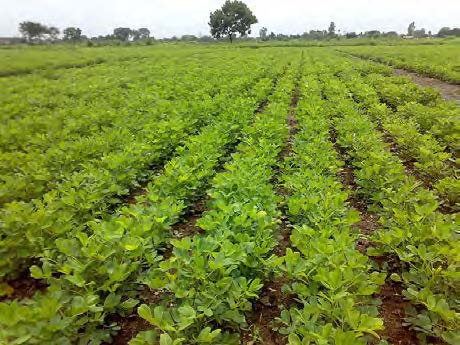
Figure 7.4 : Cultivation of Peanut crops
Sugar
Sugar is produced by even fewer producers than peanuts. It comes from either sugar cane or sugar beets. Sugarcane and sugar beet processors are subject to marketing allotments that are designed to limit domestic supply. Each marketing year (October through September), USDA establishes an overall allotment quantity (OAQ). The OAQ can be no less than 85 percent of the estimated human consumption. The annual OAQ is divided between sugar cane and sugar beets. The OAQ for sugar cane is divided among the states growing sugar cane. OAQ is further divided within states among sugar cane processors. If a processor cannot use all its allotment, the allotment is allocated to processors within the same state. If the remaining allotment cannot be used within a state, it is then allocated to other states and producers within those states. There are no state level allocations for beet sugar. Allocations are made directly to processors. There is no means for reallocating OAQ between cane and beet sugar.
Excess marketing allotment is assigned to the CCC, which supplies the sugar out of inventory. If the CCC lacks sufficient inventory, the remaining market allocation is assigned to imports. Except for imports using excess market allocation, sugar imports are subject to tariffs designed to protect the domestic market. Sugar imports are covered under TRQs with higher tariffs for imports from a country that exceeds its TQR.to protect the domestic market.
Sugar forfeit to the CCC by a processor is counted against its marketing allotment. Unlike other covered commodity marketing loans that are made to the producer, sugar marketing loans are made to processors. The reason for this is that sugar cane and sugar beets are bulky commodities that are not easily stored. Processors are required to extend the benefits of the marketing loans to the beet and cane producers.
Marketing beyond the farm gate
Farmers have a variety of options for selling their products. They may forward contract with a varieties of buyers. They may sell in the cash market at harvest. They may take out a MALP loan and forfeit the commodity to the government. They may use futures and options to market their crop. Futures markets are discussed in Chapter 14 and options markets are discussed in Chapter 15. Farmers also have an alternative to selling their commodities. They may use the commodity to feed livestock. Corn used for feeding hogs on the farm is the most common example of this alternative to markets.
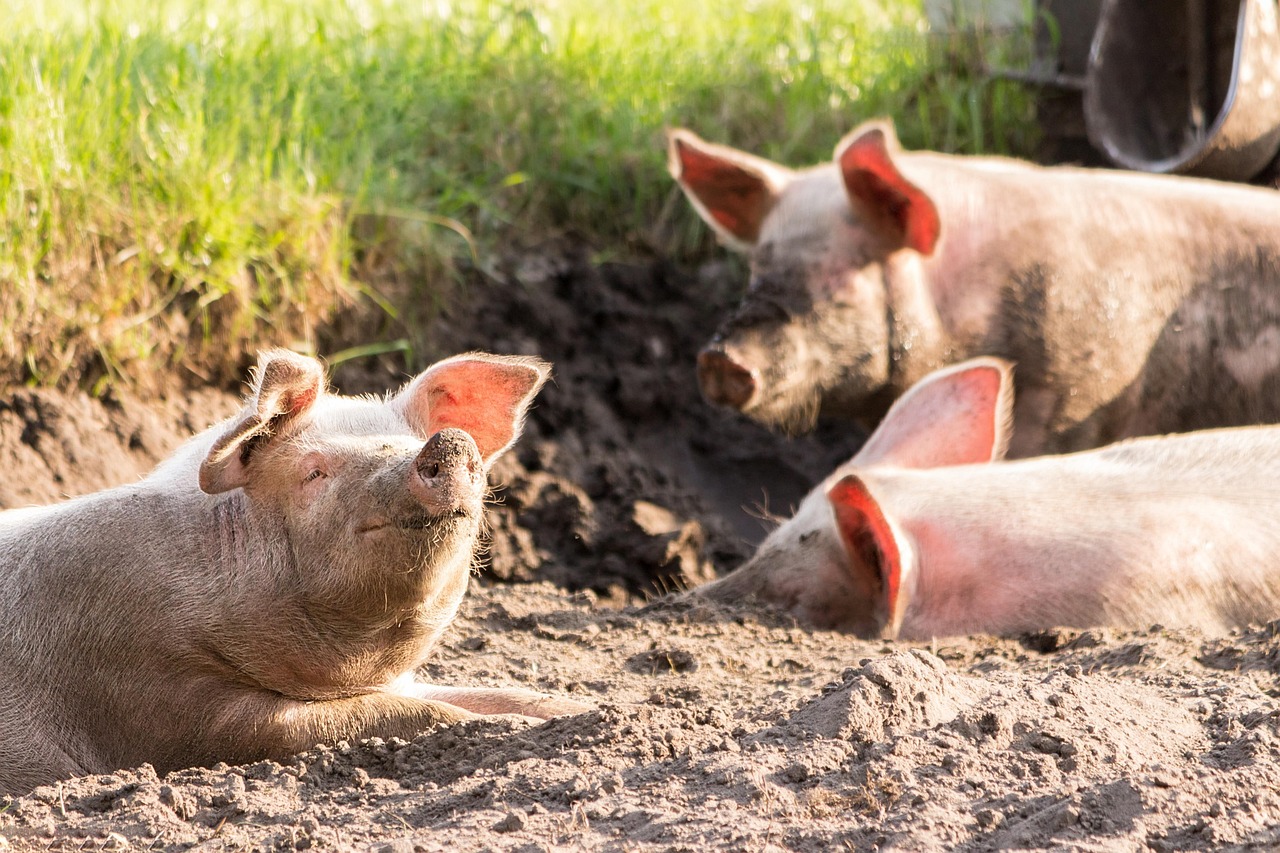
Figure 7.5 : Hogs in a farm
There are two basic types of forward contracts. These are acre contracts and contracts for a specific quantity, e.g., bushels, or bales. In acre contracts, production risk is shared with the buyer. The farmer is required to deliver only that amount of commodity that was produced on a designated acreage. If there was a complete crop failure the farmer is not required to deliver anything. With contracts for a specific quantity, the farmer is required to deliver that amount of the commodity specified in the contract. If the farmer did not produce enough of the commodity to fill the contract, the farmer must buy the additional commodity needed to fulfill the terms of the contract. Farmers using this type of contract generally contract much less than their total expected production. Any excess above that required to fulfill the contract may be sold in the cash market.
Several factors distinguish forward contracts from futures contracts. Forward contracts are negotiated between a buyer and a seller that are known to each other. Futures contracts are standard contracts that are not subject to negotiation. All futures contracts for a specific commodity are for the same quantity whereas forward contracts may be available for any quantity. Forward contracts are not easy to buy or sell. Some forward contracts may even prohibit their sale or assignment. Futures contracts are bought and sold through markets established by exchanges every day that those markets are open. The identity of the buyer and seller on a specific futures contract do not know until near the maturity of the contract. Exchanges use associated entities to assign buyers and sellers on maturing contract. Almost all forward contracts result in the sale of the underlying commodity. Most futures contracts are closed by buying a corresponding contract before the maturity date. Only a small proportion of futures contracts result in the actual transfer of the underlying commodity. Futures contracts for a particular commodity all set the same location for delivery of the contracted commodity. In a forward contract, the parties (buyer and seller) can set any delivery location upon which they can agree. Chapter 14 provides more information about futures contracts and markets.

Agricultural Commodity Futures Contracts Specifications
Historically farmers sold their commodities to local elevators that then sold them either to users or large trading firms. The types of buyers have become more diverse. It is now common for users of a commodity to buy directly from farmers. Often these buyers will pay a premium over market because these arrangements provide them with a reliable supply at distances that save transportation costs.

Smithfield Grain
Example 7.1. Smithfield Grain is a wholly owned subsidiary of Smithfield Foods, which is itself a subsidiary of the W.H. Group of Hong Kong. Smithfield Grain purchases 64 percent of the grain needs of Smithfield Foods directly from farmers. That is almost 100 million bushels of grain per year. Smithfield Foods annually feeds about 16 million hogs.
Some of the large grain trading companies have moved into processing and direct acquisition of commodities from farmers. Cargill has moved more in this direction than the other large grain trading companies. Like Smithfield Grain, Cargill operates a network of grain elevators and offers a variety of contracts to farmers. The large grain trading companies are discussed in greater detail in Chapter 13.

Cargill North America Farmer Services
RISKS TO THE CURRENT MARKETING STRUCTURE FOR SUPPORTED COMMODITIES
Federal support for major commodities has been a feature of commodity production since the enactment of the Agricultural Adjustment Act of 1933 (the 1933 AAA), although much of the 1933 AAA was ruled unconstitutional by the Supreme Court. The 1933 AAA was replaced by the Agricultural Adjustment Act of 1938 (the 1938 AAA). The 1938 AAA along with the Agricultural Act of 1949 and the Commodity Credit Corporation Charter Act (1948) are the ‘permanent legislation’.
The permanent legislation has historically been superseded by temporary legislation in a series of farm bills. Without this series of temporary legislation, the permanent legislation would be the law. Although there has been a shift from supply control programs to more marketoriented programs, the constant has been the willingness of the Federal government to mitigate the risks that farmers take. Were Congress to repeal the permanent legislation and cease to provide support, it would upend existing market structures. For farmers that make multi-decade investments, the prospect of this is unsettling. Although the prospect of ending all risk mitigation for farmers is unlikely, the probability of it happening is greater than zero. Thus, this final section of the chapter addresses the risks to the current market structure.

Expiration of the Farm Bill
One of the major risks to the current market structure and the Federal programs that support it is the size of the Federal debt. Both the Biden and Trump Administration have incurred enormous annual deficits. The national debt is on track to exceed the national income as measured by gross domestic product (GDP). As the size of the debt increases, the annual cost of interest on the debt rises. This has been exacerbated by rising interest rates. It is a situation that is not sustainable. The House Freedom Caucus is composed of members of Congress that are both ideologically opposed to commodity programs and nutrition programs (SNAP, formerly food stamps, and other programs that provide food to those in need of assistance) that are a major feature of farm bills. They are concerned about the size of the national debt as well. In both the debate over the 2014 Farm Bill and the 2018 Farm Bill they attempted unsuccessfully to put the nutrition programs and the commodity support programs in separate bills. Severing the commodity support and nutrition programs would sever the coalition that supports farm bills. The result would be either much smaller programs or none at all. This is clearly the goal of at least some members of the Freedom Caucus. Concern over Federal spending extends well beyond the freedom caucus. Lack of agreements has delayed the next farm bill. The continuing resolution that prevented a government shutdown in fall of 2023 extended the 2018 Farm Bill through September 30, 2024. Given the current fiscal situation, it is very likely that payments under the commodity programs will be less generous than they have been in the past.
A second factor is the possibility of a reduction in demand for U.S. agricultural products. Increasing population alone will not increase demand for U.S. agricultural products. People must be able to buy them. The trade disputes with China that began in the Trump Administration, and which have been continued in the Biden Administration, albeit at a lower volume, has caused China to both attempt to increase domestic production and to source its purchases elsewhere. Of more importance is an overall shift to a higher tariff environment that has been a policy of both the Trump and Biden Administrations. High tariffs on U.S. imports tend to encourage U.S. trading partners to assess higher tariffs on their imports of U.S. products.
In announcing the Biden Administration’s 2022 trade policy agenda, Ambassador Katherine Tai announced a worker-centered trade policy that is consistent with the Trump Administration’s realignment of trade. All of the World Trade Organization (WTO) Appellate Body positions have been vacant since November 30, 2020. Without these positions filled the WTO cannot resolve trade disputes. As there is bipartisan agreement (albeit for somewhat different reasons) it is likely that this realignment will be enduring. It represents the biggest shift in US trade policy since the end of World War II. It appears that we are coming to the end of one of only two periods of generally falling tariffs in US history. This will ultimately translate into lower agricultural exports. A second factor reducing demand is the mandate to replace internal combustion engine driven vehicles with electric vehicles (EVs). About 40% of the U.S. corn crop is currently used to make ethanol, most of which is blended with gasoline. As EVs replace gasoline-powered vehicles, the demand for corn will fall. As demand for supported commodities falls the cost of current farm programs will increase. This will increase calls for eliminating commodity support programs or modify them to control production as was done in prior decades.
The most likely result is modification of the commodity support programs by reducing benefits and modifying terms to eliminate costly provisions. This is the gist of two recent GAO reports, one on the sugar program and one on the crop insurance program, that are referenced at the end of this chapter. There are important reasons for continuing the farm programs in some form. Efficiency is not the only value to consider. National security dictates a need for resilient food production and supply systems that can continue to operate in the face of a national emergency such as a limited nuclear attack. The supply chain disruptions that roiled the economy as the result of COVID-19 demonstrated the importance of resilience. The U.S food system performed well under the strains caused by the pandemic. Nonetheless, those that depend upon current market structures should engage in contingency planning as major changes in the commodity support programs may well occur.
What is the farm bill and why does it
matter? (full video)
US Plans for a Nuclear Attack [These plans include plans for post-attack agricultural recovery that is not included in this video.]
The US – China Trade War Explained in One Minute:
Causes/Reasons, United States Tariffs, etc.
REFERENCES
Agricultural Policy Team. (2023, February 7). Title I: crop commodity program provisions. USDA Economic Research Service. https://www.ers.usda.gov/ topics/farm-economy/farm-commodity-policy/ title-i-crop-commodity-program-provisions/
Attah, F. S. K. (2018). A look at peanut pricing in the post quota era. [Master’s thesis, The University of Georgia]. https://getd.libs.uga.edu/pdfs/attah_ festus_s_201808_ms.pdf
Appellate Body. (2023, December). WTO. https:// www.wto.org/english/tratop_e/dispu_e/appellate_ body_e.htm
Beckman, J. (2021, March 1). Do tariff-rate quotas function as intended by the world trade organization? Amber Waves. https://www.ers. usda.gov/amber-waves/2021/march/do-tariffrate- quotas-function-as-intended-by-the-worldtrade- organization/
Commissioners. (2024, January). Harmonized Tariff Schedule of the United States (2024) Basic Edition. United States International Trade Commission. Pub. No. 5483. https://hts.usitc.gov/
Coppess, J., Janzen, J., Zulauf, C., Schnitkey, G., Swanson, K., Paulson, N., and Baltz, J. (2022, September 15). Mulling Over Margin, Part 1: Introduction and Historical Background. farmdoc daily (12):142, Department of Agricultural and Consumer Economics, University of Illinois at Urbana-Champaign. https://farmdocdaily.illinois. edu/2022/09/mulling-over-margin-part-1- introduction-and-historical-background.html
DeSilver, D. (2023, January 23). Freedom Caucus likely to play a bigger role in new GOP-led House. So who are they?. Pew Research Center. https:// www.pewresearch.org/short-reads/2023/01/23/ freedom-caucus-likely-to-play-a-bigger-role-innew- gop-led-house-so-who-are-they/
Irwin, D.A. (2006, April). Antebellum Tariff Politics: Coalition Formation and Shifting Regional Interests. NBER. https://www.nber.org/papers/w12161
Gianopolis, K. and Young, C. (2023, Oct. 31). Sugar Program: Alternative Methods for Implementing Import Restrictions Could Increase Effectiveness. GAO-24-106144. U.S. Government Accountability Office. https://www.gao.gov/products/gao-24- 106144
Smithfield. (2024). Smithfield Grain. https:// smithfieldgrain.com/fccp-about-19558
Spearman, J. (2023, November 1). Domestic, export markets move in positive direction. The Peanut Grower. https://peanutgrower.com/marketwatch/ domestic-export-markets-move-in-positivedirection/
Tai, K. (2022, March). Testimony of Ambassador Katherine Tai Before the House Ways & Means Committee Hearing on the President’s 2022 Trade Policy Agenda. Office of the United States Trade Representative. https://ustr.gov/aboutus/ policy-offices/press-office/speeches-andremarks/ 2022/march/testimony-ambassadorkatherine- tai-house-ways-means-committeehearing- presidents-2022-trade-policy
The Oxford Dictionary of Phrase and Fable. (2024). Oxford University Press. https://www. oxfordreference.com/display/10.1093/oi/ authority.20110803095425331
U.S. Customs and Border Protection. (2023, May 25). Commodities subject to import quotas. https:// www.cbp.gov/trade/quota/guide-import-goods/ commodities
USDA Farm Service Agency. (2023). ARC/PLC Programs. ARC/PLC Program (usda.gov)
USDA Farm Service Agency. (2024). Payment eligibility. https://www.fsa.usda.gov/programsand- services/payment-eligibility/index
USDA Natural Resources Conservation Service. (n.d.). Wetlands and conservation compliance. https://www.nrcs.usda.gov/sites/default/ files/2022-09/nrcs141p2_034361.pdf
Young, C. (2023, Dec. 4). Crop Insurance: Update on Opportunities to Reduce Program Costs. GAO-24- 106086. U.S. Government Accountability Office. https://www.gao.gov/products/gao-24-106086