


Chapter 10: Markets for AgriculturalMarkets Agricultural Commodities: Certifications
Markets for AgriculturalMarkets Agricultural Commodities: Certifications
It’s not just food you are buying, but pieces of people’s lives. As Tony would say: choose wisely the kind of world you are supporting.
Dr. Richard C. McDonald, Symbiont Biological Pest Management, speaking about Tony Kleese, a critically important pioneer of organic agriculture in North Carolina and beyond.
Certifications are usually based upon standards, some of which were introduced in Chapter 9. By far the most important and most widely adopted certification has been the organic certification. Certification usually reflects certain values that may include protection of the environment, equitable treatment of farmers and farm workers, and compliance with religious rules, e.g., kosher and halal.
Most of this chapter addresses organic certification. Other certifications are addressed at the end of the chapter. Multiple certifications can be used on the same product, e.g., kosher, and certified organic.
ORGANIC CERTIFICATION
The Organic Foods Production Act (OFPA), that passed Congress in 1990, created the National Organic Program (NOP) that is housed in the USDA Agricultural marketing Service (AMS). The AMS NOP was given authority over organic production, handling, and labeling. The AMS NOP approves and monitors state and private certifiers that certify organic growers and handlers. The OFPA made AMS responsible for ensuring that imports of organic products meet standards. The OFPA created the National Organic Standards Board NOSB.
Figure 10.1 : The National Organic Program (run by the USDA) is in charge of labeling foods organic. In order for a food to be labeled “organic” it must meet the USDA’s organic standards.
What is Organic
A certified organic food product is one that meets the production, handling, and processing requirements of the NOP. This statement does not answer the question of why farmers or consumers might care to incur the costs associated with producing and consuming certified organic products. The Carolina Farm Stewardship Association website provides a succinct summary that answers this question:
- Market demand,
- Environmental stewardship,
- Health benefits,
- Access to support,
- Enhanced reputation,
- Compliance with standards, and
- Soil health.
Figure 10.2 : Logo of the United States Economic Research Service, part of the Department of Agriculture.
Introduction to Organic Certification
The importance of these factors does not fall equally between farmers and consumers. For farmers, a key benefit of obtaining organic certification is that there is growing demand for certified organic products. According the USDA Economic Research Service (ERS), the demand for certified organic products has increased by about eight percent per year for the past decade. That is an impressive rate of increase in a domestic food market where demand has been relatively flat. The ERS notes that certified organic products continue to be sold at substantial premiums compared to the prices of conventional products. Figure 10.1 illustrates retail sales of various categories of certified organic products from 2001 through 2021.
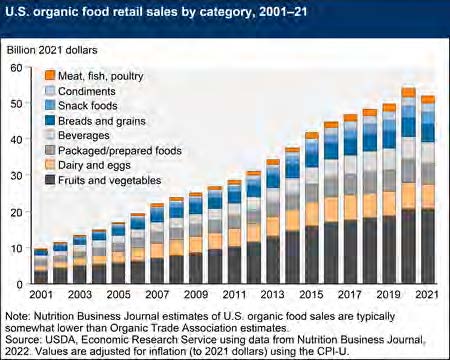
Figure 10.3 :
Environmental stewardship is valued by many famers and consumers. Organic practices promote environmental stewardship by promoting sustainability, soil health, and biodiversity. While the claim that organic practices promote environmental stewardship is broadly true, the details as Example 10.1 illustrates are much more complicated.
Example 10.1 The adoption of the synthetic herbicide glyphosate, along with crops genetically engineered for glyphosate resistance, has eliminated the need for cultivation to control weeds in conventional production of corn and soybeans. On the one hand the adoption of no till practices has been shown to reduce labor and fuel use while reducing soil loss to erosion. Overall substantial improvements in soil health have been demonstrated by switching to no till. On the other hand, use of no till requires the release of enormous quantities of glyphosate into the environment where its impact has not been well-researched. It is known that it reduces the biodiversity of aquatic microorganisms as well as the diversity of the microorganisms in the human gut. There are allegations that it is a carcinogen, a claim that Bayer and its affiliates are hotly contesting as defendants in thousands of cases brought by cancer victims and their survivors. Adopting no till production for organically produced corn and soybeans is possible but adoption has not been widespread.
There are health benefits of organic certification to both consumers and farmers. Health benefits to farmers are probably more immediate. Avoiding synthetic chemicals has important health benefits for farmers. The National Health Institute (NIH) has noted many occupational risks of pesticide use that include disruption of thyroid function and the immune system, kidney cancer, and Parkinson’s disease.
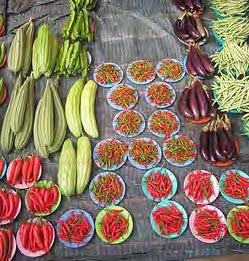
Figure 10.4 : Organic vegetables at a farmers’ market in Argentina
There is a great deal of support for farmers that wish to adopt organic practices. This includes technical support from nonprofits, and federal and state governments. Federal and state governments have grant programs to support adoption of organic practices. These programs are usually targeted at small farmers.
Farmers often include among their reasons for adoption of organic certification that it improves their reputation as a responsible and ethical producer. This can enhance their links to others in the industry.
For consumers organic certification means that farmers have complied with standards. Since these practices are publicly available, organic certification provides transparency as to the practices that farmers use.
Soil health is a benefit to both farmers and consumers. For farmers it means building soil that can sustainably produce for generations. For consumers it means reducing their carbon footprint. Certified organic production tends to increase the level of humus in the soil. Humus is a relatively stable form of soil organic carbon. The importance of agricultural practices in increasing soil carbon has been the subject of research by EPA for many years.
Labeling
There are four different types of organic labels. Depending upon the certification, wording may appear on either the front panel, the side panel or both. The principal display panel (PDP) is the portion of the package most likely to be seen by the consumer at the time of purchase. The information panel (IP) includes ingredients that are listed from highest to lowest percentage in the product. The information panel may include information in addition to the ingredients. Table 10.1 explores the similarities and differences between these labels.
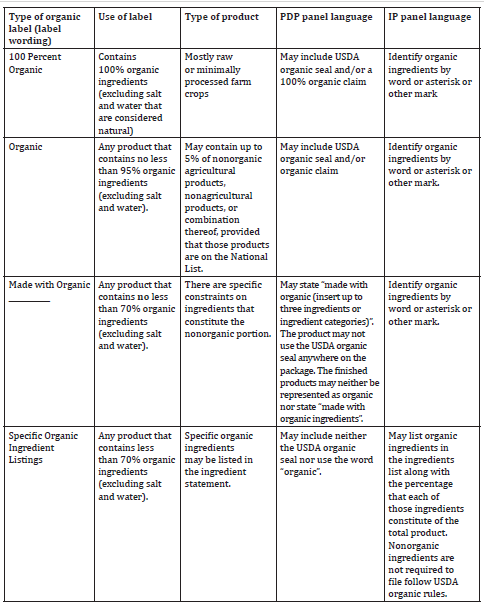
Table 10.1 : A comparison of the four types of organic labels.
There are special rules for labeling alcoholic beverages because these products must meet not only USDA organic requirements but also the regulations of the Alcohol and Tobacco Tax and Trade bureau (TTB). Wines that contain sulfites are not eligible to use the USDA organic seal. Such wines labels may state only that the wine was “made with organic grapes”. Any alcoholic beverage containing fruit other than grapes, e.g., apples, may not use the “made with” language if the product contains sulfites.
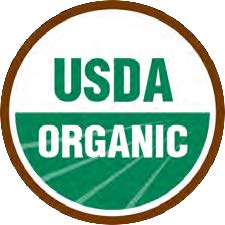
Figure 10.5 : USDA organic seal
What Does the USDA Organic Seal Really Mean?
Where a textile is made with organically produced fibers, the product may be labeled organic and use the organic seal. Where only some fibers are certified organic, the product may list the fibers that are organic along with the percentage that each is of the final product. Products that meet the Global Organic Textile Standard (GOTS) may be sold as organic in the United States if the finished product is certified under USDA organic regulations. If not, the labeling may neither imply that the product is organic nor use the USDA certified organic label.
There are no separate organic standards for honey, mushrooms, and pet food.
Producers that sell less than $5,000 of organic products every year do not have to apply for organic certification. These exempt producers must, however, comply with organic production and handling rules and keep records for at least three years. Products from exempt operations may not be used as organic ingredients in making other certified organic products. Products exempt from certification may not display the USDA certified organic label.
The National List
The full name of the National List referred to in Table 10.1 is the National List of Allowed and Prohibited Substances. The National List determines which nonorganic substances may be used in organic production and handling. The National List is organized into three categories: crops, livestock, and handling and processing.
For organic crop and livestock production natural (nonsynthetic) products are allowed unless prohibited. Synthetic products are prohibited unless specifically allowed. For handling, including processing of organic products, nonagricultural synthetic, nonagricultural nonsynthetic (natural), and nonorganic agricultural substances are allowed only if included on the National List. Some substances on the national List have annotations that describe how those substances must be used. Annotated substances are referred to as ‘restricted’, rather than ‘allowed’. The agency that certifies an operation organic must approve all substances used in the operation.
Changes to the National List are made through the rulemaking process by the NOP. Notices of proposed rules and of final rules must be published in the Federal Register. For most rules there is an opportunity for public comment prior to issuing the final rule. There are a variety of ways that rulemaking is initiated, including by petition from members of the public. The National Organic Standards Board (NOSB) is required to conduct sunset reviews of every substance on the National List every five years. During the sunset review the NSOB is required to include public comments and any new information about the substance in its review. If the NOSB determines that a substance meets the criteria for inclusion as an allowed substance, then it publishes a notice in the Federal Register to that effect. If the NOSB determines that a substance no longer meets the criteria it can vote to remove the substance from the list. It takes a two-thirds vote to remove the substance from the list. Removal requires the NOP to initiate a rulemaking.
Certifying agencies
There are currently about 80 agents authorized to certify farms and businesses to USDA organic regulations. Most of these agents are authorized to certify compliance of operations anywhere in the world; however, most operate in limited regions that are smaller than their authorization. The USDA maintains an Organic Integrity Database of approved organic certifiers.

View list of organic certification agencies search
tool, the Organic Certifier Locator.
The first step to obtaining certification is to pick a certifier. One is not required to pick a certifier in one’s own state; however, one should pick a certifier that has inspectors located near your farm and business. An applicant for certification is required to pay the travel costs of inspectors. USDA does not regulate the prices that certifiers charge so it is advantageous to compare prices.
Price is not the only factor to consider in locating a certifier. Turnaround time is important. It is useful to ask certifiers what their turnaround time is. One should anticipate 3 to 4 months with longer periods of time quite possible. Not all certifiers operate in all three areas, crops, livestock, and handling and processing.
It is important to research the history of the certifier. How long has it been in operation? Does it have experience with your type of operation? Does the certifier participate at the federal and state level by participating on committees and advisory boards?
If one is raising crops or livestock and poultry that will be sold to a particular processor, it is often useful to use the same certifier that the processor uses. Some processors and buyers provide farmers with technical (and sometimes financial) assistance with certification.
The National Organic Standards Board
The NSOB meets twice each year in a public meeting. In those meetings it works on its agenda, votes on proposals, and makes recommendations to the Secretary of Agriculture. The public may submit comments to the NOSB either by advance written comments or oral comments at the meeting.
Enforcement
The USDA uses both administrative and judicial proceedings to enforce the requirements of the NOP. It can suspend or revoke the right to use the organic certification labeling. It has an active program to protect against fraudulent organic certificates.
Religious certifications
Halal certification means that food complies with Islamic law. In the United States the American Halal Foundation offers certification in the United States. The Food and Agriculture Organization of the United Nations offers general information on which foods are halal and which are forbidden.
Explained: How does halal certification work?
What Is Kosher?
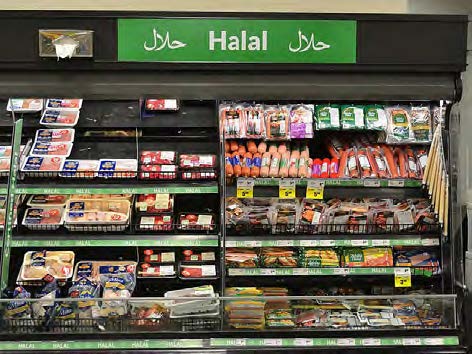
Figure 10.6 : Halal meat section at a grocery store in Richmond Hill, Ontario, Canada
Non-GMO Project Verified
The Non GMO Project is a nonprofit dedicated to helping consumers know whether products contain genetically modified products. It is widely used in high-end food products.
Certified Regenerative
The regenerative agriculture movement is a reaction to large agricultural operations and the soil losses and off-site damage from pesticides that is sometimes associated with them. It consists of a set of practices that include use of vegetative cover, crop rotation, rotational grazing, composting, minimal soil disturbance, and avoidance of synthetic chemicals and fertilizers. There is at least one certification in regenerative agriculture that is currently available.
Gluten free certification
Some people such as those with celiacs disease and other gluten-related diseases cannot have any gluten in their diets. The purpose of gluten free certifications is to provide assurance to consumers that products do not contain gluten. There are several certifying organizations. The Gluten-Free Certification Organization (GFCO) is one of these that is widely used. The Gluten-Free Certification program (GFCP) is another. It is endorsed by Beyond Celiac, a patient advocacy and research support organization.
Vegan certification
Ther is also at least one certification for those that wish to eat food that contains no animal, avian, or seafood products. Vegan Action provides a widely used certification.
Figure 10.7 : “Certified Vegan” Vegan.org – vegan product certification logo
Rainforest Alliance certification
The certification and seal associated with it means that those certified have adopted sustainable practices to protect forests, improve farmer livelihoods as farmers adapt to climate change.
Fair Trade
Fair trade encompasses the notion that farmers, fishers, and workers in the food supply chain should receive a sustainable living wage, safe working conditions, and circumstances that protect the environment. Fair Trade USA and its affiliates in other countries provide a certification for products that are produced and handled in a manner that meets the organization’s standards.
What Is Fairtrade?
Conclusion
The certifications discussed above are only the most commonly seen. With the exception of certified organic, the other certifications are private, nongovernmental certifications. Assessing their value is not easy. A business considering adoption should carefully determine what matters to its customers. It is an unneeded expense and burden to take on a certification that means nothing to a business’ customers. The values of the business owner are also important. A business owner may wish to adopt a certification because what the certifying organization does is of importance to the business owner.
Long Answer Questions
A Greener World. (2024). Certified Regenerative by AGW. https://agreenerworld.org/certifications/ certified-regenerative/
American Halal Foundation. (2022). Halal Certification Process in 3-Steps. https://halalfoundation. org/3-step-certification-procedure/
Beyond Celiac. (2024). Gluten-free certification. https://www.beyondceliac.org/gluten-freediet/ gluten-free-certification/
Breure, T.S., Estrada-Carmona, N., Petsakos, A., Gotor, E., Jansen, B., and Groot, J.C.J. (2024, March 5). A systematic review of the methodology of trade-off analysis in agriculture. Natural Food. https://doi.org/10.1038/s43016-024- 00926-x
Carolina Farm Stewardship Association. (2023, June 7). An Organic System Plan—The First Step in Applying for Organic Certification. https://www.carolinafarmstewards.org/ an-organic-system-plan-the-first-step-inapplying- for-organic-certification/
Carolina Farm Stewardship Association. (2024). Organic Certification. https://www.carolinafarmstewards. org/organic-certification/
Carolina Farm Stewardship Association. (2023, June 7). Organic Transition and Production Handbook. https://www.carolinafarmstewards.org/ organic-transition-and-production-handbook/
Creech, E. (2017, Nov. 30). Saving Money, Time and Soil: The Economics of No-Till Farming. USDA ERS. https://www.usda.gov/media/ blog/2017/11/30/saving-money-time-andsoil- economics-no-till-farming
Donigian, Jr., A.S., Barnwell, Jr., T.O., Jackson, IV, R.B., Patwardhan, A.S., Weinrich, K.B., Rowell, A.L., Chinnaswamy, R.V., and Cole, C.V. (1994, April). Assessment of alternative management practices and policies affecting soil carbon in agroecosystems of the central United States. U.S. Environmental Protection Agency. https://nepis.epa. gov/Exe/ZyPURL.cgi?Dockey=300034EJ.txt
Fair Trade. (2024). Why Fair Trade? https://www. fairtradecertified.org/why-fair-trade/
Food and Agriculture Organization of the United Nations. (1997). General guidelines for the use of the term “halal”. https://www.fao. org/3/y2770e/y2770e08.htm
GFCO. (2024). The leader in gluten-free certification. https://gfco.org/
Kleese, T. (n.d.). How to Pick a Certifier. Earthwise Company, LLC. chrome-extension://efaidnbmnnnibpcajpcglclefindmkaj/ https://www. carolinafarmstewards.org/wp-content/ uploads/2012/12/3-Kleese-How-to-Pick-a- Certifier.pdf
KOF-K. (2023). Internationally Recognized Kosher Certification. https://www.kof-k.org/ home
Larsen. A.E., Noack, F., and Powers, L. C. (2024, March 22). Spillover effects of organic agriculture on pesticide use on nearby fields. Science. https://doi.org/10.1126/science. adf2572
Morgan, A. (2020, September 1). Introducing our new seal. Rainforest Alliance. https:// www.rainforest-alliance.org/marketing-resource/ introducing-our-new-seal-a-freshlook- for-rainforest-alliance-certification/
National Institute of Health. (2022). Agricultural Health Study. https://aghealth.nih.gov/
Noble Research Institute. (2024). What is Regenerative Agriculture? https://www.noble.org/ regenerative-agriculture/
Non GMO Project. (2022). The non-GMO project. https://www.nongmoproject.org/
NSF. (2024). Kosher certification. https://www. nsf.org/food-beverage/kosher-certification
Organic Foods Production Act (OFPA), Pub. L. 106- 624, 104 Stat. 3935 (1990).
Peltonniemi, K., Velmala, S., Fritz, H., Lemola, R., and Pennanen, T. (2021, May-June). Long-term impacts of organic and conventional farming on the soil microbiome in boreal arable soil. European Journal of Soil Biology. https://doi.org/10.1016/j. ejsobi.2021.103314
Regenerative Organic Alliance. (2024). Why regenerative organic? https://regenorganic.org/ why-regenerative-organic/
Savory Institute. (2023). A History of Savory’s Work. https://savory.global/history/
Seeds for a Future. (2024). The Permaculture Systems, Design, and Demonstration Centers of Seeds for a Future. https://seedsforafuture. org/permaculture-guatemala/
Skorbiansky, S.R. (2024, January 11). Organic Agriculture. USDA ERS. https://www.ers.usda.gov/topics/natural-resources-environment/ organic-agriculture/
Soil Health Institute. (2021, February 19). What are the Four Steps to Healthier Soils? https:// soilhealthinstitute.org/news-events/whatare- the-four-steps-to-healthier-soils/
USDA AMS. (n.d.). Labeling organic products. https://www.ams.usda.gov/rules-regulations/ organic/labeling
USDA AMS. (n.d.). The National List. https://www. ams.usda.gov/rules-regulations/organic/ national-list
USDA AMS. (n.d.). National Organic Program. https://www.ams.usda.gov/about-ams/ programs-offices/national-organic-program
Vegan Action. (2024, March 29). We certify. https://vegan.org/