


Chapter 15: Hedging Using Agricultural Option Markets
Hedging Using Agricultural Option Markets
Greed is all right, by the way. I want you to know that. I think greed is healthy. You can be greedy and still feel good about yourself.
Attributed to Ivan F. Boesky, Wall Street titan later convicted of insider trading (He was one of the models for the movie character, Gordon Gekko.)
Agricultural options allow hedging strategies that are not available with agricultural futures. An option contract is a contract to buy or sell a futures contract. There are two types of option contracts, puts and calls. Put and call contracts are separate contracts from each other. They are not offsetting contracts. A put contract is offset with an opposite put contract and a call contract is offset with an opposite call contract. Like futures contracts, call and put contracts are highly regulated. The exchange serves as an intermediary between the buyers and sellers of these contracts. This provides assurance that there is no counterparty risk.
Iowa State video on how to use options.
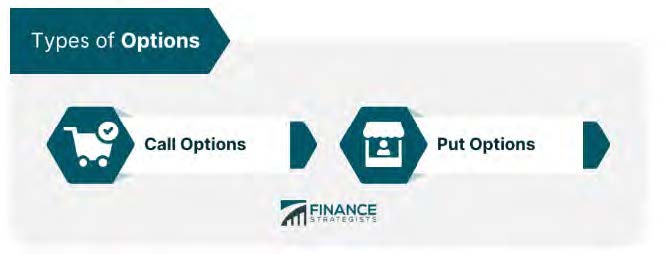
Figure 15.1 : Types of options
The underlying for an option contract is a futures contract. Please review futures (from Chapter 14) before proceeding with your study of options.
Bill Poulos Presents: Call Options & Put Options Explained In 8 Minutes (Options For Beginners)
Unlike futures contracts, option trading on exchanges is a relatively recent development. The 1973 founding of the Chicago Board of Options Exchange (CBOE) represents the beginning of the modern era of exchange-traded options. The Options Clearing Corporation (OCC) was founded to provide reliable transaction clearing to ensure the elimination of counterparty risk.
On January 23, 1984, the Commodities Futures Trading Commission (CFTC) published a final rule in the Federal Register adding agricultural options to those commodity options that were already part of a three-year pilot program to test the feasibility of exchange trading of commodity options. The program was limited to trading options on futures contracts. Options contracts on physical agricultural commodities as an exchange traded derivative was not and is not allowed. The CFTC took a cautious approach to agricultural options given what it referred to as the “checkered history” of agricultural options.
Figure 15.2 : Seal of the United States Commodity Futures Trading Commission.
Without extension the CFTC pilot program would have ended on October 1, 1985. By order dated August 30, 1985, the CFTC extended exchange-traded options indefinitely.
It was largely a result of the desire of those in the agricultural industry that the CFTC assumed responsibility for regulating exchange-traded options. Regulation has provided transparency and trust on the part of market participants. Market participants can be assured that the transfer of assets occurs fairly. Counterparty risk has been eliminated. The enormous growth in the use of agricultural options reflects the confidence that the efforts of regulators, exchanges, and clearing houses in the late 20th Century have brought to market participants.
There remains an OTC market in some agricultural options. Counterparty risk remains a feature of OTC options. Participation in OTC options is advisable only for sophisticated market participants that can withstand the inevitable occasional large losses.
Definitions
These definitions are a distillation of terms generally used in the trade. There is some variation between authors in the terms used to describe options. When there is more than one commonly used to term this text notes both. These terms arose before electronic trading. Terms needed to be short, clear, and easily understood when shouted on the trading floor.
American-style exercise – in the United States options contracts may be exercised at any time prior to expiration. European style exercise allows exercise only on the last trading day before expiration.
Assignment – the process by which the clearing corporation matches an exercised put or call with the writer of a matching put or call.
At the money – means that the strike price and the futures price are equal.
Brokerage fees – amounts charged by brokers for executing trades on futures and options exchanges. Brokers must be approved by the exchanges upon which they trade prior to exercising trades. Brokers are highly regulated by federal and state governments.
Call – the right to buy a futures contract (or other asset) at a specified price prior to a specified time (the expiration date).
Derivative – a contract whose value derives from some underlying asset. Agricultural options’ value is based upon the value of futures contracts. Some non-agricultural options are based upon the value of physical assets. It was the decision of the CFTC, in consultation with industry, in the 1980s that exchange-traded options for agricultural commodities should be based upon agricultural futures contracts.
Exercise – the election by the owner of a put or call to sell or buy, respectively, the underlying asset.
Exercise notice – the notice that a broker gives to the clearing house after the owner of the option asks the broker to exercise the option.
Expiration date – the date by which an option must be exercised. Options become worthless if not exercised by the expiration date.
Extrinsic value (time value) – the amount by which the premium exceeds the value of the option on exercise. This amount reflects the risk associated with time. The farther an option is from its expiration date the greater is the risk associated with time. From the point of view of the option seller (writer), the more time until the expiration date, the more time there is for something to go wrong (from the perspective of the option seller). It is the option seller that is bearing the risk and must maintain adequate funds in a margin account. The premium compensates the option seller for taking this risk.
Initial margin – the equity required upon taking a position, e.g., selling (writing) a put.
Intrinsic (exercise) value – the value of the option upon exercise and closing of resulting futures contract. In the money – means that there is money to be made by exercising a put or call. A call is in the money when the futures price is trading above the strike price. A put is in the money when the futures price is trading below the strike price.
Maintenance margin – the level to which equity must be raised when a margin call is received.
Mark to market – Valuing a derivative at its current market value. This is usually done at the close of the market for the day. It allows minimum margins to be recalculated.
Margin call – a demand by the exchange to raise the equity supporting a position sufficient to meet minimum margin requirements.
Minimum margin – the level of equity at or above which the account holder must maintain.
Open interest – the total number of futures or options contracts for a particular commodity that are outstanding and have not been settled.
OTC – over the counter. OTC options are not exchange-traded.
Out of the money – a put or call that is out of the money has no value. A call is out of the money when the futures price is trading below the strike price. A put is out of the money the money when the futures price is trading above the strike price.
Premium – the money that the buyer of a put or call pays to the writer (seller) of the put or call. It is compensation to the writer of the put or call for the risk that the writer takes on.
Put – the right to sell a futures contract (or other asset) at a specified price prior to a specified time (the expiration date).
Strike price – the price at which an option is exercised.
Volatility – change in price in percentage terms without regard to direction. Historic volatility is the change in price in the past. Future volatility can only be estimated. Since different forecasters make different estimates, it is possible to see different estimates of the theoretical value of an option.
Basics of trading agricultural options
To trade agricultural options, one must first become the client of a broker authorized to trade on the exchange where the options contracts that you wish to trade are traded. One can identify appropriate brokers by going to the website for the relevant exchange.
If, on the one hand, one is buying a put or call, no margin is required. On the other hand, if one is selling a put or call (as a put or call writer) margin is required. Margin is the amount that one must put in a margin account to ensure financial responsibility. A put buyer has the right but not the obligation to sell a futures contract. A call buyer has the right but not the obligation to buy a futures contract. Since put buyers and call buyers have no obligation there is no possibility of incurring financial risk. This is not true for put writers and call writers. They can lose large sums of money that could adversely affect the exchange were no margin posted to make the exchange whole. This is part of the reason that there is no counterparty risk to buyers and sellers. The heavily regulated nature of exchanges is another important part of eliminating counterparty risk.

All clearing firms for all of the CME Group exchanges are list on the CME Group website. For those that wish to trade agricultural options, those options can be traded by forms with authorization to trade on the CBOT. Brokers tend to specialize. Picking the broker that trades the contract that interests you is essential. https://url.linuslearning.com/QBOih
At the end of each trading day all the derivatives in a person’s account are marked to market. Margin accounts are adjusted accordingly. Those that have less than the required margin are required to add money to their margin account.
Once a client tells their broker that they wish to exercise a put or call, the broker sends an exercise notice to the clearing house. The clearing house randomly assigns a matching contract to the contract of the exercising party. With American style options the option can be exercised at any time. European style options may only be exercised on the last trading day before the expiration date. An option not exercised by its expiration date is worthless.
An option buyer makes money when the option appreciates in value. For a put this happens when the price of the underlying futures contract declines. For a call this happens when the price of the underlying futures contract rises. Puts and calls are not opposites. To extinguish (offset) a put one must buy a put. To extinguish (offset) a call one must buy a call.
Hedging using puts
Farmers can use a put as a substitute for selling a futures contract. The advantage of using a put is in the ability to lock in a price without the obligation to sell at that price if the price goes even higher. The cost of doing this is the option premium plus any brokerage fees. Example 15.1 compares using a futures contract versus using a put.

Corn Options – Contract Specs
Corn Futures – Contract Specs
Example 15.1. Arden is a corn farmer whose farm is along the Missouri River. With his rich alluvial soils his yields are high, and his break-even price is lower than for many other corn farmers. His practice is to always have an entire year’s production in the bin (not necessarily a good marketing strategy). The December 2024 futures (DEC 2024 ZCZ4) price is at $4.01 (401’0). He can buy a put on a $4.00 December futures contract for 6.875 cents (6’7) per bushel. [Options for corn are traded in 1/8 cent increments. Futures contracts for corn are traded in ¼ cent increments.]
Example 15.1. Arden is a corn farmer whose farm is along the Missouri River. With his rich alluvial soils his yields are high, and his break-even price is lower than for many other corn farmers. His practice is to always have an entire year’s production in the bin (not necessarily a good marketing strategy). The December 2024 futures (DEC 2024 ZCZ4) price is at $4.01 (401’0). He can buy a put on a $4.00 December futures contract for 6.875 cents (6’7) per bushel. [Options for corn are traded in 1/8 cent increments. Futures contracts for corn are traded in ¼ cent increments.]
Scenario A: Arden decides to sell December futures contracts at $4.00 per bushel. With half a million bushels of corn in the bin and a healthy crop, Arden felt that there was little risk in selling December futures contracts for 100,000 bushels (20 contracts). He did not anticipate that the Russo-Ukrainian war would become a regional war raging along a 1200-mile front from Tallin to Odessa. The price of corn rose swiftly to over $10 per bushel. Compounding Arden’s woes, the Missouri River flooded destroying both his corn in the bin and his crop in the field. By watching the market closely Arden managed to close out his futures contracts at $10 per bushel. His net loss was $6 per bushel plus brokerage fees, for a total loss of $600,000. That does not include his grain in the bin and his crop in the field, both of which were a total loss. If he had crop insurance, he would have received some of the value of the crop in the field through making a claim with his crop insurance carrier. It might have been possible to reclaim some of his loss on the corn in the bin if he had insured it. Crop insurance does not cover it, and it is not usually covered by whole farm insurance.

Figure 15.3 : Corn affected by flood
Scenario B: Arden bought put options on his entire expected crop of half a million bushels. It gave him the right but not the obligation to sell a futures contract at $4.00 per bushel. He paid 6.875 cents per bushel ($34,375 in total) for the put. The same events of Scenario A occurred. Arden let the put expire. He was able to protect the $4 price while avoiding the upside risk of scenario A.
Hedging using calls
Users of corn may use a call as a substitute for buying a futures contract. The advantage of using a call is in the ability to lock in a price without the obligation to buy at that price if the price goes even lower. The cost of doing this is the option premium plus any brokerage fees. Example 15.2 compares using a futures contract versus using a call.
Example 15.2. Best Taste Snacks Corporation (BTSC) makes snacks for business meetings and customer giveaways. It is famous for its corn donuts, Corndos.
The December 2024 futures (DEC 2024 ZCZ4) price is at $4.01 (401’0). BTCS can buy a call on a $4.00 December futures contract for 15.125 cents (15’1) per bushel. [Options for corn are traded in 1/8 cent increments. Futures contracts are traded in ¼ cent increments.]
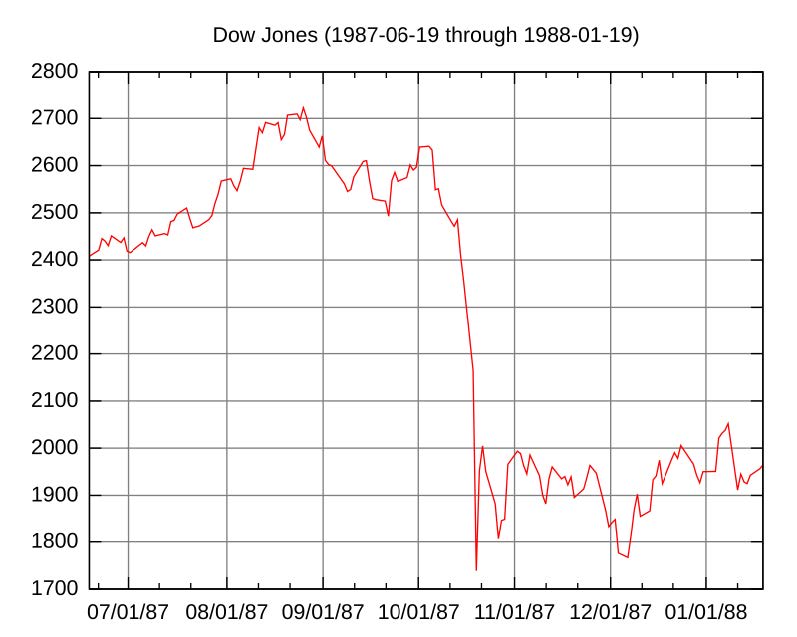
Figure 15.4 : Black Monday Dow Jones
Scenario A: BTSC decides to buy a December futures contract at $4.00 per bushel. With little risk in such a low price, BTSC bought December futures contracts for 100,000 bushels (20 contracts). BTSC did not anticipate Black Monday II that triggered a fall of 40% in the Dow Jones Industrial average by mid-November. Companies cut discretionary spending. Orders for Corndos plummeted, reducing BTCS’s need for corn to 20,000 bushels. U.S. exports of corn fell as the world economy contracted. Transportation needs dropped, reducing demand for corn for ethanol production. To close its position on the unneeded 16 contracts, BTCS sold matching futures contracts at $2.00 per bushel (excluding brokerage fees) for a loss of $160,000.
Scenario B: BTCS bought call options on its entire expected need of 100,000 bushels. It gave BTCS the right but not the obligation to buy 20 futures contracts at $4.00 per bushel. BTCS paid 15.125 cents per bushel ($15,125 in total) for the calls. The same events of Scenario A occurred. BTSC let the calls expire. BTCS was able to protect the $4 price while avoiding the downside risk of scenario A.
CONCLUSION
Economic theory teaches that greater volatility is generally accompanied by higher profits. Thus, a farmer (producer) or a user of grain (e.g., a feed manufacturer) that avoids using options to reduce price risk will make more money in the long run than a producer or user grain that uses options to hedge to mitigate price risk. One might wonder why anyone would use options.
The problem with theory is that the long run is a very long time. Few if any farmers or consumers of grain have the financial depth to withstand the losses that may occur in the short to medium term run. For any firm that fails to survive to the long run, the theory is irrelevant. It is beneficial to almost all market participants to use options to insure against price risk.
The analogy to insurance of hedging is welltaken. Both have costs that reduce long-term profits. Both help ensure that the firm survives to the long-term. Therein is the paradox of both hedging and insurance.
Examples 15.1 and 15.2 illustrate basic uses of puts and calls that producers and consumers of agricultural commodities can use to mitigate price risk. These approaches are not beyond the abilities of any farmer or user of agricultural commodities.
There are far more complex ways by which puts and calls can be used to mitigate price risk. It takes more resources to use the more sophisticated strategies. Farmers do well to avoid any strategies that they cannot understand.
Finally, it is worth saying a little more about speculators (traders). Speculators have a bad reputation because they are often seen as the cause of devastating price fluctuations. In wellregulated and transparent markets, speculators are not the cause of these price fluctuations. The history of options prior to Federal regulations teaches that speculators have sometimes been the cause of devastating price fluctuations where markets lack transparency and regulation.
It is here that government plays a critical role. Government can be thought of as the referee in a baseball or basketball game. A system of referees was created because games proved to be chaotic in their absence. Fans found more interesting activities elsewhere. The result was the creation of a referee system that ensured that every game was played according to the same rules. As with sports, the system sometimes fails but failures are rare compared with an unregulated system.
Example 15.3. The Noble brothers were very wealthy having inherited an enormous fortune from their father. Under the principle that the rich get richer, the brothers decided upon a scheme to enhance their already enormous wealth. They decided to corner the world silver market and profit by squeezing the shorts. The brothers began by secretly buying silver to restrict the supply. This reduced supply led to short sellers of silver futures contracts being unable to meet their margin calls. The brothers profited by selling highly inflated silver to short sellers that had contractual obligations to deliver. The Federal government began selling government stocks of silver. The price of silver fell rapidly thereafter breaking the hold of the Noble brothers on the market.
References
Anderson, S. (2018). Grain Marketing Bible. Abundant Press. https://abundantpress.com/
Angell, G. (1990). Agricultural Options. Windsor Books. https://windsorpublishing.com/
Bittman, J.B. (2013). Trading and Hedging with Agricultural Futures and Options. Wiley. www. wiley.com
Cboe. (N.D.). About Us. https://www.cboe.com/ about/
CFTC. (n.d.). Agricultural Trade Options. https:// www.cftc.gov/IndustryOversight/ContractsProducts/ AgriculturalTradeOptions/ index.htm
CME Group. (2023, October 24). You Can Quote Us on That, Part 2 – How to Trade CME FX Options Strategies. https://www.cmegroup. com/articles/2023/you-can-quote-us-onthat- part-2.html
CME Group. (2023, June 13). You Can Quote Us on That – Using RFQs to Access FX Option Liquidity. https://www.cmegroup.com/articles/ 2023/you-can-quote-us-on-that.html
Domestic Exchange-Traded Commodity Options; Expansion of Pilot Program to Include Options on Domestic Agricultural Commodities. (1983, October 14). 48 Fed. Reg. 46797 (1983). https://www.govinfo.gov/content/ pkg/FR-1983-10-14/pdf/FR-1983-10-14. pdf
Domestic Exchange-Traded Commodity Options; Expansion of Pilot Program to Include Options on Domestic Agricultural Commodities, 49 Fed. Reg. 2752 (1984) (to be codified at 17 C.F. R. § 33.4(a)(6)) https://www.govinfo. gov/content/pkg/FR-1984-01-23/pdf/FR- 1984-01-23.pdf
Kaprelian, J. (2021, October 26). Options for Farmers. Kapco Futures, Inc. https://www. kapcofutures.com/
Leibold, K. and Hofstrand, D. (2022, March). Crop Price Options Basics. Ag Decision Maker, Iowa State University. https://www.extension. iastate.edu/agdm/crops/html/a2-66.html
Leibold, K. and Hofstrand, D. (2022, April). Crop Price Options Fence. Ag Decision Maker, Iowa State University. https://www.extension. iastate.edu/agdm/crops/html/a2-69.html
Leibold, K. and Hofstrand, D. (2022, April). Crop Price Options Fence. Ag Decision Maker, Iowa State University. https://www.extension. iastate.edu/agdm/crops/html/a2-68.html
OCC. (2024). What is OCC? https://www.theocc. com/company-information/what-is-occ
Order Extending Contract Market Designations. (1985, August 30), 50 Fed. Reg. 35213 (1985) https://www.govinfo.gov/content/pkg/FR- 1985-08-30/pdf/FR-1985-08-30.pdf
Prager, D., Burns, C., Tulman, S. and MacDonald, J. (2020, October). Farm Use of Futures, Options, and Marketing Contracts. USDA Economic Research Service. https://www.ers.usda.gov/ webdocs/publications/99518/eib-219.pdf
OPTIONSTRADING.ORG. (2024). The History of Options Trading. https://www.optionstrading. org/history/
Treasure, S.K. (2015). The Farmer’s Guide to Grain Marketing: Maximizing Profit While Minimizing Risk.