


Chapter 18: Export Markets – Basics
Export Markets - Basics
As President Biden often says, competition with China must be fair. American workers, farmers, producers, and businesses must be able to compete on the merits, not against unfair state-led industrial planning and targeting of certain sectors, labor rights suppression, a weak environmental regime, or other distortions that put market-oriented participants out of business.
Ambassador Katherine Tai, the 19th United States Trade Representative
Exports are critically important to many segments of U.S. agriculture. Without exports, the total revenue of U.S. agriculture would be much lower. Profits would be lower and the pressure on Congress to support farmers would be higher. Resistance from the public to more costly farm programs would also be greater. Although the benefits of being an agricultural powerhouse to U.S. security and foreign policy are large, convincing the public to support agriculture has always been a hard sell.
Table 18.1 shows agriculture’s contribution to US trade. The dollar value of trade flows reflects both the volume of exports and imports and the price of those exports and imports. Since 2021, the volume and price of the major agricultural commodities have tended to move in opposite directions.
According to USDA much of the decline in the value of exports is associated with a decrease in unit prices for soybeans, corn, and cotton. Soybeans and corn increased the total units exported. However, this increase in volume was more than offset by the decrease in unit prices. Beef contributed to the lower forecast as a result of a decline in the volume of exports.
Overall export statistics are useful, but the most useful statistics are for individual commodities. It is not unusual for the prospects for exports of individual commodities to move in the opposite direction from the overall export statistics. USDA’s Economic Research Service (ERS) has developed an Interactive Visualization Tool that allows users to explore data and trends for individual commodities.
TARIFFS, DUTIES, TAXES AND COSTS OF IMPORTING AND EXPORTING
Countries impose taxes and fees of various sorts on imported and exported goods. These taxes go by various names. Various services are required to get goods from where they are produced to purchasers. This becomes particularly complex when goods move from one country to another. What follows is a list of these costs and services that are required to export or import agricultural products. Each is defined and described below. The reader should be aware that this is a complex matter. What follows is only an introduction to the topic.
Logistics management.
Whether importing or exporting, supply chains require logistics management. Logistics management is the art and science of getting goods from one place to another. The recent pandemic and the continuing wars in the Middle East and Ukraine have revealed the fragility of the world’s supply chains. In an effort to promote economic efficiency resiliency has been lost. Resiliency is the ability to withstand shocks such as wars and pandemics.
Only the largest companies have the capacity to manage their supply chains entirely in-house. However, even large companies contract-out certain aspects of supply chain management for reasons of efficiency or the need to obtain the specialized expertise of third-party contractors. Third-party logistics companies (3PLs) manage other businesses’ supply chains. Well-known 3PLs include DHL, UPS, and FedEx Supply Chain.
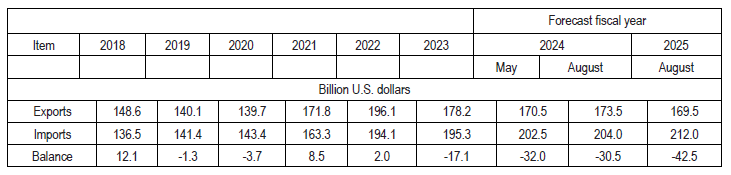
Table 18.1 : U.S. agricultural trade, fiscal years (FYs) 2018–25
Notes: Due to rounding, the balance may not agree with import and export data. The fiscal year is defined as October 1 of the previous year through September 30 of the current year.
Sources: USDA, Economic Research Service and USDA, Foreign Agricultural Service analysis and forecasts using data from U.S. Department of Commerce, Bureau of the Census.

UPS provides supply chain services.
3PLs are typically compensated by a fee or commission paid by the exporter; however, the fee may be charged indirectly, e.g., the fee may be paid by the importer. It is important to understand how 3PLs are compensated. The term freight forwarder is also used. Freight forwarders typically arrange for the transport of goods by one or more carriers with whom the freight forwarder contracts. Typically, the services offered by freight forwarders are narrower than those provided by 3PLs; however, there is no precise definition of either term. Services offered include warehousing, transportation, packing, inventory management, reverse logistics, consolidation, and deconsolidation. These terms are discussed below.
Warehousing involves the storage and management of goods. Transportation involves the shipping of goods by water, land, air, or some combination thereof. Goods must typically be packed unless they are bulk commodities.
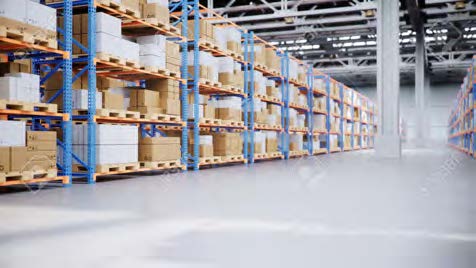
Figure 18.1 : A warehouse
TARIFFS, DUTIES, TAXES AND COSTS OF IMPORTING AND EXPORTING
Correct packing ensures that the goods arrive at their destination in acceptable condition. Even with bulk commodities it is necessary to ensure that the shipper is using an acceptable vessel, truck, or aircraft. Dry bulk commodities such as grains and oil seeds suffer deterioration in transit if conditions such as ambient moisture conditions, vermin control, and temperature control are inadequate for the product being shipped. Inventory management is critical to controlling costs. Shippers that must wait for an adequate load to be assembled charge for wait time. The same applies when products cannot be unloaded in a timely manner.
Harvesting Vegetables (Rhubarb) Packing and Transport
Inventory management is the process of managing supplies of inputs and products. Farmers, processors, exporters and others need supplies of inputs to ensure that the production process goes smoothly. Supplies of products are needed to promptly fill orders. Example 18.1 illustrates the need for adequate inventories of inputs.
Example 18.1. Farmer Steve needed fertilizer to plant corn in the spring of 2022. Due to a shortage of potash, the result of sanctions on Belarus where it is mined, he could not get fertilizer in a timely fashion. The delay in planting reduced his production by 10%. Had he purchased fertilizer before the Russian invasion of Ukraine began, he would have been able to plant in a timely fashion. Inventory management is key to maintaining efficient production. With enough inventory one can mitigate the impact of supply shocks.
Reverse logistics is the process of handling returns. In retailing, it is the process of taking items that the consumer did not want for reasons such as wrong size or product defect. In international trade, logistics become more complex. Example 18.2 illustrates problems that can arise in international trade.
Example 18.2. The XYZ Cooperative obtained a contract to sell specialty grain to a customer in China. They contracted with a shipping company to ship a bulk transport of grain to their customer in China. Upon arrival at the Port of Shanghai, the grain failed to pass inspection. It was contaminated with a GMO variety not approved by the Chinese government. The grain was refused entry into China. XYZ had no plans to handle events such as this. Had XYZ hired a reputable 3PL to handle the shipment, the 3PL would have helped XYZ with a plan to deal with a refusal of entry and the subsequent return. The 3PL might have even suggested testing that would have avoided shipping grain that was likely to be denied entry.
Consolidation and deconsolidation involve combining smaller shipments into larger shipments or splitting larger shipments into smaller shipments, respectively. A shipment by ocean-going vessel involves the consolidation of loads provided by many shippers. When the vessel arrives at its destination, it is necessary to break the shipment apart so that trucks can then carry the various goods to the individual recipients.
Tariffs and Duties.
Tariffs and duties are forms of import taxes. These two types of taxes are often confused. Tariffs are direct taxes paid by the exporter. While all import taxes raise money for the government assessing them, tariffs often have a primary purpose of protecting domestic industry from foreign competition. In some cases, tariffs are set at punitive levels to shut down trade in the affected goods as punishment for some offense committed by the exporter’s country. Punitive tariffs are allowed by WTO rules as a remedy for certain violations of trade rules. The WTO will be discussed in Chapter 19. To determine a tariff, one must determine the HTS code for the good that is applied by the importing country. HTS stands for the Harmonized Tariff Schedule. Each country has a Harmonized Tariff Schedule that is based upon the international Harmonized System. The international Harmonized System is a global system of nomenclature applied to most goods in international trade.

The Harmonized Tariff System of the United States provides the tariff rates for all goods imported into the United States. Pick an agricultural import and find the tariff rate that applies to it.
Despite international standardization there is some variation in codes from one country to another.
It is important to accurately apply HTS codes. There is always a temptation to game the system. Tariffs can vary significantly even for codes that describe similar goods. The risk in misassigning codes is that products can be held up in customs while customs authorities determine the correct codes and determine possible fines or other punitive measures. Delays can be costly. Costs can include storage costs and demurrage charges for shipping containers held beyond the rental period.
When the United States gets into trade disputes with the countries with which it trades, agricultural products are often subject to retaliatory tariffs. The most recent event that subjected U.S. agricultural exports occurred during the first Trump Administration. In 2018 the United States imposed Section 232 tariffs on a range of steel and aluminum imports. In separate action it imposed Section 301 tariffs on a range of Chinese exports. Sections 232 and 301 are remedies applied against exporting countries for practices that the United States has determined to be unfair trade practices. The countries whose exports were subjected to these tariffs retaliated. The USDA Economic Research Service has estimated the costs to U.S. agriculture of these retaliatory measures. The range of retaliatory tariffs targeted at agricultural products ranged from 2 to 140 percent. From mid-2018 through 2019 these retaliatory tariffs caused a reduction of $27 billion in U.S. agricultural exports. Figure 18.2 illustrates how these reductions were spread across a wide range of agricultural commodities.
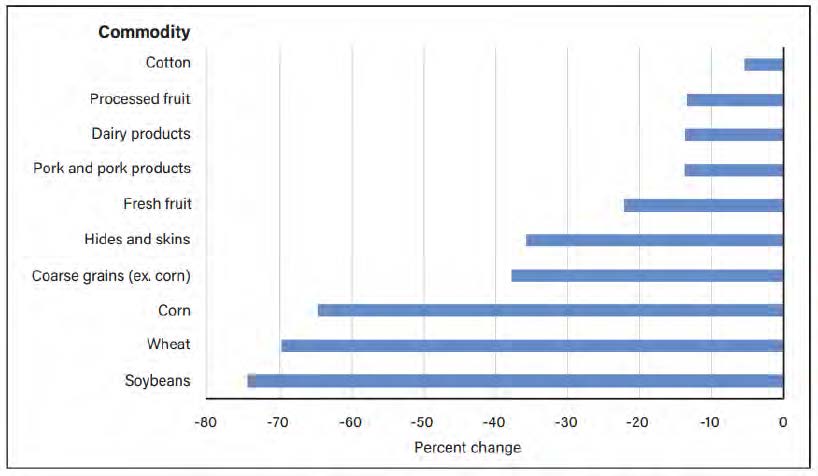
Figure 18.2 : Annual percentage decline in the value of U.S export to China, 2018 relative to 2017
The Biden Administration took a more conciliatory approach to trade. Hence retaliatory tariffs have been a relatively minor issue for the last four years. The second Trump Administration has created a more difficult tariff environment is expected. The Wall Street Journal has that importers rushed imports ahead of the January 20th inauguration. The tariff environment for agricultural products can be expected to be more challenging for both exporters and importers.
Tariffs are a type of duty; however, not all duties are tariffs. There is much confusion about these two terms. Duties may be applied to either imports or exports. The reader may legitimately ask why a country would tax its exports. Example 18.3 answers this question.
Example 18.3. Article I, section 9, of the Constitution prohibits taxes on exports. This provision protected cotton growing states that feared that Northern states would seek such a tax on cotton exports to provide an indirect subsidy to Northern textile manufacturers that relied upon Southern cotton. Indeed, after the Civil War an amendment to the Constitution was proposed to tax cotton exports both to provide Northern textile producers with a cheaper source of cotton than was available to their foreign competitors and to punish the rebellious Southern states. Neither of the two bills ever came to a vote. The Congressional committees charged with reviewing them chose not to send the bills forward for a vote. Prior to the Civil War, the United States produced 80% of the world’s cotton. This gave the United States a monopoly position that could have been exploited to produce revenue without significant damage to cotton exports. The Southern states opposed and feared doing this because they feared that its long-term effect would be to encourage foreign competitors to increase their capacity to produce cotton. The Confederate States of American, in its desperation for revenue, assessed a 1.5% duty on cotton exports. It is estimated that the tax was collected on only 5% of the cotton exports of the Confederacy. The tax was strongly opposed by cotton growers and easily evaded. Many planters had docks beyond the scrutiny of Confederate revenue agents that could accommodate ocean going vessels.

National Bureau of Economic Research working paper
Taxes.
In addition to tariffs and duties, there are many taxes that may be applied in various parts of the export process. Some domestic taxes may be refundable for products to be exported. Whether a domestic tax is refundable upon export depends upon whether the WTO allows it.
Most countries have Value-Added Taxes (VAT) or Goods and Services Taxes (GST). The VAT and GST are similar. The process for refunds on exports varies. One must ask for a refund. It is not automatic. The other side of this is that imports are subject to VATs and GSTs. The United States is one of the few countries without a value added tax. Most U.S. states have sales taxes which are similar to the VAT; however, these may not be refundable. To determine whether a state sales tax is refundable one must check with the taxing authority of the state that collected the tax.
Inspection fees.
There are a variety of inspection fees that an exporter faces. These include inspections required by the exporting country, inspections conducted before shipping that are required by the importing country, inspections required by the importing country upon arrival in that country, and any private inspections required by shippers or customers.
Shipping and preparation.
Bulk commodities must be conditioned prior to shipping to ensure that moisture levels (usually maximum) are met along with any other physical characteristics specific to that commodity. Perishable commodities must be packed to prevent damage. Most perishable commodities require adequate temperature and atmosphere control.
How to Ship Vegetables? [shipping perishable food]
Insurance.
There is a wide variety of insurance that is required when exporting or importing. The key to understanding who must purchase insurance depends upon who has the risk of loss. The risk of loss is defined as who bears the financial loss if the goods are destroyed or damaged. The risk of loss usually, but not always, follows ownership of the goods. Contractual provisions may alter when the risk of loss passes. There are numerous shipping terms that exporters and importers need to understand to adequately assess their risk of loss.
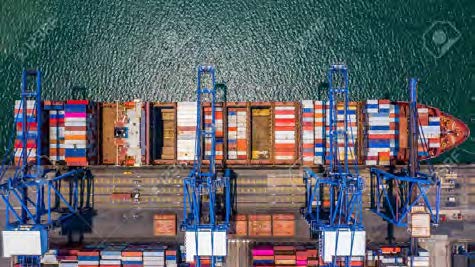
Figure 18.3 : Shipping of goods

U.S. Department of Transportation, Federal Highway Administration

Funk, K. (2018, Nov. 29). Shipping Abbreviations and Terminology You Need to Know. Blog, easypost.

School of Shipping (2002). Common Shipping Terms and Abbreviations

For more information about the School of Shipping see:
Types of insurance needed vary. Usually, separate policies cover the risk of loss of goods in a warehouse from those goods in a truck or vessel. For certain routes it may be necessary to buy war risk coverage. That coverage provides protection for losses caused by acts of war or terrorism. These are but a few of the types of insurance that may be required. It is advisable to hire someone with expertise in insurance.
Security.
Physical security is always a risk with importing and exporting. One needs an assessment of risks. That allows purchase of the appropriate services to protect that which is being shipped. It is also necessary to provide for the security of employees and contractors.
Legal, tax, and accounting services.
International transactions are complex. Appropriate legal, tax, and accounting services are essential to successful importing and exporting. The number of these professionals and firms that handle these transactions is relatively small.
STANDARDS
Standards and grades were discussed in Chapter 9. This is a brief discussion related to trade.
Phytosanitary standards.
Compliance with phytosanitary standards is required to ensure that pathogens and other pests are not transferred in international shipments. Inadvertent introduction of pests and pathogens has been recognized as a problem for a long time. It remains a serious problem. Countries will refuse entry to shipments that do not comply.
Modernizing Sanitary and Phytosanitary Measures for Trade in the CAREC Region
The U.S. Animal and Plant Health Inspection Service (APHIS) provides phytosanitary certificates and other certifications necessary for export of U.S. agricultural products. APHIS inspects incoming plant and animal products. Its services include inspections of live plants and animals as well as products. APHIS is part of USDA. Some state departments of agricultural also provide certain certifications.

APHIS conveniently provides links to state agencies on its site. Start with the Trade tab and work your way into the website to the specific category of product for which you need to find your state’s agency.
Grades.
Grades are discussed in Chapter 9. Accurate grading is essential to both exporting and importing.
Other standards.
There are many other standards that specific countries apply to U.S. exports. Bans or other restrictions on genetically modified organisms (GMOs) are common in both Europe and Asia. Allowable pesticide residue levels are often different from U.S. limits. Some pesticides allowed in the U.S are banned in other countries. While organic standards have been harmonized there remain some differences between countries. It is essential to understand what the country one exports to requires.
EXPORT AND IMPORT FINANCING
It is often necessary to finance the export process. Banks with export experience usually provide this. The USDA provides support through its Foreign Agricultural Service (FAS). These programs are discussed in Chapter 20.
Many transactions are supported by bankissued letters of credit. An exporter can secure a letter of credit from a bank. An application and fee are required. If the importer fails to pay the exporter, the bank will pay the exporter. The bank then attempts to collect from the importer. A letter of credit is essentially payment insurance.
Block chain technology (the technology that makes Bitcoin and other cryptocurrencies possible) opens possibilities for making international transactions both safer and less costly. Speed comes from the digital environment. Security comes from the ledger that block chain technology creates that makes it easy to identify each transaction. That allows for easy audit of transactions – something that is more difficult with other systems.
References
Baseline Team. (2024, February 22). International Baseline Projections. USDA Economic Research Service. https://www.ers.usda. gov/data-products/international-baselinedata/ visualization-international-baselineprojections/
Credlix. (2024, September 2). Understand the Difference between Duty and Tariff. https:// www.credlix.com/blogs/understand-thedifference- between-duty-and-tariff
Dfreight.org. (2021). The Difference Between Customs Duties, Taxes & Tariffs. Blog. https:// dfreight.org/blog/difference-between-customs- duties-and-taxes/
Gerval, A. (2022, July 19). USDA’s New Interactive Visualization Tool Aids Exploration of Global Agricultural Trends. Amber Waves. https:// www.ers.usda.gov/amber-waves/2022/july/ usda-s-new-interactive-visualization-tool-aidsexploration- of-global-agricultural-trends/
Gupta, M. (2024, July 19). The Difference Between Duties, Taxes, and Tariffs—How They Factor into Your International Shipping Strategy. DCL Blog. https://dclcorp.com/blog/supplychain/ duties-taxes-tariffs-explained/
Irwin, D.A. (2001, December). The Optimal Tax on Antebellum U.S. Cotton Exports. Working Paper Series, No. 8689, National Bureau of Economic Research. http://www.nber.org/papers/w8689
Kenner, B., Jiang, H., Kaufman, J. and Williams, A. (2024, June 12). Foreign Agricultural Trade of the United States (FATUS). USDA Economic Research Service. https://www.ers.usda.gov/ data-products/foreign-agricultural-trade-ofthe- united-states-fatus/
Kenner, B., Jiang, H., Kaufman, J. and Williams, A. (2024, August 27). Outlook for U.S. Agricultural Trade: August 2024. USDA Economic Research Service. https://www.ers.usda.gov/ publications/pub-details/?pubid=109831
Kenner, B., Jiang, H., Kaufman, J. and Williams, A. (2024, August 27). U.S. Agricultural Exports in Fiscal Year 2025 Forecast at $169.5 Billion; Imports at $212.0 Billion. AES-129. USDA Economic Research Service. https://www. ers.usda.gov/webdocs/outlooks/109832/ aes-129.pdf?v=9733.5
Kenner, B., Jiang, H., Kaufman, J. and Williams, A. (2024, June 6). U.S. Agricultural Trade. USDA Economic Research Service. https://www. ers.usda.gov/topics/international-marketsu- s-trade/u-s-agricultural-trade/
Miao, H. (2024, Nov. 20). American Companies Are Stocking Up to Get Ahead of Trump’s China Tariffs. The Wall Street Journal. https://www.wsj. com/economy/trade/american-companiesare- stocking-up-to-get-ahead-of-trumpschina- tariffs-c1ca4744
Morgan, S., Arita, S., Beckman, J., Ahsan, S., Russell, D., Jarrell, P. and Kenner, B. (2022, January). The Economic Impacts of Retaliatory Tariffs on U.S. Agriculture. ERR-304, USDA ERS. https://www.ers.usda.gov/publications/ pub-details/?pubid=102979
Schneider, W. (2024, March 14). Customs Duties, Taxes & Tariffs: Understanding Global Trade. Blog, WarehousingAndFulfillment.com (a division of insightQuote, Inc.). https://www. warehousingandfulfillment.com/shippingresources/ customs-duties-taxes-tariffsunderstanding- global-trade/
The Descartes Systems Group Inc. (2024). Import Compliance FAQs: What is a Customs Duty? https://www.descartes.com/resources/ knowledge-center/what-is-customs-duty#
USDA Animal and Plant Health Inspection Service. (n.d.). Trade. https://www.aphis.usda.gov/
Zeng, W. (2022, January 21). International Markets & U.S. Trade. USDA Economic Research Service. https://www.ers.usda.gov/topics/ international-markets-u-s-trade/