

Chapter 19: Export Markets – International Agreements
Export Markets – International Agreements
Under free trade the trader is the master and the producer the slave. Protection is but the law of nature, the law of self-preservation, of self-development, of securing the highest and best destiny of the race of man.
President William McKinley in a speech given in Boston on October 4, 1892 (William McKinley Papers, Library of Congress)
Trade agreements embodied in treaties are agreements between countries that govern trade generally, trade in certain categories of items, trade in specific items, or some combination thereof. Broadly speaking treaties may be bilateral or multilateral. A bilateral treaty has only two countries as parties. A multilateral treaty has three or more countries as parties. Treaties are negotiated by the President of the United States and those he designates to lead the negotiation. Before the President may ratify a treaty, it must have the advice and consent of the Senate. The advice and consent of the Senate is given by a two-thirds majority vote of the members present. Once a treaty is ratified by the president it becomes the law of the United States. A treaty enters into force according to terms set forth in the treaty itself. It may be that ratification by the named countries is required or, in the case of large multilateral treaties, by a minimum number of countries.

For those students that wish to know more about researching treaties, this webinar given by Louis Myers of the Library of Congress provides an introduction. The webinar is about an hour long.
Federal departments involved with agricultural trade negotiations include USDA, the Department of Commerce, the Office of the United States Trade Representative, and the Department of State. International organizations involved with agricultural trade include the World Trade Organization (WTO) and the United Nations Food and Agriculture Organization (FAO).
WORLD TRADE ORGANIZATION
The World Trade Organization (WTO) was created by the Marrakesh Agreement Establishing the World Trade Organization on April 15, 1994, and came into force (being) on January 1, 1995. It was built upon and absorbed the original ad hoc organization created by the General Agreement on Tariffs and Trade (GATT). There was never a formal organization under the GATT until the WTO was established in 1995.
The GATT was originally negotiated in 1947 and came into force on January 1, 1948. This agreement arose from the Bretton Woods Conference of 1944 that laid the foundations for the post-World War II economic order (that is now crumbling – more on that later in this chapter). Agreements to establish an International Trade Organization at that time failed because the U.S. Senate refused to ratify the agreement parallel to the GATT that would have created it.

Figure 19.1 : The headquarters of the World Trade Organization in Geneva, Switzerland
The GATT agreement today is a multilateral agreement with many parts. The Marrakesh Agreement and its annexes are known as the founding documents. The annexes are as follows:
- Annex 1A – a series of multilateral agreements that govern trade in goods. The 1994 General Agreement on Tariffs and Trade (GATT 1994) is included in this annex.
- Annex 1B – the General Agreement on Trade in Services (GATS).
- Annex 1C – the General Agreement on Trade- Related Aspects of Intellectual Property (TRIPS).
- Annex 2 – rules governing the resolution of disputes between WTO member states (the Dispute Settlement Understanding or DSU).
- Annex 3 – mechanism for regular, multilateral reviews of the trade policies of WTO member states.
- Annex 4 – the Agreement on Trade in Civil Aircraft and the Agreement on Government Procurement (the plurilateral agreements). Unlike the Marrakesh Agreement and the first three annexes (the covered agreements), the plurilateral agreements apply only to those countries that have opted into them.
The covered agreements apply to all countries that have acceded to the GATT. The original 1947 GATT agreement remains in force. Any conflicts between amendments and the 1947 GATT agreement are resolved in favor of the original 1947 text.
There are many controversies over the various parts of the GATT. Agriculture figures prominently in many of these disputes. Dispute resolution (Annex 2) is probably the most prominent. All the positions on the WTO Appellate Body are vacant. The WTO is thus unable to make enforceable decisions. Although the Director-General of the WTO has put a good face on this, the WTO now has little formal power to resolve trade disputes. The Biden Administration did not show interest in filling those positions and, indeed, has stated that the WTO is not useful for solving our trade dispute with China. The first Trump Administration refused to fill vacant positions. As of the date of this writing, the incoming Trump administration is no more likely to fill the vacant positions.

Please read the Director-General’s statement. That statement was made in 2019. There has been no progress on this issue in the intervening time.
Without US support, the WTO dispute resolution mechanism is unlikely to be restored. The U.S. power over who sits on the WTO Appellate Body reflects the power that the United States has traditional had over the world’s trade. Many U.S. trading partners think that the current favored position of the U.S. is out of touch with the times. Either a reordering of the WTO or its gradual irrelevance will have a profound impact on prospects for U.S. agricultural exports.
WTO rules governing trade in goods (Annex 1A) are also a source of unhappiness. President Trump believes that the current low tariff environment seriously disadvantages U.S. labor and manufacturing. With the tariff disputes that occurred in the first Trump Administration, President Trump was able to offer assistance to farmers that partially offset losses from reduced trade. Secretary of Agriculture Brooke Rollins announced a plan for a Market Facilitation Program (MFP) similar to the MFP of 2019 that was used to offset retaliation against U.S. products.
Some intellectual property measures under Annex 1C are a source of controversy. Some lesser developed countries (LDCs) that are rich in biodiversity demand compensation for their genetic material that is used in developing new crops and drugs. How this issue is resolved, if it is resolved, is likely to affect the availability of genetic material available for genetic modification of crops and livestock.
Although Annex 3 provides for regular review of the various agreements under the GATT, little progress has been made to resolve longstanding issues. During the 30 years that have elapsed since the Marrakesh Agreement much has changed. The internet scarcely existed. The entirety of e-commerce has arisen during that time period. Satoshi Nakamoto had not yet created bitcoin. The potential for block chain technology to revolutionize international trade was not even a gleam in anyone’s eye. In other words, the world’s trading system is badly in need of an update. The prospects of that happening soon do not appear likely.
Participants and operation of the WTO
As of August 30, 2024, the WTO had 166 members. The goal of the WTO is to ensure that trade flows as smoothly as possible. All states or customs territories that have full autonomy over their territories are eligible to join the WTO.

Click on the member map on the WTO website to see which areas are members, observers or non-members.
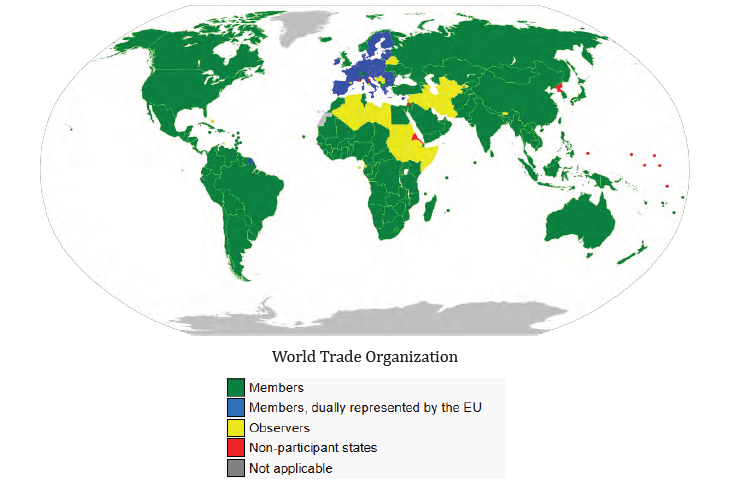
Figure 19.1 :
Example 19.1. Both Taiwan and China are members of the WTO. Only China is a member of the United Nations. In the civil war that followed the end of Japanese occupation at the conclusion of World War II, the Chinese Communist Party overthrew the existing government (the Republic of China under the rule of the Kuomintang (KMT)). General Chiang Kai-shek led a remnant of the army of the Republic of China to the islands of Taiwan, Penghu, Kinmen and Matsu. In WTO documents, it is referenced as Chinese Taipei. Although it has not been a one-party state under the rule of the KMT since 1987, it remains separate from the rest of China, referred to as the Peoples’ Republic of China or simply China. The government of Taiwan, since it is not a nation, is not a member nor even an observer at the United Nations.
The highest level of decision making within the WTO is the General Council. The General Council includes representatives of all of the members of the WTO. Representatives generally have ambassadorial status. The General Council also meets under different rules as the Dispute Settlement Body and the Trade Policy Review Body.
The initial step in the dispute resolution process is for the member alleging a violation of trade rules to ask for a consultation. If the parties do not reach a settlement of the issue, the dispute proceeds to a panel that reports on the case. Either party may appeal to the Appellate Body. All seven positions on the Appellate Body are currently vacate. The term of the last sitting member expired on November 30, 2020. The first Trump Administration declined to fill vacancies. The Biden administration elected not to fill vacancies. It is safe to say that the second Trump Administration will not fill any vacancies. It is the consensus of both the Republican and Democratic parties that the WTO dispute resolution process does not serve the interest of the United States. Given that the consent of the United States is required to fill vacancies, it is unlikely that the vacancies will be filled in the foreseeable future.
Enforcement was through the cumbersome process of allowing the successful complainant to impose punitive tariffs on selected goods in an effort to force the offending party to alter its prohibited trade practices. There is no longer any enforcement process within the WTO. Countries may still impose punitive tariffs outside of the WTO framework. President Trump knows how to do this and certainly will. He refers to himself as the “tariff man”. The use of the term has a long heritage. William McKinley, the 25th president of the United States also referred to himself as the ”tariff man”. Without the WTO dispute resolution process, there is now no mechanism to punish a nation that imposes punitive tariffs that themselves violate WTO rules.
The Trade Policy Review Body has three objectives. The first is to provide regular monitoring to improve the transparency and understanding of countries’ policies. The second purpose is to improve public and intergovernmental debate on trade policies and practices. Finally, the review process provides for multilateral assessment of existing policies and their impact upon the world trading system.
Through its ministerial conferences, the WTO facilitates negotiation of multilateral trade agreements. 1994 was the last time that the WTO succeeded in a major agreement. This reflects the trend toward bilateral, or agreements between only a few countries. That can work to the advantage of large countries; however, it tends to leave small countries out of the process. It is similar at the national level. Producers of crops with a large dollar value and wide geographic distribution, e.g. corn and soybeans, have enough political leverage with the government to support negotiation of bilateral treaties covering their commodities. Crops with limited production and a limited geographic area of production tend to get left out, e.g., macadamia nuts and butternut squash. The last ministerial conference was the 12th Ministerial Conference, held in June 2022. It produced no new agreements.
The WTO Committee on Agriculture (CoA) oversees the Agricultural Agreement. Although the Agricultural Agreement came into force in 1995, it was the beginning not the end of negotiations over trade in agricultural products. The goal of these negotiations has been to reduce domestic subsidies that distort trade, reduce export subsidies and improve market access for agricultural products. Although the WTO’s 10th Ministerial Conference, held in Nairobi in 2015, was supposed to abolish subsidies, the effort has not been very successful. Developed countries continue to subsize exports, albeit in altered form that provides the appearance of compliance.
UNITED STATES-MEXICOCANADA AGREEMENT (USMCA) AND OTHER AGREEMENTS
The USMCA is one of fourteen free trade agreements that cover a wide range of products and issues in agriculture. The USMCA entered into force on July 1, 2020. It was an important accomplishment of the first Trump Administration. It replaced NAFTA (the North American Free Trade Agreement). It has been important to increasing U.S. agricultural exports to Canada and Mexico. Nonetheless, the second Trump Administration plans to renegotiate the USMCA to address a number of issues including illegal immigration, fentanyl smuggling, and the reluctance of Mexico to accept GMOs (genetically modified organisms). Many U.S. crops are produced using GMO technology.

Pick one of the free trade agreements from the list on the USTR website. How does it affect U.S. agriculture?
The United Nations is a multilateral organization created through agreements between nations. As of 2011 it had 93 member states. Two UN agencies, the Food and Agriculture Organization (FAO) of the United Nations and the World Health Organization (WHO), created the Codex Alimentarius through their Codex Alimentarius Committee. Please watch this brief video that explains the Codex Alimentarius.
CODEX AND THE FOOD WE EAT – ANIMATION
The purposes of the Codex Alimentarius are to protect consumer health from food borne illnesses and ensure fair practices in the food trade. The creation of a uniform standard facilitates international trade in food by reducing the need for testing and monitoring. The Codex includes standards for all foods whether raw, semi-processed or fully processed. Its provisions address a long list of topics including:
- food hygiene
- food additives
- residues of pesticides and veterinary drugs
- contaminants • labelling and presentation
- methods of analysis and sampling
- and import and export inspection and certification.
The texts of the Codex are not intended to be a substitute for, or alternative to the laws and regulations of individual nations. Work on the Codex Alimentarius began in 1963. It is updated as necessary. Compliance may be by private contracts between importers and exporters. It may also be required by importing countries in addition to their own laws and regulations.
References
Agriculture. (2024). World Trade Organization. https://www.wto.org/english/tratop_e/ agric_e/agric_e.htm
Codex Alimentarius Commission. (2024). Codex Alimentarius International Food Standards. https://www.fao.org/fao-who-codexalimentarius/ home/en/
Export Competition. (2015, December 19). World Trade Organization. https://www.wto.org/ english/thewto_e/minist_e/mc10_e/l980_e. htm
Goodson law Library. (2017, October). GATT/ WTO. Duke Law. https://law.duke.edu/lib/ research-guides/gatt
International Trade Law Research Guide: From the GATT to the WTO: A Brief Overview. (2024, Nov. 5). Georgetown Law Library. https://guides.ll.georgetown.edu/c. php?g=363556&p=4108235
Members and Observers. (2024, August 30). World Trade Organization. https://www.wto.org/ english/thewto_e/whatis_e/tif_e/org6_e.htm
Myers, L. (2024, September 20). Researching Treaties and International Agreements. Library of Congress Research Guides. https://guides.loc. gov/researching-treaties-and-internationalagreements
Growth in United Nations membership. (2024). United Nations. https://www.un.org/en/ about-us/growth-in-un-membership
United States-Mexico-Canada Agreement (USMCA). (2023). Office of the United States Trade Representative. https://ustr.gov/tradeagreements/ free-trade-agreements/unitedstates- mexico-canada-agreement