EXPERIMENT 10: Properties of Gases pH and Buffer solutions
10
Properties of Gases pH and Buffer solutions
Acids and bases are found in common industrial and household substances. They are also important components of biological fluids. A living organism contains acids and bases in the form of proteins, enzymes, blood, genetic material, and other components. To make our food tasty and healthy, we add acid, for example, in salads, juices, and drinks. Vertebrates (fish, amphibians, reptiles, birds, and mammals), including humans, commonly have HCl in their stomachs as part of their gastric acid. This gastric acid aids digestion and protects against harmful microorganisms.
Acids are also major industrial products. Sulfuric acid is the most produced chemical in the world, about 300 million tons annually. Hydrochloric acid (HCl) is produced in the amount of 20 million tons annually. Approximately 85 million metric tons of phosphoric acid (H3PO4) and 58 million tons of nitric acid (HNO3) are produced annually. Huge quantities of ammonia (8 million tons), urea (10 million tons) are also produced. Acids and bases are also common electrolytes.
NaOH and NH3 solutions are basic, whereas HCl and HNO3 solutions are acidic. Most salts are neutral because they are products formed in the neutralization reactions of acids and bases. As an example, the salt NaCl is formed by the reaction of NaOH and HCl and NaNO3 is obtained by reaction between NaOH and HNO3
NaOH(aq) + HCl(aq) NaCl(aq) + H2O (l)
NaOH (aq) + HNO3 (aq) NaNO3 (aq) + H2O(l)
Most soluble salts are strong electrolytes and exist in aqueous solutions such as ions. Water reacts with many ions to produce acidic or basic solutions. Salts can also be basic or acidic. Salts such as sodium nitrite (NaNO2) and potassium acetate (KC2H3O2) are basic, whereas some salts are acidic, for example, NH4Cl and FeCl3.
Early experiments in chemistry identified acids and bases by their characteristics. Acids taste sour and change color, while bases taste bitter and feel slippery (like soap). In the 1880s, Swedish chemist Svante Arrhenius (1859–1927) defined acids as substances that produce H+ ions in water, and bases as substances that produce OH– ions in water. Thus, acids are often called proton (H+) donors. Protons in aqueous solutions are solvated by water molecules, just as other cations. Molecules of different acids ionize to form different numbers of H + ions. Both HCl and HNO3 are monoprotic acids, yielding one H+ per molecule of acid. Sulfuric acid H2SO4 and other diprotic acids occur in two steps:
According to the Arrhenius definition, an acid is a substance that increases the concentration of hydrogen ions (H+) or hydronium ions (H O+) and base is the substance that increase the concentration of OH – in aqueous medium. In simpler terms, acids and bases release H+ ions and OH – ions respectively when mixed with water.
Bronsted (1879-1947) and Lowry (1874-1936) independently introduced a more general definition of acids and bases in 1923. Brønsted and Lowry defined acids and bases based on their ability to transfer protons (H+):
- A Bronsted acid is a substance (molecule or ion) that donates a proton (H+) to another substance.
- A Bronsted base is a substance that accepts a proton (H+).
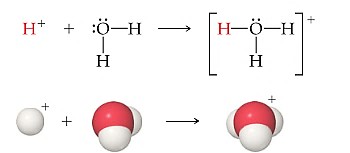
As a bare proton, hydrogen ions would interact strongly with any source of electron density, such as oxygen atoms and nonbonding electron pairs. Hydronium is formed when a H+ interacts with water.
Figure 10.1
Let us take an example of an aqueous solution of an acid HCl. At first glance, it might seem that HCl ionization in water results only in H+ and Cl –. But, because the H + is highly reactive, HCl molecules transfer it to a water molecule instead. We therefore represent the reaction as occurring between HCl molecules and water molecules to form hydronium and chloride ions:
When HCl dissolves in water as an acid, donates a proton (as a Brønsted–Lowry acid) to H2O, and H2O accepts a proton (as a Brønsted–Lowry base) from HCl.
Proton transfer occurs in both forward and reverse reactions in acid–base equilibrium. For example, an acid in HX reacts with water as follows:
In the forward reaction, HX donates a H+ to H2O . Therefore, HX is acid by Brønsted–Lowry definition and hence H2O is Brønsted–Lowry base. In the reverse reaction, H3O+ is the acid as it donates H+ to X – , thus X – is the base. When a H+ is removed from acid HX, it becomes a conjugate base X –. Every acid has a conjugate base, formed by removing a H+ from the acid. For example, OH – is the conjugate base of H2O , and X – is the conjugate base of HX. Every base becomes conjugated acid when a H+ is added to the base. Thus, H3O+ is the conjugate acid of H2O , and HX is the conjugate acid of X – .
Figure 10.2
Two pairs of conjugate acid-base pairs can be identified in any acid-base (proton-transfer) reaction. Ammonia and water reactions will have the following conjugate pairs.
Autoionization of water:
An important chemical property of water is its ability to act as either a Brønsted-Lowry acid or a Brønsted-Lowry base. Such a substance is called an amphoteric substance. In the presence of an acid, it functions as a H+ acceptor; in the presence of a base, it functions as a H+ donor. The water molecule can also selfionize in presence of another water molecule and donate a proton to the water molecule next to it and the process is called autoionization of water. In this case one water molecule acts as acid and other water molecules act as base.
In pure water, only a little water undergoes dissociation, and a small number of hydronium and hydroxyl ions are formed. In 1 L of water, only 10-7 mole of hydronium and the same amount of hydroxyl ions are found. The dissociation expression for the autoionization of water is:
Kw = Hence the K = 10-7 ´10-7 = 10-14 . This is the equilibrium constant at 25℃, however water can dissociate more as temperature increase, so Kw can change as temperature changes. If we add acid to water, the total hydronium ion will be hydronium ion that will produce from acid plus already present hydronium in water. Hence the number of hydronium ion will be increased, however 10-7 is too small number so we may ignore it if the concentration of acid is below 10-6.5 .
Find the [OH– ] concentration of a 0.003M nitric acid solution.
We know water already have ions. HNO is strong acid so it will dissociate 100% in water. So, [H3 O+ ] produced from dissociation = 0.0003 M
pH and pOH
The negative logarithm of is pH and negative logarithm of
is pOH. The
If pH is known, we can calculate pOH and vice versa. The range of pH at 25℃ is 0 to 14. The solution that has pH above 7 is basic and below 7 is acidic.
What is the pH of 0.003M HCl.
Solution, as we already calculated [H3O+] = 0.003 , pH = -log (0.003) = 2.52 and pOH = 14-2.52 = The pH of a solution can be measured by pH meter. It also can be measured but less accurately, by an indicator.
[H3O+] = 0.003, pH = −log(0.003) = 2.52 and pOH = 14 − 2.52 = 11.48
The pH of a solution can be measured by pH meter. It also can be measured but less accurately, by an indicator.
There are certain solutions that resist changing the pH even when we add acids or bases to them. Such systems are called buffers. A buffer system consists of a mixture of weak acid and its conjugate base. Our blood contains a HCO3– / CO2– buffer with pH around 7.4. Buffer resists the pH due to Le Chatelier Principle. Another example of a buffer is a mixture of acetic acid and sodium acetate.
Add H3O+ :
Add O– H :
Adding H3O+ will react with the conjugate base CH3COO– and converting it into CH3COOH, using up the H3O+. As a result, the H3O+ is taken out of the solution, and the pH is not changed appreciably. Similarly, if OH – is added it will react with the conjugate acid, CH3COOH to produce CH3COO– and H3O. As a result, the OH– is taken out of the solution, and the pH is not changed appreciably.
Buffer maintains the pH up to some limit and that is called buffer capacity. This depends upon the nature of buffer and buffer concentration. For example, the above buffer of sodium acetate and acetic acid has a pH of 4.26 when two are mixed in 1:3 ratio. And the pH of the buffer will be 6.21 if the two are in the ratio of 3:1. The pH of the buffer depends upon the concentration ratio of acid and base present in the buffer. We use a value pKa to determine the pH of a buffer. The pKa value of an acid determines its strength, not its pH. The pH indicates the concentration of hydrogen ions in a solution, while pKa indicates the acid’s intrinsic ability to donate H+. The Henderson-Hasselbalch equation below provides the relation between pH and pKa. This equation is useful for buffer solutions.
A chemist prepared an acidic buffer by mixing equal amount of solution of acetic acid and sodium acetate respectively, 0.3 M and 0.5M. What is the pH of buffer, if the pKa of acetic acid=4.74
Sodium acetate completely dissociates in water so the concentration of CH3COO– will be [CH3COO–] = 0.5M. The concentration of CH3COOH = 0.3M. Using Henderson-Hasselbalch equation, we have
LEARNING OBJECTIVES
- To learn how to measure pH
- To understand the action of buffer solution
⚠ Safety
Always wear gloves, goggles, be in full paints, full shirt or other, closed toe shoes, tied hair, cut nails, no jewelry on fingers. Dispose of your reaction mixtures according to your laboratory instructor’s directions.
Materials
| Equipment | Chemicals |
1. Micro lab pH meter 2. pH paper 3. beakers 4. Watch glass 5. Kim Wipes 6. pH papers 7. Spot plate | 1. 0.1 MHCl 2. 0.1 M CH3COOH (acetic acid) 3. 0.1 M CH3COONa (sodium acetat) 4. 0.1 M H2CO3 ( Carbonic acid or club soda or seltzer) 5. 0.1 M NaOH (sodium hydroxide) 6. 0.1 M NH3 (aq) (ammonia solution) 7. 0.1 NaHCO3 (sodium bicarbonate) |
Table 5.3:
Procedure:
PART I: MEASURING PH USING PH PAPER.
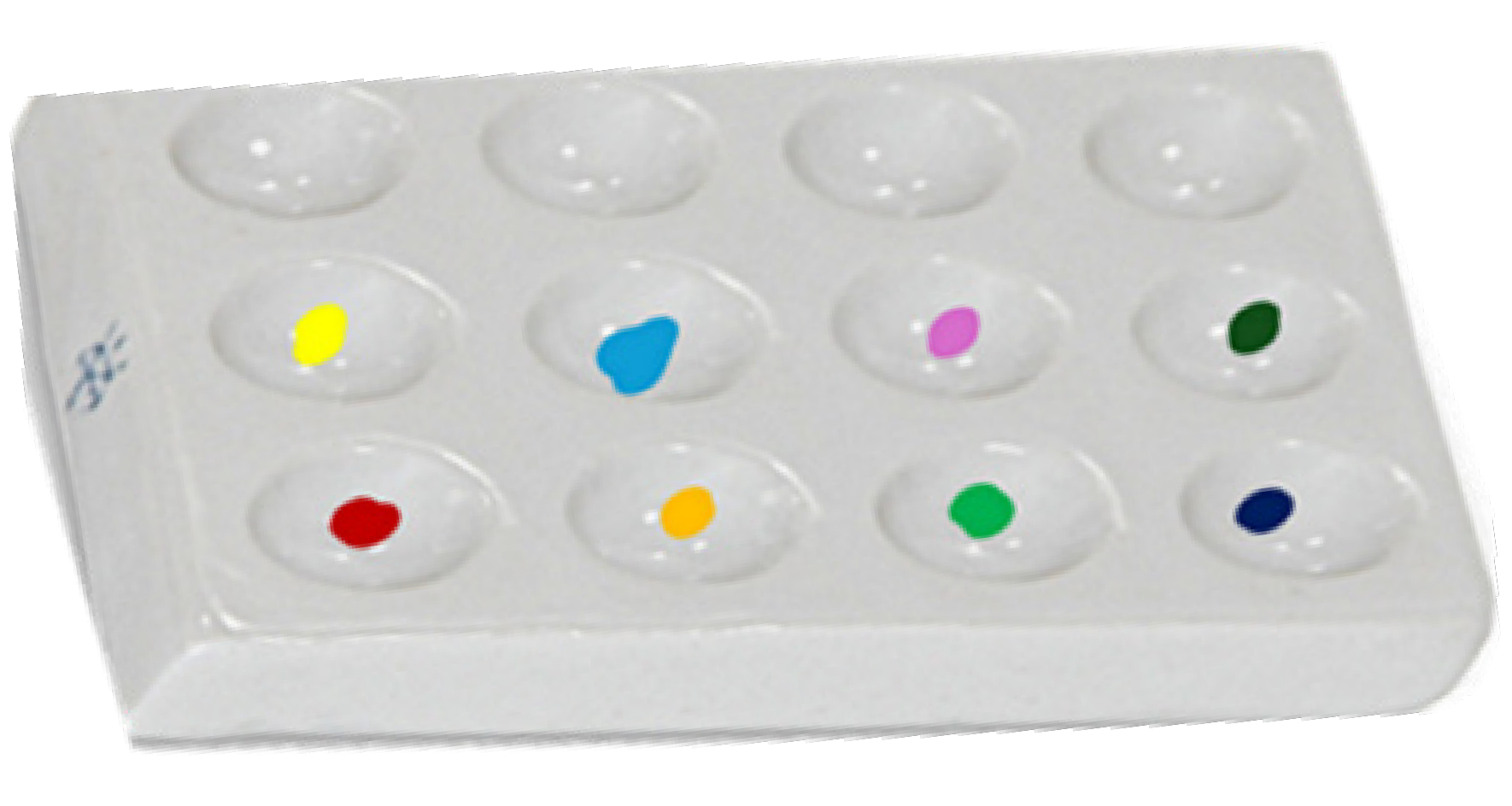
- Add a drop of each chemical in one depression of spot plate as shown in Figure 1.
- Dip a piece of pH paper in each chemical. Compare the color of the pH paper with the color chart given. Record the pH in Table 10.1
Figure 10.1: Spot plate
PART II: MEASURING PH USING PH METER.
- Obtain a 10 mL beaker, rinse it with DI water and dry with paper.
- Add 5 mL of HCl to it.
- Put that beaker inside another larger empty beaker to save it from spilling (beaker inside beaker)
- Check all the connections to the Microlab.
- Open the computer attached, use the password given there!
- Open Microlab (m L)
- Open Microlab Experiment
- Click on “add sensor.”
- Select pH/DO.
- Click on “Use existing calibration file” and chose the latest calibration file.
- Click on “Finish”
- Rinse the pH electrode with water and wipe it with Kim paper smoothly and gently.
- Dip the electrode inside the HCl solution. Make sure the tip bulb of the electrode is submerged in it.
- Click on “Start” on Microlab.
- Start monitoring the pH on the screen, once the value does not change and it stabilizes, record the pH on Table 1 (ask your instructor if not sure)
- After getting pH of the HCl, discard the HCl to designated place (ask your instructor)
- Clean the beaker, rinse with DI water and dry it.
- Add 5 mL of another compound, in the beaker and repeat taking pH. Repeat steps 12-18 for all compounds. Record data in Table 10.1.
PART III: MAKING BUFFER:
- Obtain four separate 50 mL beakers, clean them, dry them and label them as Buffer A, Buffer B, Buffer C, Buffer D.
- Prepare buffer as follows:
a. Beaker A: add 5mL 0.1 acetic acid + 5 mL 0.1 M sodium
b. Beaker B: add 1 mL 0.1 acetic acid + 10 mL 0.1 M sodium
c. Beaker C: add 5 mL 0.1 Carbonic acid + 5mL 0.1 M sodium
d. Beaker D: add 1 mL 0.1 Carbonic acid + 10mL 0.1 M sodium
- Measure the pH of each buffer solution as directed in previous steps with the Microlab and record them in Table 10.2
- Divide each buffer into two parts and add two separate 10 mL Beakers: For example, take two 10 mL beakers, clean and dry them, then pour half of solution of beaker A into one and another half in the Now you have 2 parts of the buffer of Beaker A. Add 0.5 mL of HCl in one beaker and 0.5 mL NaOH in another beaker. Mix using stirring rod and measure the pH of each. Record the pH values in Table 10.2. While using stirring rod, do not contaminate it with different solutions.
- Repeat the same process for Buffers B, C and D
- Finally put 6 mL DI water into two different 10 mL clean beakers. Add 0.5 mL HCl in one and 0.5 NaOH in the other and measure the pH. Record the data in Table 10.2.
- Dispose all the solution at designated place and container (ask your instructor)
Name: Section:
| Solutions | pH from pH Paper | pH from pH meter |
| 1. 0.1 M HCl | ||
| 2. 0.1 M acetic acid | ||
| 3. 0.1 M sodium acetate | ||
| 4. 0.1 M carbonic acid | ||
| 5. 0.1 M sodium bicarbonate | ||
| 6. 0.1 M ammonia solution | ||
| 7. 0.1 M NaOH |
Table 10.1: pH of solutions
| Buffer | composition | pH from pH meter | Observation: Change in pH |
| Buffer A | 1. 5 mL of 0.1M CH3COOH + 5 m L of 0.1 MCH3COONa | ||
| 2. pH after adding 0.5 mL of 0.1MHCl | |||
| 3. pH After adding 0.5 mL of 0.1 NaOH | |||
| Buffer B | 1. 1 mL of 0.1M CH3COOH +10 m L of 0.1 MCH3COONa | ||
| 2. pH after adding 0.5 mL of 0.1MHCl | |||
| 3. pH After adding 0.5 mL of 0.1 NaOH | |||
| Buffer C | 1. 5 mL of 0.1M H2CO3 + 5 m L of 0.1 M NaHCO3 | ||
| 2. pH after adding 0.5 mL of 0.1MHCl | |||
| 3. pH after adding 0.5 mL of 0.1MNaOH | |||
| Buffer D | 1. 1 mL of 0.1M H2CO3 +10mL of 0.1M NaHCO3 | ||
| 2. pH after adding 0.5 mL of 0.1MHCl | |||
| 3. pH after adding 0.5 mL of 0.1MNaOH | |||
| No buffer system | 1. Distilled water | ||
| 2. pH after adding 0.5 mL of 0.1MHCl | |||
| 3. pH after adding 0.5 mL of 0.1MNaOH |
Table 10.2: Buffer solutions
POST LAB QUESTIONS:
- Calculate the pH of buffer A using Henderson-Hasselbalch equation? The pKa value of acetic acid = 4.74. What is the % error in pH measurement?
- Did the pH measurements for the paper and pH meter agree?
- Based on your observation, which buffer A, B, C or D is most efficient against acid addition?
- Based on your observation, which buffer A, B, C or D is most efficient against base addition?
- You have calculated the % error in question 1, what could be the source of error?

REFERENCES
- Nelson JH. Laboratory Experiments for Chemistry, Central Science. Prentice Hall;
- Chemical Principles, The Quest for Insight, Third edition, Peter Atkins, Loretta Jones
- Harvard Natural Sciences Lecture Demonstrations, Harvard University
- Chemistry, the molecular nature of matter and change, 10th edition, Martin Silberberg and Patricia Amateis
- General inorganic chemistry laboratory, H. Anthony Neidig and N. Spencer, Midland College John Anderson, Thomas Ready. Custom edition for Cengage Learning.
- Chemistry laboratory manual: chem1405, midland college, author Cengage custom edition.
- Po HN, Senozan NM. The Henderson-Hasselbalch equation: its history and limitations. Journal of Chemical Education. 2001 Nov;78(11):1499.
- Oommen V, Ganesh G, Vadivel K, Kantha Kumar The Henderson-Hasselbalch equation: a threedimensional teaching model. Indian J Physio Pharmacol. 2016 Jan 1;60(1):70-5.
- Harris KR. The determination of the pH of standard buffer solutions: A laboratory experiment. Journal of Chemical Education. 1985 Apr;62(4):350.
- Kulevich SE, Herrick RS, Mills A discovery chemistry experiment on buffers. Journal of Chemical Education. 2014 Aug 12;91(8):1207-11.