


Chapter 07: Delivery (THE FLOW, PROCESS, PRESENTATION)
Delivery (THE FLOW, PROCESS, PRESENTATION)
It is normal to find yourself caught up on how the story is being told more than what the story is about. Although both are equally important, content should come first.
In the previous discussion chapters, concentration was primarily on what the story is about, how the pieces fit together, the techniques you can use to help you organize your thoughts, and ways to sharpen your technique; all having to do with content.
In this discussion on delivery, we will concentrate on various ways to tell the story. In other words, we will explore how the story can be told, the flow, and the P in C.R.O.P., which represents the process or presentation. A good delivery can make a difference between a successful and an unsuccessful speech.
In the movies, the successful end result begins with a good script/story, and you, the presenter/producer of the story will have to determine how you wish that story to unfold.
In public speaking, there are four basic methods of delivering your message; demystified, it can be referred to as the M.I.M.E.
M – Manuscript; I – Impromptu; M – Memory; E – Extemporaneously. Each method of delivery has its advantages and disadvantages, so you would have to decide at the onset, before you begin doing research and preparing your material, and long before you deliver the speech, what your speech purpose is This would help you determine which method of delivery to select and apply.
PART 1
THE MANUSCRIPT DELIVERY
In the manuscript speech, the speech is scripted and read verbatim, generally from that manuscript. However, a skilled orator uses the written material artfully so that the speech never sounds as though it is written out and being read. The words and delivery carry the impact the speaker desires, as in a conversation.
Dr. Martin Luther King Jr’s “I have Dream” speech (1963) was scripted and he did not detour to any degree from his written words. Yet, he was not so locked into the words written on that paper that the audience could not feel the passion and force of his words.
MLK I have A Dream Speech HD (subtitles)
President John Kennedy, for his speech in West Berlin, “Ich bin ein Berliner”(June, 1963), carried a stack of what appears to be 5 X 8 index cards to the Berlin wall. The skill of the Orator coupled with the skillful use of the manuscript enabled President Kennedy to capture the imagination as well as the hearts of the West Germans during his 10-minute delivery.
For your manuscript speech to be successful, the following techniques would help polish your delivery, and add clarity and power to your spoken words;
Rehearse the speech several times, aloud.
You want to hear the words as you speak them. The key is to make those words sound as natural as possible, as you would say them in a conversation rather than as you would read them to an audience.
Rehearsal of the script allows you to become more and more familiar with the words as well as the meaning of the statements, especially if those words are not in your native language.
President Kennedy rehearsed the lines “Ich bin ein Berliner” over and over on the plane while on his way to Berlin. He even sought the help of one of his staff members who was fluent in German, to help him with the pronunciation of those words so that he would sound more natural, hence more relatable to his Berliner audience.
During rehearsal, practice with an audience or in front of the mirror. Watch yourself establishing and maintaining eye contact with your audience even while using the manuscript. Your use of the written notes should seem to be incidental eye contact each time you glance down at the script; the material should therefore be legible at a glance.
As you practice aloud, work on both the verbal and non-verbal in your language, your pronunciation, delivery tone, and expressions until you feel comfortable with the words you have written. The more familiar you are with the words, the more comfortable you will feel, and the more comfortable you feel, the more natural you will sound.
Easy to Read Manuscript
The final copy of the manuscript should be free of mark-ups. You can write directional cues in margins on either side of the card, if so desired. These are cues that would tell you what to do, verbally or non-verbally (for emphasis or dramatic appeal), when you get to that part of the speech.
Your manuscript should incorporate large lettering, and beclearly written or typed in print format using dark ink, with as few words as possible on each page/card. Try not to deviate too much from the written script, especially if time is a factor.
Public speaking, no matter what delivery style is used, is conversation. Don’t read to your audience and don’t talk to them either; talk with them. If they’re with you, you will hear the response in kind, both verbally and/or non-verbally.
The script thus becomes just a guide that tells you where you are in the speech, and it no longer a crutch you need to depend on to see you through the speech. When you engage your audience by maintaining eye contact, they will engage you with positive feedback.
If you are an experienced speaker or even a beginner, you will learn how to read the audience, their level of interest, their attentiveness, and attitudes, but you can only do this successfully by maintaining eye contact, which allows you to monitor these behaviors.
Advantages and Disadvantages
The Manuscript gives you the advantage of a better organization of the information you are delivering. You will be able to hit all your points and not miss anything important you wish to include, and if you were allotted a fixed amount of time, chances of you running longer than scheduled would not be a factor of hindrance.
However, while the manuscript is great for keeping you on track, on point, and on time, you have to be very careful that your audience is engaged through-out the speech since many novice orators tend to become script-dependent. As the eyes go, so does the language; therefore, if you are able to maintain eye contact with your audience, chances are you will be talking with them in a spontaneous conversational manner and tone even while using your manuscript.
PART 2
THE IMPROMPTU DELIVERY
For many of my students, this is one of the most stressful speeches they have claimed to have done in their lives.
The Impromptu speech is done with little or no immediate preparation, and this, they have stated, is the most dreaded aspect of the impromptu; there is no time to prepare. It is a test of your critical thinking, and organizational skills, and also your ability to articulate well and control your fear and nervousness.
My impromptu speeches are generally the first graded, and peer-reviewed speech my public speaking students must present.
The added pressure is the fact that the speech is being peer-reviewed, videotaped, graded, and then video-reviewed after everyone gets a chance to present.
The requirements are; speakers must give a 2.5-3 minute speech on a blindly selected, unrehearsed, and non-practiced topic. The 50-60 possible topics are shared verbally, but students have no idea what topic they will select, and these topics range in categories from college education, politics, sports, health care, social issues, culture, and relational issues.
Although it sounds like an impossible uphill task for students, the ones who do well are those who are well-read, critical thinkers. We purposefully make this the first graded/peer-eviewed speech so the student can appreciate the value of preparedness.
Success involves preparation for speeches, careers after college, and for life in general, and the impromptu speech blends perfectly with this philosophy. It is the most difficult test of your critical thinking skills, and after the experience of this exercise, students appreciate, embrace, and value even more, the importance of preparation, structure, and practice, all vital for successful speeches and speech delivery.
After this speech, students are awarded with the prepared speeches which now provide them with greater control over their topic, purpose, and speech content.
Accomplishing the Impromptu Speech
Following these four key steps below will enable you to prepare deliver a structured, well thought out speech, with little or no pre-preparation and regardless of the topic you are presented with.
Step 1 – State the point to which you are responding.
Topic example: “Should Gifted Athletes forego College and join the draft for the Pros”
After introducing yourself and properly greeting the audience, you then restate the above topic you are addressing.
Step 2 – State the point you wish to make.
Example: “I would like to make two points regarding the stated topic, whether a gifted athlete should forego college and join a professional sports team. My first point will deal with the financial/economic situation of that gifted athlete, and the second point will deal with that athlete’s life situation after sports”.
Step 3 – Support your point(s); use examples, statistics, testimony, real life or personal situation.
Example: You may want to use examples of current NBA or NFL players who have made a successful transition directly from High School to the Pros (if that example supports your point). If you use statistics, don’t fudge the numbers; if you think you’ll be way off on your numbers, then generalize those numbers instead of giving a specific percentage.
Step 4 – Summarize your point(s).
Example: “In closing, let me once again recap my points. Since it is a very tough decision to make, especially for a young athlete who cannot see what lies ahead, that athlete’s decision should be based on their present financial situation,..”
The four steps would allow you to quickly gather your thoughts so that you might be able to speak coherently in spite of the pressure you may be experiencing at that moment.
What will help you to quickly organize your thoughts would be your past experiences with the topic, information you may have heard or read, discussions or debates you may have been involved in with others about the topic, or even just thoughts you may have pondered regarding choices that might be similar in nature.
For Composure
Take a deep breath, think and see the word, relax, relax, relax, floating off in front of you.
Establish eye contact with your audience (feel confident that they are interested in what you have to say).
Speak slowly and deliberately. It provides you with time to think on your feet, and as you speak, continue to maintain eye contact (It gives you the appearance of being confident).
As you speak, use signposts like “my first point”, “my next point”, “for example”, “in conclusion”, “to recap” etc.
If you have time to do so, knowing that you may be called on to give a comment, you can jot down on a napkin or a piece of paper, previous remarks made by other speakers that you can refer to or brief notes to help you remember what to say.
Advantages and Disadvantages
The Impromptu speech gives you the advantage of being able to improve your critical thinking power because it forces you to think on your feet. You also become better at pacing your delivery and, in general, slowing down that adrenaline rush you get. You, therefore, learn how to manage your fear and anxiety.
However, if the fear controls you, you will begin to listen to yourself and may begin to sound incoherent and unintelligent, especially if your thoughts and speech are not fluent.
Your experience, if it is negative, can lead to a loss of confidence in speaking in public, whether it is spontaneously or with preparation. If this is not dealt with properly, it can lead to stage fright and a reluctance to speak in public, period.
PART 3
MEMORY DELIVERY
These are speeches prepared ahead of time, but presented with no notes or script, and strictly done from memory. Speeches that are memorized utilize trigger mechanisms in order for the speaker to remember the various parts of the speech.
When doing a speech from memory, it is important that you practice the speech aloud as many times as possible until it is completely memorized, since repetition is the key to memorization.
Other techniques you can employ are peg and loci; both are mnemonic techniques that employ visualization, rhyming, and numbers to aid in memorizing large lists of items, placement of objects within a space, and information in books and speeches.
In the peg method, a list of items is memorized in a fixed numerical order, numbering from 1-10 or from 1-100, depending on the number of items in the list. When a random list is generated, an association of each of those random items is then made with each of the items in numerical order on the memorized fixed list, and by association, each random object or item can be remembered.

Art of Memory
The loci method uses visualization of a pathway, journey, or place (it could be a room or house as well), with items to be remembered in a particular order along that pathway or journey. Following that virtual pathway would then allow you to remember those items as you make that imaginary mental journey along that pathway. If it’s a speech, you can then convert that information (the items) into main points, sub-points, or points of argument, depending on where the item is placed along the pathway and what it is you wish to achieve during the speech.
Accomplishing the Memorized speech
You must learn the speech thoroughly; don’t try to memorize everything in the speech. Memorize the key points or material within the speech, then use a trigger word or image as a bridge to connect you to the other parts of the speech. You can use the loci or peg method if you’re familiar with its usage. Remember, repetition in the precise order each time you practice the speech will give you the desired results.
Advantages and Disadvantages
A key advantage of the speech done primarily from memory is, you’re able to engage your audience fully, maintain eye, and deliver your speech in a conversational tone. An audience is more captivated when the speaker is fully engaged, and they can sense when a speaker is engaged with them; the speech comes across as more appealing, even if it is not, it sounds more spontaneous, and the speaker appears to be more credible and knowledgeable.
However, if you forget material, especially if it’s one of your trigger mechanisms or a bridge point, the speech can quickly unravel because there is no safety net (notes) to catch you as you are free falling (begin to ramble). As a natural occurrence, you, the speaker, would then break eye contact in order to remember.
When eye contact is broken, whether it’s during a speech or an informal conversation, a speaker will use his/her eyes to recall text. The speaker will most likely look up or turn their eyes upwards at a 20-25% angle; this, in turn, unknowingly to the speaker, triggers the alpha region of the brain (scientists refer to this region as the zone or sleep region).
In fact, this is quite similar to an individual about to lose consciousness An observer will witness the individual’s eyes roll backwards, indicative of that person going into the first inner consciousness or sub-conscious level or state. At this level, time appears to slow down or sometimes even stand still.
Practitioners of master classes, dealing with enlarging the mental capacity, have used this natural human reflex action of coping with memory deficiency.
So, if you become stuck in your memorized speech, you may be able to recall by using your eyes. Practice turning them up to a 20-25% angle; this would enable conscious recall by tapping into the alpha region of the brain whenever you wish, and if practiced diligently, it would appear as if it were a natural body movement.
PART 4
EXTEMPORANEOUS DELIVERY
Extemporaneous speaking is a speech delivered using a combination of Memorization and Manuscript. The actual definition of extemporaneous is, “delivered or presented without preparation”.
Skilled orators can actually make a speech appear to be done as you would an impromptu speech, extemporaneously. The difference is, that for this delivery style, the speech is researched, organized and prepared ahead of time, practiced thoroughly, and presented from limited set notes.
The introduction and conclusion are the memorized portions of the delivery, and for the body (main points), the manuscript is employed. However, in the delivery, the speech is neither read nor memorized, and that’s the true delivery style of the extemporaneous style of delivery.
The Extemporaneous Speech Technique
- Thoroughly learn the introduction and conclusion of the speech.
- You can script those parts of the speech at home when practicing them.
- Practice those parts until they are engrained and sound natural when delivered; keep in mind, during the speech, both the introduction and conclusion will be done from memory.
- Plan the body of the speech; each main point should carry at least one sub or supportive point and related visual/material support for that point.
- Practice how you will transition from one point to the next and the type of visual or material support that would accompany each point.
- Limit the written notes which should be in the form of brief two or three word memory joggers or directional cues on a 5 X 8 index card.
- Practice the transitions and the timing of each point.
- Finally, practice the entire speech timed using all the elements.
- Do at least one dress rehearsal.
Advantages and Disadvantages
The extemporaneous speech delivery provides you with greater control over your language because you have practiced it, and greater control over your ideas because the speech is researched and planned ahead of time, unlike the impromptu speech.
You sound more spontaneous and less rehearsed, because you have rehearsed the speech thoroughly, especially by fully engaging the audience in the first few minutes of the introduction.
The extemporaneous style encourages a conversational tone of delivery and vocal qualities, and when accompanied by natural gestures and eye contact, as you would in a conversation it gives you the edge in delivering a strong speech to a captivated audience.
There are really no disadvantages except your willingness to practice and really engage your audience.
PART 5
Using Your Voice in Delivery
Your message is carried via the instrument of voice; no voice equals no message and no message equals little or no impact.
Performers like singers and actors train their voices so as to deliver impactful messages to an audience, and it does not matter what type of voice you possess, what matters is how you use the instrument.
When you speak to others, they hear two things: what you’ve said and how you’ve said it. The listener or audience would then interpret what it means to them, regardless of your intent and your voice that helps to tell the story.
Effective speakers learn to control their voices in order to enhance the impact of their message through cadence.
Cadence is the rhythmic inflection of the voice, or the rising and falling of the voice when reading or delivering a speech. For example, in English, when a question is asked, or when someone is being sarcastic, the voice goes up or rises at the end of the statement, and when a conversation has closed, whether in annoyance or to signal completeness, the voice falls at the end of the statement. In deep, sarcastic disbelief, the voice also falls at the end of the statement.
In poetry, cadence helps to set a rhythmic pace to either slow down or speed up the reading of the words. In music, cadence is used in the notes as well as in the lyrics of songs to convey certain feelings.
For example, in Bob Marley’s song “One Love”, at the lyrics “One Love”, the musical note on “Love” is high so as to convey emotion. The artist uses a high cadence as well as repetition on certain words. For example, in the lyrics “Hear the children crying”, at “crying” the cadence is up to convey intense emotion, and the lyrical lines are repeated for added impact.
[Chorus]One Love! One Heart!
Let’s get together and feel all right
Hear the children crying (One Love!)
Hear the children crying (One Heart!)
Saying: give thanks and praise to the Lord
and I will feel all right
Saying: let’s get together
and feel all right.
Wo wo-wo wo-wo!
Music & Lyrics by Bob Marley

One Love, by Bob Marley, Audio music
The following characteristics of voice-control in delivery, when used effectively, will enhance and impact your delivery:
Volume – how loudly or softly you speak. This can be varied for effect. You must project (throw your voice) or raise your volume depending on the situation or circumstance. Projecting is not necessarily shouting; it is making yourself audible, without a microphone, to the person sitting in the back of the room.
Pitch – the highness or lowness of voice tone. There are various definitions of pitch depending on whether pitch is used as a noun, adjective, or verb, as well as how the word is used and in what context, and it differs somewhat for music and language. Therefore, pitch is used here in reference to language, voice, and speech delivery.
Speech Therapists, such as SLPs (Speech Language Pathologists), would often speak about intonation when explaining how pitch varies in spoken language, and pitch and intonation would sometimes be used interchangeably.
As referenced in the discussion above on cadence, a change in intonation occurs when we ask questions and make statements. We raise our intonation at the end of a sentence when asking a question lower our pitch at the end of a sentence when making a statement.
Similarly, when you are excited, you raise your intonation to show the emotion in your language and lower the intonation when wishing to express or convey sadness.
When used well, a speech will be less monotone and more interesting depending on the variances of your intonation (the vocal variety), and regardless of the topic.
Rate – refers to how quickly or slowly you speak. Speech speed can affect the outcome of a speech because it would determine how an audience understands the speech.
Most quick thinkers speak at a quick rate, such as presenters, radio talk show hosts, and sales people. The average conversation speech rate in the United Sates for English is 150 w.p.m. (words per minute) (NCVS, 2022). NCVS stands for the National Center for Voice and Speech.
Research has discovered that speaking quickly provides excitement for an audience, while speaking slowly provides clarity. Combining the two elements would normally slow the pace somewhat for the fast speaker, though not necessarily quicken it for the slow speaker. To provide added excitement, the slow speaker must practice quickening the pace of speech while maintaining clarity.
The fast speaker may be able to get by with pace provided there is clarity in the speech. Using simple words adds clarity; however, if a fast speaker practices slowing down just a bit while maintaining clarity, that speaker would hold an audience’s attention for a longer period of time than a slower speaker who is speaking clearly would, and why is this? The slower-paced speaker will eventually bore most of the audience after a while since most of the audience is processing the information they hear at a much quicker pace than the presenter is providing it, and this leads to distraction and eventually, boredom.
Pauses – refer to the silence during the delivery of information in a conversation or speech; this silence can have a dramatic effect on an audience’s mood.
Silence in speech delivery can be used to punctuate your point, transition from one thought or idea to another, and to allow an audience to absorb information they have just heard or seen.
In meditation, to gather your thoughts and become reenergized, periods of silence are useful. To calm frayed nerves, soothe and reassure, silence could be a life changer.
In music, pause is denoted by the rest symbol, which is in effect, silence. In speech, the pause is most often used to create an impression or mood for dramatic effect.
As the speaker, you will have to decide (based on the speech topic and audience reaction) whether a pause at a particular juncture of the speech would yield you the kind of reaction you wish for from your audience. Too many pauses could render your speech choppy, non-fluent, and halting, and could blunt the effect you were trying to attain. Therefore, use pauses and silence sparingly.
Pronunciation – it is how the words you speak are formed or accented.
Having an accent is a misnomer since everyone has an accent, even those who speak English as a first language, and the reason we do have accents have mostly to do with nurture (parentage) as opposed to nature (environment) (telc language tests, 2015).
The mix of cultures in various regions around the world has produced a mixture of various languages, and therefore, accents.
Pidgin is a mixture of the African dialect, Chinese, Japanese, Filipino, Portuguese, Hawaiian, and English spoken in Hawaii. Pidgin is also spoken in regions of West Africa, and is a mixture of dialects from several regions of that continent. Taki taki is a mixture of Dutch, African dialect, and Saran-Tongo, and is the language of Suriname. Papiamento is a mixture of Portuguese, Spanish, Dutch, and African dialect, and is the language spoken in Aruba and Curacao.
Gullah Gee Chee language spoken in the United States in parts of North and South Carolina, Georgia, and Florida, is a mixture of African dialect and Creole English spoken by black slave descendants, thought to have originally brought to North America from places like Angola and Sierra Leone in West and Southwest Africa during the slave trade.
Creole is a dialect of English also spoken throughout the English speaking Caribbean countries, and the accents or pronunciations of the words are very similar to Gee Chee and Pidgin.
The many and varying accents we hear today are products of the intermingling of cultures, language being that primary catalyst of culture.
The Gullah, like the Caribbean-American, when delivering a spoken message, would code-switch constantly (adjust the accent and manner of speech), depending on the audience or listener.
You may have an accent; however, the pronunciation of words rests on two principles; one is, pronouncing your words clearly and in ways that your audience would recognize those words and understand your message, and secondly, you must listen well, especially to the intonations, or develop better listening skills.
We can easily miss so many aspects of our rich cultural heritage by being dismissive of the linguistic differences among us, and by not listening and paying attention to the richness of our culture that makes us so unique in our cultural expressions.
Articulation – speaking distinctly, crisply, and clearly by physically moving the tongue, lips, teeth, jaw, and soft palate to form particular speech sounds of words and sentences. Articulation, therefore, can be described as the clear and distinct pronunciation of a word.
The distinction becomes crystalized when you think of articulation and pronunciation in a language you’re not quite familiar with and you’re trying to understand what is being said to you. The speaker must pronounce and articulate the words in a way that would add clarity to your understanding.
There are roughly 25 rules of pronunciation in the English language (Cristiano, M; Sept 2022). I’ll just mention 3 of them here:
- Short words have short vowels, like the words “bat”, “run”, or “zinc”.
- Two vowels side by side make a long vowel, like “rain” or ”beat”.
- If “e” is at the end of a word, it is silent, like in “like”, ”love”, or “write”.
PART 6
Using your Body in Delivery
You can use your body to enhance the impact of your message when delivering a speech. Your body is in fact a great visual display for supporting your speech.
Most people speak with their bodies or parts of it, and in most cases, the body unconsciously accompanies the produced sound heard from that speaker. The verbal is supported nonverbally via bodily actions or activities.
The four parts of the body that are utilized in delivery and play a role in impacting your speech are the body, eyes, hands, and face.
Posture/Body Movement – As a speaker, you must be aware of the placement and positioning of your body during delivery because through your posture, you communicate your feelings nonverbally to your audience, thereby creating certain impressions that might be interpreted unfavorably by them. An example might be distracting movements like playing with your hands or fidgeting. Because you are seen before being heard during a speech, your personal appearance and movement matter. Dress the part if you find it necessary.
Eye contact – The study of eye contact is called Oculesics, and as a speaker, looking directly at the audience as you speak enables you to establish a communicative bond, credibility, and sincerity with the audience. The audience, on the other hand, begins to root for you, believe in you and depending on the speech and topic, even empathize with you. However, when you break eye contact with the audience, they will, in turn, disengage with you and eventually lose interest in your speech, especially if you have un-sustained eye contact. It is, therefore, imperative to establish and maintain audience eye contact throughout your speech delivery.
Some functions of eye contact include: to influence attitudes and change perceptions, exercise dominance, express emotions, indicate your power and status, regulate interactions and form impressions in others, and monitor feedback and the effect of your communication.
Gesture – the movement of your fingers, hands, and arms during the delivery of a speech done in large part, subconsciously, emphasizes and reinforces a point.
Hand gestures should not detract from your speech or draw unnecessary attention to the gestures themselves, but should be natural and spontaneous as if they are parts of the dynamics of the speech itself.
There are cultures that habitually “speak with their hands” like Italians; while other cultures are somewhat animated in the use of gestures, Italians are known to use hand gestures pervasively.
In the music industry, rappers have also developed the reputation of pervasive hand gestures, used in some instances subconsciously as an accompaniment to the spoken word and additionally, as a way to keep in rhythm and timing with the beat of the music.
However, gestures are not only relegated to the hands. Head gestures are also used prominently. Nodding and pointing with the head and lips is quite common in parts of the Caribbean, South America, and Africa.
According to research done in the interior of Papua New Guinea on pointing (Cooperrider, Nunez, 2018), the Yupno, natives of that area in New Guinea, point with their noses by scrunching their noses and looking in the direction of the needed attention.
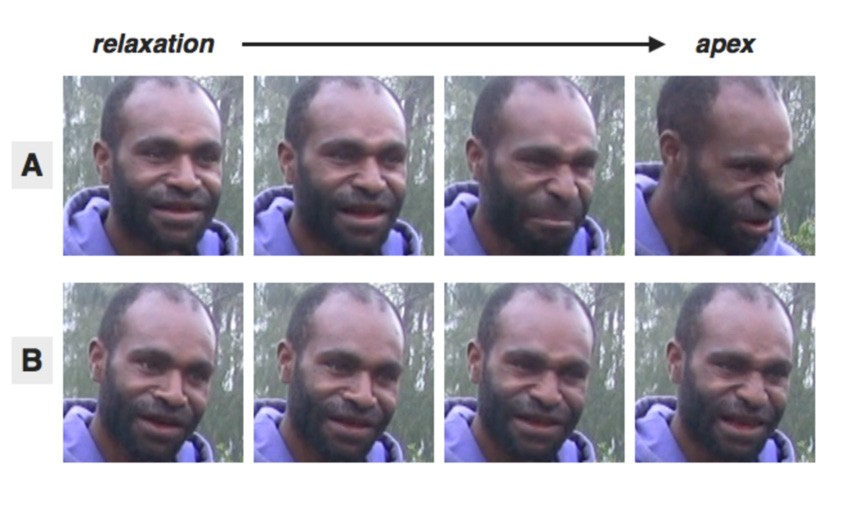
Figure 7.1 :
Facial Expression – refers to the manipulation of the facial muscles to non- verbally enhance, reinforce, or compliment speech.
In speech delivery, facial expressions can help bring a speech to life and reinforce the verbal message of the speaker. The facial expression must compliment the message and not contradict it. A smile during a somber or very serious message can weaken the message by diluting it of its seriousness.
Therefore, facial expressions can display personal emotions in line with a social situation, and appropriately express the seriousness of that social situation.
You can express facial Intensification by increasing the level of facial intensity of an emotion, De-intensification by lessening the facial intensity of an emotional display, or you can have an expression of Neutralization, where the facial display of emotions is nonexistent or erased.
Practice in front of the mirror as a way of monitoring your use of facial expressions during a speech delivery. The chin, mouth, cheeks, lips, eyes, brow, forehead, and nose collectively and singularly provide non-verbal support for your speech.
Delivering Speeches on Line:
The COVID-19 pandemic, in 2020, forced Colleges, High Schools, and private and public primary schools all across the world to migrate to online learning. Students and teachers were forced into a new type of learning environment, one that was virtual, and isolated to some degree, and definitely different from what most of us were accustomed to over the years.
Studies have shown that “online coursework generally yields worse student performance than in-person coursework” (Cellini 2021).
To summarize some of the research findings for online classes, researchers discovered that online education lowered students final grades, and students with lower academic abilities suffered the most from online learning. These findings were drawn out based on studies after studies conducted pre, during, and post-pandemic.
I had the unique perspective as an instructor of public speaking, pre-pandemic, during the height of the pandemic, and post pandemic, to evaluate students’ public speaking performances.
My public speaking courses were conducted hybrid (online and In-person) or hy-flex (a combination of online/in-person classes). All speech presentations were conducted mostly in-person in the classroom, although some students were forced to deliver their speeches virtually for medical reasons.
Delivering a speech virtually via one of the available platforms such as zoom, presented several challenges to both the evaluator (Professor), and the presenter/ speaker (student).
Apart from technical issues, which declined as users became more experienced in using this new medium, one unique challenge was assessing a student’s usage of kinesics during their oral speech presentation. It was difficult, and still is, to monitor a speaker’s eye contact, gestures, and posture, while they are seated in front of a 12” or 13” screen, seemingly reading off a script for a speech that is supposedly extemporaneous.
There is no audience for the student to engage with, and most students sit isolated in a room with nothing else except a computer, or surrounded by distractions. Some students love the fact that there is no live audience hanging on their every word and perhaps judging them, and they hide behind the screen for this reason, and tend to feel less pressured and nervous during virtual speech presentations. However, those presenters are the ones who have the tendency to read the speech and not present it in an engaging way for the audience.
During the height of the pandemic, international students who could not travel due to restrictions were forced to be engaged and fully alert virtually at 11 p.m., 12 a.m., 3 a.m., 4 a.m., or 5 a.m. in their time zone due to global time differences, while simultaneously facing the pressure of being evaluated.
It was difficult for an evaluator/assessor to accurately monitor the speaker’s eye contact or level of audience engagement, with an audience being absent and the screen and viewership being one dimensional.
During presentations, the moment visual support, such as slides, are shown, it is very easy to lose your audience, and many presenters do. The speaker cannot observe his/her audience since the visuals present the challenge of blocking most of the audience, thereby forcing the presenter to rely on the few audience members visible for feedback as they present. This is a challenge in online presentations that cannot be overlooked and/or remedied easily.
An evaluator, on the other hand, cannot adequately asses the physical aspects of the speaker’s delivery, and can only rely on the verbal presentation and the simultaneous visual images being seen.
Other challenges for online presentations involve students who are sometimes reluctant to turn their computer cameras on, while others have poor lighting conditions in their spaces or poor camera angles which make it difficult to see their faces, much less to assess their presentations effectively, or to accurately assess audience involvement and interest in the speech.
Some of these issues are relatively easy to fix while others require creativity in its approach to make the process of presenting online more viable.
The following are some techniques employed during the height of COVID-19 for virtual presenters in my classes. These suggestions helped presenters improve the quality of their virtual speech presentations.
- Stand, don’t sit, if possible when presenting your speeches virtually, readjust the camera angle so that you can be seen from the waist or knees up, and you must project your voice more to be audible during the presentation.
- Practice the speeches more thoroughly so that you have greater control over the material and the language.
- The length of time slides or visuals remain on the screen should be minimized; this allows you to be seen more and be more of a presence, rather than become the background to your slide captions or visual support.
- Think outside the box and be more creative when presenting speeches virtually. Break the rules, if necessary, to elevate clarity, interest, and retention of the speech.
- During lectures, minimize note-taking; discourage yourself from writing lots of Instead, take screen shots of the notes or ask what is important to be noted for future reference.
- Constant switching from share to stop share of discussion slides helps to circumvent lots of note-taking and encourages more interactive class discussions.
- Adopt the constant switching transitions to virtual presentations; they help to keep the audience interested, if not alert, throughout your presentation.
- On assessments of speeches, focus attention on delivery aspects such as tone, intonation, pitch, volume, and pronunciation, and not as much concentration on the physical aspects of the delivery unless the presenter has exercised creativity outside of or beyond the standard physical approach.
PART 7
SUMMARY
From this discussion on delivery, you learned that there are four ways to deliver your speech; M.I.M.E – the Manuscript; the speech is written out and delivered from a script, the Impromptu; where the speech is delivered with little or no pre-preparation, Memory; the speech is delivered without the support of a script or set notes, and the Extemporaneous method; this speech delivery is done using a combination of notes (manuscript method) and memory (without notes).
Each speech delivery type has advantages and disadvantages, except for the extemporaneous speech delivery, which seems to have no obvious disadvantages and is usually the delivery speech style employed by many, if not most speakers.
You learned that you can use your voice and body when delivering a speech to effectively enhance and impact the speech.
The voice characteristics include volume (loudness or softness of speech), pitch (high and low tones), rate (speed of delivery), pauses (silence in between the delivery), pronunciation (word formation and accentuation), and articulation (the clarity of speech sounds), and if used effectively, the voice can carry the emotions the speaker wants to convey so as to move the audience into action or generate positive response to the message.
The Body can be utilized as a visual display for your speech, and the four aspects of delivery the body utilizes are: posture (body position/movement), gestures (using the hands and head), eye contact (using the eyes to monitor and engage the audience), and facial expressions (manipulating the facial muscles for effect).
You learned that public speaking is more difficult online than face to face, mainly because of the nature of the technology being utilized to accomplish the task online.
To improve your overall speech delivery, here is a 6-Step Approach:
- Go over your preparation outline aloud – hear the words, revise, clarify, and reinforce the message.
- Prepare a speaking outline – reinforce your familiarity with the speech.
- Practice the speech aloud several times – take hold and take charge of the speech ideas.
- Polish and refine your delivery – practice in front of an audience and/or in front of the mirror, aloud.
- Do a Dress Rehearsal – if you can, replicate the conditions of the actual speech: the delivery, the dress, and the facial expressions.
- Get a jump start – begin your speech preparation, including your research, early. Practice a lot.
DISCUSSION QUESTIONS
- Try to think of a speech you’ve listened to being given by someone who does not share your philosophical ideas or beliefs; would you be able to listen to the entire speech? If you had no choice but to listen, how would you be able to get past the listening barriers to the point where you were able to listen objectively, even though you may not have agreed with some of the positions expounded?
- Which of the delivery styles discussed do you feel most comfortable with, and why do you feel comfortable with that delivery style? What specific difficulties do you believe the other styles present that make you uncomfortable?
- Are there aspects of delivery discussed in this chapter that come as a revelation or surprise to you, and what are they? Discuss how you might be able to implement some of the delivery aspects discussed in this chapter into your future